Home of the Practically Perfect Pink Phlox and other native plants for pollinators
Showing posts with label Phlox pilosa. Show all posts

Wednesday, April 24, 2019

Wildflower Wednesday: Phlox pilosa is still a star

My friends, welcome to Wildflower Wednesday.

I love introducing you to new wildflowers, but, this month I want to honor a very old and dear wildflower friend.
Phlox pilosa
Practically Perfect Pink Phlox is our star....and what a star with fragrant delicate pink blooms that last for more than a month.


Long time readers know how much I adore this beauty. I can't imagine gardening without her.
Downy phlox was a gift from a gardening friend so long ago I can no longer remember when she came to Clay and Limestone. After a few years she had spread into a beautiful pink carpet over the Garden of Benign Neglect. I thought she would always be there to delight the senses, but, she almost disappeared. The summer droughts that lasted way too long and possibly bunnies and deer decimated the colony.

But, she's making a come back. Believe it or not she's very happy in the sunny Susan's Bed despite the shallow soil and limestone bedrock. She gets more attention and a good soaking when the summer droughts arrive.


 P pilosa is a stoloniferous, semi-evergreen native wildflower which can form large colonies. Although, I've never heard anyone call PPPP a thug, some gardeners may not appreciate how quickly it can spread in rich soil. Colonizing is a plus for me, I love that it makes a big statement and unlike some colonizing plants, it's easy to lift and transplant.
There is wide variety in flower color from the palest pink to shades of light and dark purple and pink. It has the sweetest fragrance that wafts all over the garden on warm days. You'll have to agree, a plant like that is practically perfect!
Hairy stems and leaves

Phlox pilosa is about a foot tall in my garden. It has narrow, opposite lance like leaves. The inflorescence is a panicle of loosely branched clusters of individually stalked flowers (cymes) atop the stem and from the upper leaf axils. Prairie Phlox is also called Downy Phlox for the somewhat hairy appearance of the stems and leaves.
 
Phlox flowers are the classic butterfly plant with their perfect landing pad (flared petals), a narrow tube that is accessible to the long proboscis of butterflies and fragrant flowers that occur in loose, rounded clusters.  The long bloom time (6 weeks if the temperatures stay cooler) means there's plenty of nectar for pollinator visitors from early to mid-spring. I've seen butterfly, skippers, bumblebees, Minor bees, carpenter bees and Flower flies visiting. I've read that Hummers visit as well and since it's blooming late here, they might stop by, too.


P pilosa is found naturally growing in open woodlands, meadows, prairie remnants and limestone glades through out the central and eastern US and Canada. I am especially pleased at how well it's growing in the shallow soil in the Susan's Bed....That says a lot about a plant.


The Particulars
Phlox pilosa
Common names: Downy Phlox, Prairie Phlox, Fragrant Phlox
Family: Polemoniaceae
Perennial
Size: 1 to 2 foot tall
Color: shades of pink
Frangrance: Yes and noticeable on warm days

Native Range: Connecticut south to Florida, west to eastern North Dakota, south through the eastern part of the prairie states to most of Oklahoma and Texas as far as west Texas, south into Coahuila
Zone: 4 to 9
Bloom Time: April to June (in my garden)
Sun: Full sun, part sun
Water: Medium to dry (but not xeric)
Pollinators:  Hummingbirds, Butterflies, long tongued bees, Flies
Comments: Do yourself a favor and plant this beauty, the bees and butterflies will thank you.

Pretty pink fragrant flowers, long bloom, easy to grow, high wildlife value is how this plant got  Practically Perfect Pink Phlox as its sobriquet.

xoxogail
Welcome to Clay and Limestone's Wildflower Wednesday celebration. WW is about sharing and celebrating wildflowers from all over this great big, beautiful world. Join us on the fourth Wednesday of each month. Remember, it doesn't matter if they are in bloom or not; and, it doesn't matter if we all share the same plants. It's all about celebrating wildflowers. Please leave a comment when you add your url to Mr Linky.


Gail Eichelberger is a gardener and therapist in Middle Tennessee. She loves wildflowers and native plants and thoroughly enjoys writing about the ones she grows at Clay and Limestone. She reminds all that the words and images are the property of the author and cannot be used without written permission.

Thursday, February 8, 2018

Blogging Anniversary


PPPP~Practically Perfect Pink Phlox
Ten years ago today, with equal excitement and anxiety, I clicked the publish button on my first blog post. There was no way I could have predicted what was to come or what an adventure it would be. Since that first brief~seven sentence post~a lot has happened. I've made new and dear friends. I've seen more gorgeous gardens than you can possibly imagine. I've even attended a garden bloggers get together in the UK. Along the way, I've grown as a writer, a photographer, a nature lover and a gardener.

I don't for one minute regret the time I've spent sitting at my desk hunting and pecking my way to posts I was never sure anyone would ever read! I've been one fortunate garden blogger...Because of you, dear readers.

I started blogging to connect with other gardeners who felt as passionate about gardening as I did. What I found were generous, kind and supportive people, many of whom have become very dear friends.

Most of us have only been able to visit each other's gardens through our blog photos and posts, but, that doesn't diminish our connections.

A few of us have been able to visit each other's gardens...What a delectable treat that has been.
Quite a few of us have exchanged seeds and plants.

So my dear friends I continue to blog because it's still important to me to connect with other gardeners; it's still important to talk about native plant gardening for wildlife; and, it's still important to showcase wildflowers on Wildflower Wednesday. My friends, you are all dear to me. Thank you for being here for this marvelous and magical experience.

xoxogail


PS I thought you would enjoy seeing Phlox pilosa the the Practically Perfect Pink Phlox again. I love knowing that many of you have a bit of Clay and Limestone in your garden.

 Gail Eichelberger is a gardener and therapist in Middle Tennessee. She loves wildflowers and native plants and thoroughly enjoys writing about the ones she grows at Clay and Limestone. She reminds all that the words and images are the property of the author and cannot be used without written permission.

Wednesday, May 25, 2016

Wildflower Wednesday: Oenothera fruticosa

I love this little beauty. Love that it has spread around the garden and flowers just where a spot of golden yellow is needed in late spring. It doesn't mind my shallow soil, in fact, in nature it is often found growing on shallow, rocky soil. That makes it a perfect wildflower for Clay and Limestone. It's blooming and it's our May, Wildflower Wednesday star.
Oenothera fruticosa or Sundrops, is a spreading perennial wildflower with reddish evergreen winter rosettes.
Flowers are borne in racemes of 3-10 at the tips of the branches.
In mid-spring the rosettes send up slender reddish stems with narrow leaves that herald the arrival of the red flower buds. In late May the buds open to reveal lovely bright yellow saucer shaped flowers. Each flower has one day in the sun and fades by the late afternoon. Luckily for this gardener, the pretty yellow flower show lasts for several weeks, which more than makes up for its daily flower fading. 
An individual flower is about 1-2 in (2.5-5 cm) across.
I do love sunny yellow flowers.

Have you noticed that each flower has four sepals at the end of a slender tube, orange stamens and a conspicuous 4-branched stigma that forms a cross or what always looks to me like a great big X?
In fact, members of the Onagraceae or evening primrose family are easily recognized by that X. They're the only flower with sepals that are conspicuously reflexed downward at the base of the flower or fruit capsule forming an X.
small carpenter bee visiting Sundrop

That X-marks the spot where native bees, beetles, butterflies, skippers and honeybees land to sup on the nectar and/or pollen of the Oenothera fruticosa flowers; where caterpillars of several moths feed on the foliage; and, where hummingbirds visit for nectar and to feed on small insects. By the time the Eastern goldfinch, mourning dove and other songbirds eat the seed, the X is gone, but, Oenothera fruticosa has done its job providing for wildlife.
Sundrops dancing with Echinacea pallida and Asclepias tuberosa
Plant Sundrops with Asclepias tuberosa, Coreopsis major, Monarda punctata, Liatris microcephala, Glandularia canadensis and Phlox pilosa.


They're perfect massed or allowed to roam~which ever style makes you happy. Just seeing their bright sunny yellow flowers makes me happy.

The particulars

Common Name: Sundrops, narrow leaf primrose
Herbaceous perennial 
Onagraceae Family
Growing Zone: 4 to 8
Native: Occurs from Quebec to Nova Scotia and Florida and west to Manitoba, Michigan, Missouri and Louisiana.

Size: 1.00 to 1.50 feet tall by 1.00 to 2.00 feet spread.
Bloom: Late May to June
Bloom color: Bright yellow
Light: Full sun to light shade
Water: Dry to medium
Maintenance: Low
Propagation: Collect and sow seeds in autumn or by divide the stoloniferous roots. Can also make stem tip cuttings in spring. If you bend the stems and cover with soil, they will root.
Tolerates drought, dry, rocky soil, shallow soil. But, would appreciate richer soil.
Comments: Let it naturalize in your wildflower, cottage or meadow planting
Attracts Wildlife: Butterflies, Songbirds, Pollinators and Hummingbirds
Deer, bunny and rodent resistant: So far!

Thanks for stopping by to help celebrate Wildflower Wednesday.

Wildflower Wednesday is about sharing wildflowers all over this great big beautiful world. It doesn't matter if we sometimes show the same plants, how they grow and thrive in your garden is what matters most. I hope you join the celebration...It's always the fourth Wednesday of the month!
xoxogail 


Gail Eichelberger is a gardener and therapist in Middle Tennessee. She loves wildflowers and native plants and thoroughly enjoys writing about the ones she grows at Clay and Limestone. She reminds all that the words and images are the property of the author and cannot be used without written permission.

Tuesday, April 22, 2014

Wildflower Wednesday: The Happy Flower Trinity

If you're a cook, you know that creating a delicious stock, soup, or stew often starts with basic ingredients and builds from there. The French have their mirepoix of onions, carrots and celery; the Italians have their tomato, garlic and basil; and Cajun cooking has its holy trinity of onions, peppers and celery.  Each of these  flavor bases makes the food tasty and delicious and unique to that region.
Clay and Limestone has its own trio of flowering beauties~Golden Ragwort, Columbine and Downy Phlox ~ that make the garden a colorful and tasty treat each spring.
Clay and Limestone is a small side dish of this delicious mixture (photo 2011)
All three are native to the Nashville Basin. The Basin is an elongated mixing bowl of land where Mother Nature has tossed cedar glade and Tennessee native plants into a unique and delicious mixture. Our tasty dish is never the same year to year, like local cooking, the proportions all depend upon the weather and what nature makes available!
 The Happy Trinity have been liberally sprinkled about the garden
Let's take a look at these special plants that combine wonderfully to make this garden's flavor base for Wildflower Wednesday.
notice a few aphids~I leave them for the beneficial insects to gobble up
Golden Ragwort or Packera aurea is a bright daisy with evergreen basil foliage. It makes a wonderful groundcover if the conditions are right~even moisture year round. Strangely enough, that may be why many people don't add it to their gardens~fear of a plant making too big a statement. I like big statement plants, after all, this is the home of rough and tumble wildflowers!

I think it's absolutely beautiful. The small daisy like golden flowers on tall stems are chock full of pollen and nectar for small bees, flies and butterflies. Occasionally, aphids show up on a few plants, but, I leave them for the ladybugs. There are no cultivars of this beauty, the straight species is perfect!

Family: Asteraceae
Native Range: Eastern North America to Texas
Zone: 3 to 8
Height: 0.50 to 2.50 feet Spread: 0.50 to 1.50 feet
Bloom Time: April Bloom
Sun: Full sun to part shade
Water: Medium to wet
Pollinators: Small bees and butterflies
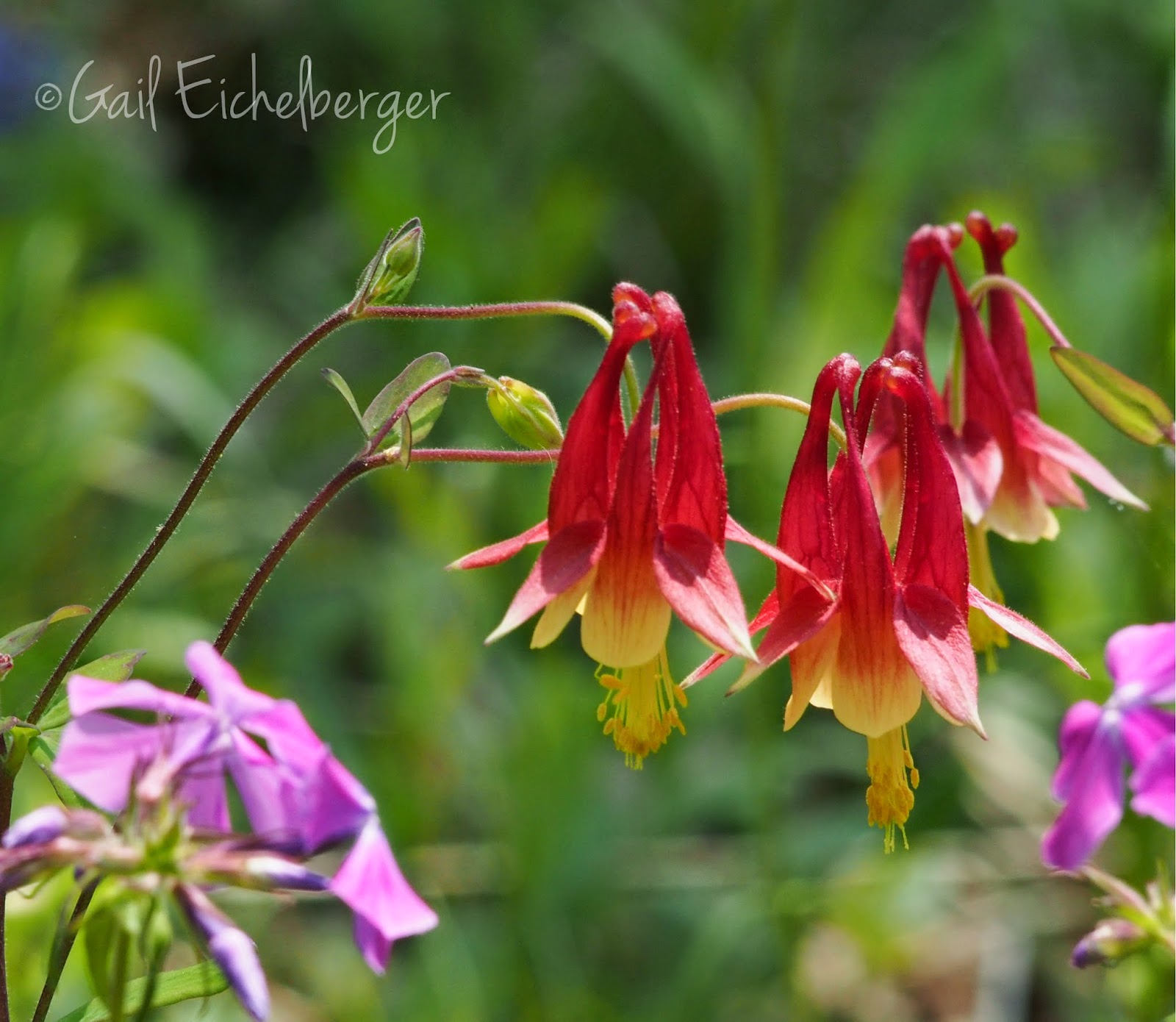
How does one describe Aqiulegia canadensis! I think of it as bright lanterns that sway in the slightest breeze sending a signal to pollinators that there's nectar in those spurs!  Here's a good reason to plant more Columbine! "Ornithologists have discovered that the ruby-throated hummingbirds tend to follow the blossoming of Aquilegia canadensis on its journey north in spring, since the flowers are the first to provide nectar for the birds." (source)

Columbine thrives in part to full shade, in any well-drained soil. I find it happiest in cracks and crevices, really, it grows anywhere a seed falls and the drainage is good! Plants tolerate full sun if temperatures are cool, but they grow better in my garden in partial shade. Red columbine is found in rocky woods from Nova Scotia to the Northwest Territories south to Florida and Texas.
growing between the flagstone in the Garden of Benign Neglect
Family: Ranunculaceae
Native Range: Eastern North America
Zone: 3 to 8
Bloom Time: April to May (even earlier after a gentle Middle South winter)
Sun: Full sun to part shade
Water: Medium
Pollinators: Hummingbirds, bees, butterflies, and hawk moths feed on columbine necta

...and finally
Practically Perfect Pink Phlox Pilosa

Long time readers already know about her charms...PPPP has an exceptionally long bloom time (six weeks or longer), fantastic pink flowers, grows in sun and part sun, tolerates clay soil that's wet all winter and dry all summer, has a marvelous ground covering effect, and has the sweetest fragrance that wafts all over the garden on warm days. You'll have to agree, a plant like that is practically perfect!
P pilosa is a stoloniferous, semi-evergreen native wildflower found naturally growing in open woodlands, meadows, prairie remnants and limestone glades through out the central and eastern US and Canada. Although, I've never heard anyone call PPPP a thug, some gardeners may not appreciate how quickly it can spread in rich soil. Colonizing is a plus for me and unlike some colonizing plants, it's easy to lift and transplant. I am especially pleased at how well it's growing in the shallow soil over the bedrock in the Susan's Bed....That says a lot about a plant.

PPPP with River Oats
Family: Polemoniaceae
Native Range: Eastern and central United States (also Canada)
Zone: 4 to 9
Bloom Time: April to June (in my garden)
Sun: Full sun
Water: Medium
Pollinators:  Hummingbirds, Butterflies, Bees, Flies

So what do you think? Is this trio a tasty and delicious treat?
xoxogail

Welcome to Wildflower Wednesday! It's time to share your wildflowers no matter where you garden~the UK, tropical Florida, Europe, Australia, Africa, South America, India or the coldest reaches of Canada. It doesn't matter if we sometimes show the same plants, how they grow and thrive in your garden is what matters most. I hope you join the celebration..It's always the fourth Wednesday of the month!


Gail Eichelberger is a gardener and therapist in Middle Tennessee. She loves wildflowers and native plants and thoroughly enjoys writing about the ones she grows at Clay and Limestone. She reminds all that the words and images are the property of the author and cannot be used without written permission.

Friday, April 18, 2014

A Few Favorite Flowers For Friday

Aquilegia canadensis
Columbine is found in rich rocky woods, north-facing slopes, cliffs, ledges, pastures, and roadside banks. Native to all states east of the Rockies, except Louisiana. A Duskywing skipper feeds on the leaves and hummingbirds seek out its nectar.
Phacelia bipinnatifida 

Purple Phacelia is common biennial wildflower in Middle Tennessee where it's found growing in moist woodlands and rocky slopes. Phacelia is all about the bees and that makes this gardener happy.
 Trillium luteum
Yellow trillium can be found in deciduous forests, open woods and along rocky stream banks in Eastern Tennessee, but, it grows happily in my Middle Tennessee garden.

 Phlox pilosa
The Practically Perfect Pink Phlox has just begun blooming~It has had a late start, which means that it might bloom into June! "Phlox flowers are the classic butterfly plant with their perfect landing pad (flared petals), a narrow tube that is accessible to the long proboscis of butterflies and fragrant flowers that occur in loose, rounded clusters.  The long bloom time means there's plenty of nectar for pollinator visitors from early to mid-spring. I've seen butterfly, skippers, bumblebees, Minor bees, carpenter bees and Flower flies visiting. I've read that Hummers visit as well and since it's blooming late here, they might stop by, too." It's happy in shade, sunshine, dry open woods, along roadsides and prairies. I am sad to report that the bunnies have discovered the PPPP and have taken a toll on the population~Not to worry, I bought new plants!
Hydrophyllum appendiculatum

Appendaged Waterleaf is a northern species of Waterleaf that is frequently found in rich woodlands in  Middle Tennessee. You'll recognize it and its near relatives by the mottled/waterstained leaves. You'll be able to tell this from the others by its maple leaf shaped leaves. Like its distant cousin Phacelia, it's a bee magnet.
Just a few of my favorite blooming wildflowers for Garden Bloggers Bloom Day! Yes, I'm late, but, you can still pop over to Carol/May Dreams Gardens blog to check out gardens from all over this great big beautiful world.

xoxogail

Gail Eichelberger is a gardener and therapist in Middle Tennessee. She loves wildflowers and native plants and thoroughly enjoys writing about the ones she grows at Clay and Limestone. She reminds all that the words and images are the property of the author and cannot be used without written permission.

Wednesday, May 15, 2013

Bloom On for May 2013

Practically Perfect Pink Phlox pilosa is blooming on for Bloom Day~It's my favorite spring plant and I am happy to say it's made a marvelous comeback from the last years droughts.
Although, it's an adaptable plant it needed more moisture than we have had the last many summers to set seed and spread around the garden. This year has more than made up for those disappointing years.

Next up is Penstemon. I am having a marvelous love affair with P 'Prairie Twilight' and P 'Prairie Dusk'.  Both plants rescued from a big box sale rack last summer. Experts often tell you not to buy late in the season or off the sale racks because plants are root bound, etc. That has never stopped me, I've gotten my best bargains from the racks and I am careful to choose plants that can take a good root pruning. I rinsed the potting medium away from the roots, trimmed the roots, making sure none were circling the plant and then planted them in good soil (or in this case, a fast draining rocky soil that these penstemons require). (Go here to read more about Penstemons and Bumblebees)

Also blooming are Western Daisy/Astranthium integrifolium~I discovered these cutie pie daisies in my way back 'meadow' many years ago...and they have been moved all over the garden. WD is a winter annual that blooms heavenly in the late spring and on and off all summer. The flower is small by daisy standards, but, it carries a lot of wow factor when allowed to naturalize in your native plant lawn or as a ground cover beneath later blooming perennials.

Golden Alexander has been in my garden several years, but this year it's been outstanding. I think I need to take a page from Fairegarden and plant a pretty purple flower to compliment the golden yellow and help it stand apart. In my garden it's made a lovely two foot mound and smells of  honey. It evokes memories of my childhood when my good friends and I had the freedom to explore neighboring overgrown fields in early summer. If you get a chance, lean into Zizia aurea and catch that delicious fresh summer fragrance.

Camassias continues to bloom on. I adore them and will be planting more this fall, in fact I have already put a reminder in my calender to order more. One thing I won't do is underplant it with the Tommies. The chipmunks have dug around trying to get the tasty Tommie corms and damaged several of the Camassia quamash.  (But true to advertising the squirrels don't touch it, which is perfect if you garden where there are no chippers))

Verbena canadensis is looking more beautiful than you can imagine. The plants survived our non winter and have been blooming their hearts out.

Phlox 'Minnie Pear' is new to the garden. Research reveals that Minnie is a naturally occurring hybrid between Phlox maculata and Phlox glaberrima. I've placed it next to species P glaberrima, it needs the same moist soil and I do want to see any offspring from this union.

Two-flowered Cynthia is still blooming. You can read about this dandelion imposter and pollinator attractor Krigia here.
Oenothera speciosa
Showy Evening Primrose is just working up to a big show~I love its colonizing ways. I'll pull up the spent flowers, but there's no stopping this plant once it's in your garden.

I fell head over heals in love with Monarda bradburiana while at Chicago Fling several years ago. It blooms faithfully each year and doesn't require a moist soil. Take that M didyma cultivars that tempt me in the nursery and fail to bloom after the first year.


The non-native alliums are gorgeous and as always a nectar treat for all the visiting pollinators.
The last Columbine bloom of the spring 
All in all the garden has enjoyed the long spring and extra rainfall and now, summer is coming on strong. There's a lot more in bloom, but I have to hold some flowers back to post about later! I know you understand.

Happy Bloom Day my dears,  now take the magic carpet ride to May Dreams Gardens and host extraordinaire Carol's links to gardens all over this great big beautiful world.

xoxogail


Gail Eichelberger is a gardener and therapist in Middle Tennessee. She loves wildflowers and native plants and thoroughly enjoys writing about the ones she grows at Clay and Limestone. She reminds all that the words and images are the property of the author and cannot be used without written permission.