Home of the Practically Perfect Pink Phlox and other native plants for pollinators
Showing posts with label PPPP. Show all posts

Wednesday, April 24, 2019

Wildflower Wednesday: Phlox pilosa is still a star

My friends, welcome to Wildflower Wednesday.

I love introducing you to new wildflowers, but, this month I want to honor a very old and dear wildflower friend.
Phlox pilosa
Practically Perfect Pink Phlox is our star....and what a star with fragrant delicate pink blooms that last for more than a month.


Long time readers know how much I adore this beauty. I can't imagine gardening without her.
Downy phlox was a gift from a gardening friend so long ago I can no longer remember when she came to Clay and Limestone. After a few years she had spread into a beautiful pink carpet over the Garden of Benign Neglect. I thought she would always be there to delight the senses, but, she almost disappeared. The summer droughts that lasted way too long and possibly bunnies and deer decimated the colony.

But, she's making a come back. Believe it or not she's very happy in the sunny Susan's Bed despite the shallow soil and limestone bedrock. She gets more attention and a good soaking when the summer droughts arrive.


 P pilosa is a stoloniferous, semi-evergreen native wildflower which can form large colonies. Although, I've never heard anyone call PPPP a thug, some gardeners may not appreciate how quickly it can spread in rich soil. Colonizing is a plus for me, I love that it makes a big statement and unlike some colonizing plants, it's easy to lift and transplant.
There is wide variety in flower color from the palest pink to shades of light and dark purple and pink. It has the sweetest fragrance that wafts all over the garden on warm days. You'll have to agree, a plant like that is practically perfect!
Hairy stems and leaves

Phlox pilosa is about a foot tall in my garden. It has narrow, opposite lance like leaves. The inflorescence is a panicle of loosely branched clusters of individually stalked flowers (cymes) atop the stem and from the upper leaf axils. Prairie Phlox is also called Downy Phlox for the somewhat hairy appearance of the stems and leaves.
 
Phlox flowers are the classic butterfly plant with their perfect landing pad (flared petals), a narrow tube that is accessible to the long proboscis of butterflies and fragrant flowers that occur in loose, rounded clusters.  The long bloom time (6 weeks if the temperatures stay cooler) means there's plenty of nectar for pollinator visitors from early to mid-spring. I've seen butterfly, skippers, bumblebees, Minor bees, carpenter bees and Flower flies visiting. I've read that Hummers visit as well and since it's blooming late here, they might stop by, too.


P pilosa is found naturally growing in open woodlands, meadows, prairie remnants and limestone glades through out the central and eastern US and Canada. I am especially pleased at how well it's growing in the shallow soil in the Susan's Bed....That says a lot about a plant.


The Particulars
Phlox pilosa
Common names: Downy Phlox, Prairie Phlox, Fragrant Phlox
Family: Polemoniaceae
Perennial
Size: 1 to 2 foot tall
Color: shades of pink
Frangrance: Yes and noticeable on warm days

Native Range: Connecticut south to Florida, west to eastern North Dakota, south through the eastern part of the prairie states to most of Oklahoma and Texas as far as west Texas, south into Coahuila
Zone: 4 to 9
Bloom Time: April to June (in my garden)
Sun: Full sun, part sun
Water: Medium to dry (but not xeric)
Pollinators:  Hummingbirds, Butterflies, long tongued bees, Flies
Comments: Do yourself a favor and plant this beauty, the bees and butterflies will thank you.

Pretty pink fragrant flowers, long bloom, easy to grow, high wildlife value is how this plant got  Practically Perfect Pink Phlox as its sobriquet.

xoxogail
Welcome to Clay and Limestone's Wildflower Wednesday celebration. WW is about sharing and celebrating wildflowers from all over this great big, beautiful world. Join us on the fourth Wednesday of each month. Remember, it doesn't matter if they are in bloom or not; and, it doesn't matter if we all share the same plants. It's all about celebrating wildflowers. Please leave a comment when you add your url to Mr Linky.


Gail Eichelberger is a gardener and therapist in Middle Tennessee. She loves wildflowers and native plants and thoroughly enjoys writing about the ones she grows at Clay and Limestone. She reminds all that the words and images are the property of the author and cannot be used without written permission.

Thursday, February 8, 2018

Blogging Anniversary


PPPP~Practically Perfect Pink Phlox
Ten years ago today, with equal excitement and anxiety, I clicked the publish button on my first blog post. There was no way I could have predicted what was to come or what an adventure it would be. Since that first brief~seven sentence post~a lot has happened. I've made new and dear friends. I've seen more gorgeous gardens than you can possibly imagine. I've even attended a garden bloggers get together in the UK. Along the way, I've grown as a writer, a photographer, a nature lover and a gardener.

I don't for one minute regret the time I've spent sitting at my desk hunting and pecking my way to posts I was never sure anyone would ever read! I've been one fortunate garden blogger...Because of you, dear readers.

I started blogging to connect with other gardeners who felt as passionate about gardening as I did. What I found were generous, kind and supportive people, many of whom have become very dear friends.

Most of us have only been able to visit each other's gardens through our blog photos and posts, but, that doesn't diminish our connections.

A few of us have been able to visit each other's gardens...What a delectable treat that has been.
Quite a few of us have exchanged seeds and plants.

So my dear friends I continue to blog because it's still important to me to connect with other gardeners; it's still important to talk about native plant gardening for wildlife; and, it's still important to showcase wildflowers on Wildflower Wednesday. My friends, you are all dear to me. Thank you for being here for this marvelous and magical experience.

xoxogail


PS I thought you would enjoy seeing Phlox pilosa the the Practically Perfect Pink Phlox again. I love knowing that many of you have a bit of Clay and Limestone in your garden.

 Gail Eichelberger is a gardener and therapist in Middle Tennessee. She loves wildflowers and native plants and thoroughly enjoys writing about the ones she grows at Clay and Limestone. She reminds all that the words and images are the property of the author and cannot be used without written permission.

Wednesday, December 24, 2014

Wildflower Wednesday~2014 Roundup

Welcome to Clay and Limestone and Wildflower Wednesday!


Wildflower Wednesday is about sharing wildflowers no matter where you garden~the USA, the UK, Europe, Australia, Africa, South America, India or the coldest reaches of Canada. It doesn't matter if we sometimes show the same plants, how they grow and thrive in your garden is what matters most. I hope you join the celebration...It's always the fourth Wednesday of the month!

Without further ado, here are the best and brightest of Clay and Limestone's 2014 wildflowers.

 Seersucker Sedge~January 2014
The blooms are an added bonus
 The best description I've read for this totally underused sedge (I find most native sedges are underused and under appreciated) is "puckered like  Christmas ribbon" and it is indeed puckered! This wonderfully textured sedge is perfect massed near a path with Christmas fern and other shade loving natives. It's semi-evergreen in my Zone7 garden.

 Shrubs in a wildflower garden~February 2014
Beginning to bloom with PPPP~the orange flower is Two-flowered Cynthia
Itea virginica is only one of several perfect shrubs for a wildflower garden. It's versatile~a stand alone plant or massed and it will grow just about anywhere except in a xeric garden. It's does best with regular water, and by best I mean covered with pollinator attracting flowers that have a sweet scent and marvelous fall color. Follow the link for more ideas for adding woodies to your garden.

False  Rue anemone~March 2014
Enemion biternatum
A member of the Buttercup family (Ranunculaceae) this cutie patootie will make a sweet colony in late winter only to disappear in late spring.  It really is happiest in a leaf mold rich soil~which is another reason to let your leaves decay in place! I see false rue anemone in woodlands in Nashville area parks and it manages to thrive and not be smothered by a thick layer of fallen leaves! I was surprised to find out that it is a pollen only plant, so the earliest visitors don't get a nectar reward for pollinating the flowers.

Happy Flower Trinity~April 2014
 If you're a cook you know that creating a delicious stock, soup, or stew often starts with basic ingredients and builds from there. The French have their mirepoix of onions, carrots and celery; the Italians have their tomato, garlic and basil; and Cajun cooking has its holy trinity of onions, peppers and celery.  Each of these  flavor bases makes the food tasty and delicious and unique to that region. Clay and Limestone has its own trio of flowering beauties~Golden Ragwort, Columbine and Downy Phlox that make the garden a colorful and tasty treat each spring.

All three are native to the Nashville Basin. The Basin is an elongated mixing bowl of land where Mother Nature has tossed cedar glade and Tennessee native plants into a unique and delicious mixture. Our tasty dish is never the same year to year, like local cooking, the proportions all depend upon the weather and what nature makes available! (from Happy Flower Trinity)

Downy woodmint~May 2014
Do you know Blephilia ciliata? It's a delightful little charmer that will brighten a shady spot in your dry woodland garden.  I met Downy Wood Mint the first summer after we moved into this house. I was wandering around in my new yard when I spotted what looked like monarda growing in the lawn. Was I ever excited. It was definitely a mint; it had square stems, opposite leaves and whorled light lavender flowers at the top of the stalk! The only thing missing was the tell tale monarda fragrance, instead, there was just the tiniest hint of a minty smell when the leaves were crushed.

I wasn't disappointed for long. Downy Wood Mint is a beautiful flowering plant and it's happier in my garden than Monarda has ever been. It is tolerant of my dry shade, isn't an aggressive grower and was naturally growing here.

Talk about right plant-right place! It really is and it's so worth giving it a try!

A Mint You and the Pollinators Will Love~June 2014
The flowers of Pycnanthemum muticum might be small, but they are mighty!

Researchers at Penn State's The Pollinator Trial found that Clustered Mountain Mint was the best plant for flowering longevity; for pollinator visitor diversity; for sheer number of insect visitors (78); and, for sheer number of bee and syrphid visitors.

That's one powerful pollinator magnet and one powerful reason for planting Clustered Mountain Mint in your garden. As a side note, it was still a bit green after two deep freezes.

In praise of a rather tall wildflower~July 2014
Silphium perfoliatum is one tall wildflower!
Some would say that this beauty is a beast of a plant and I might have agreed several years ago when it stood 9 feet tall and 3 foot wide in my little sunny Susan's Bed! I've since learned to cut it back at the same time I clip the ex-asters. I suggest you do the same, because banning this beauty from your garden because it's tall and colonizing would be a shame.

What can I say about Cup plant!
Big plant,
good looking flowers,
spreads assertively,
a rough and tumble wildflower,
tons of happy pollinators,
great wildlife value...

 It's not all about the Susans~August 2014
Rudbeckia fulgida is mainstay in the garden, but, easily over looked until mid July when Mother Nature turns on the switch and overnight the garden is a field of golden yellow. They're pushy and would take over if I let them and truth be told some years I haven't had the heart to rip out all that I should/could have! When visitors stop by and comment on the abundance of Susans in the sunny and shady garden areas, I secretly feel like the adoring mother of that unruly, but, delightful child, who's been running amok at a party. "He did what? Really! Isn't he adorable!",  I exclaim as I ignore notice that several salvia have been overrun and the verbena has disappeared. 

I hope you're not turned off by their brilliant yellow color or their lack of a sexy pedigree; the Susans rock and are especially helpful in a garden that has harsh summer sun!

 Some plants like to challenge the boundaries~September 2014
just one of the many colonizing flowers at C and L!
If you like a well behaved plant that never, ever trespasses into another plant's space then forget about Physostegia virginiana, aka, False dragonhead, it will make you crazy. Its colonizing ways don't bother me, I love rough and tumble plants that don't need special care and I find it quite easy to transplant them to other spots in the garden.

Follow the link to read about other colonizing beauties, I know there's one or two you might like.

The Charming Indian physic~October 2014
Porteranthus stipulatus in flower
I am not sure why Porteranthus stipulatus isn't in more gardens. It's really lovely and not at all difficult to grow. It is found naturally growing in rich woods on calcareous soils in a good portion of the Eastern US and can take full sun in northern states. I recommend half sun in gardens that are on the hot/dry side.

For the greatest impact, plant it along a shady path where the small flowers would be seen by anyone walking by. Be generous, plant several for the biggest impact~remember, these are small flowers and you want your garden visitors to appreciate their subtle beauty!

Paw-paw the experiment~November 2014

Everything I knew about Pawpaws I learned from Captain Kangaroo...sort of
Back in TV land in the mid-fifties the Captain invited us to sing along and mime picking up Paw-paws and putting them in a basket! I hadn't the faintest idea he was talking about a fruit, actually a giant berry, but, I remember loving the game.

That was the last I heard about Asimina triloba or Common Pawpaws until I became a native plant gardener and began learning to identify native wildflowers and trees. I began to get interested in learning more about them when a small patch was pointed out to me on a trail at Edwin Warner park. Paw paws are not only a charming looking understory tree, but, has good wildlife value for critters. It's a favorite host plant (larvae feed on the leaves and flowers) of the zebra swallowtail butterfly in the southeastern states and the only host plant for more northern locations.

A plant like this had to be in my garden~follow the link to read about the experiment...


 My dear friends, Thank you for planting more wildflowers, thank you for taking care of the bees and all the other pollinators, thank you for tolerating what others consider pesky wildlife, and thank you for another year of your friendship, visits, comments and for joining me in celebrating wildflowers all over this great big wonderful world. 

You are the best and having you in my life has enriched it beyond measure.
See you next year!
xoxogail


Gail Eichelberger is a gardener and therapist in Middle Tennessee. She loves wildflowers and native plants and thoroughly enjoys writing about the ones she grows at Clay and Limestone. She reminds all that the words and images are the property of the author and cannot be used without written permission.

Tuesday, April 22, 2014

Wildflower Wednesday: The Happy Flower Trinity

If you're a cook, you know that creating a delicious stock, soup, or stew often starts with basic ingredients and builds from there. The French have their mirepoix of onions, carrots and celery; the Italians have their tomato, garlic and basil; and Cajun cooking has its holy trinity of onions, peppers and celery.  Each of these  flavor bases makes the food tasty and delicious and unique to that region.
Clay and Limestone has its own trio of flowering beauties~Golden Ragwort, Columbine and Downy Phlox ~ that make the garden a colorful and tasty treat each spring.
Clay and Limestone is a small side dish of this delicious mixture (photo 2011)
All three are native to the Nashville Basin. The Basin is an elongated mixing bowl of land where Mother Nature has tossed cedar glade and Tennessee native plants into a unique and delicious mixture. Our tasty dish is never the same year to year, like local cooking, the proportions all depend upon the weather and what nature makes available!
 The Happy Trinity have been liberally sprinkled about the garden
Let's take a look at these special plants that combine wonderfully to make this garden's flavor base for Wildflower Wednesday.
notice a few aphids~I leave them for the beneficial insects to gobble up
Golden Ragwort or Packera aurea is a bright daisy with evergreen basil foliage. It makes a wonderful groundcover if the conditions are right~even moisture year round. Strangely enough, that may be why many people don't add it to their gardens~fear of a plant making too big a statement. I like big statement plants, after all, this is the home of rough and tumble wildflowers!

I think it's absolutely beautiful. The small daisy like golden flowers on tall stems are chock full of pollen and nectar for small bees, flies and butterflies. Occasionally, aphids show up on a few plants, but, I leave them for the ladybugs. There are no cultivars of this beauty, the straight species is perfect!

Family: Asteraceae
Native Range: Eastern North America to Texas
Zone: 3 to 8
Height: 0.50 to 2.50 feet Spread: 0.50 to 1.50 feet
Bloom Time: April Bloom
Sun: Full sun to part shade
Water: Medium to wet
Pollinators: Small bees and butterflies
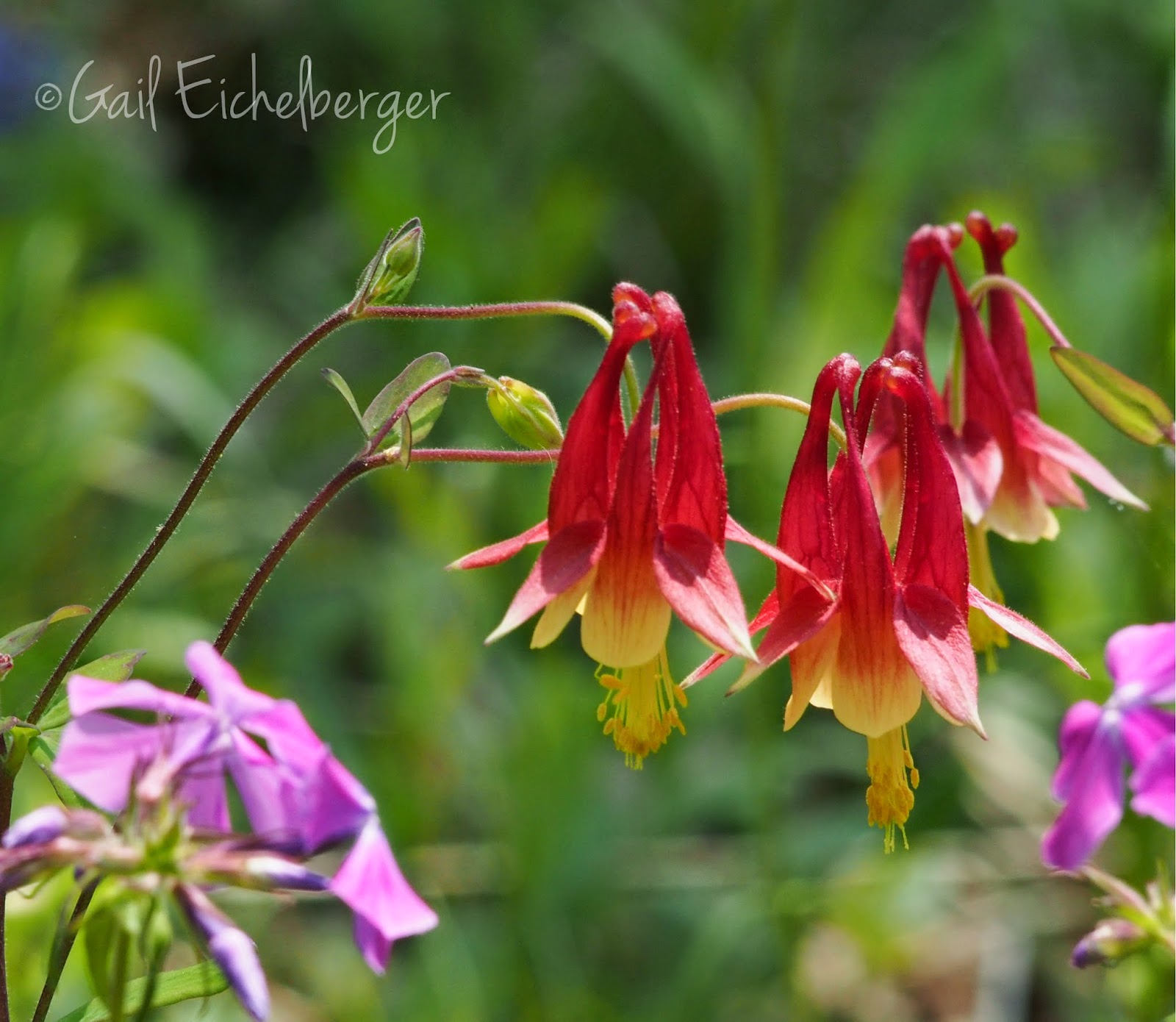
How does one describe Aqiulegia canadensis! I think of it as bright lanterns that sway in the slightest breeze sending a signal to pollinators that there's nectar in those spurs!  Here's a good reason to plant more Columbine! "Ornithologists have discovered that the ruby-throated hummingbirds tend to follow the blossoming of Aquilegia canadensis on its journey north in spring, since the flowers are the first to provide nectar for the birds." (source)

Columbine thrives in part to full shade, in any well-drained soil. I find it happiest in cracks and crevices, really, it grows anywhere a seed falls and the drainage is good! Plants tolerate full sun if temperatures are cool, but they grow better in my garden in partial shade. Red columbine is found in rocky woods from Nova Scotia to the Northwest Territories south to Florida and Texas.
growing between the flagstone in the Garden of Benign Neglect
Family: Ranunculaceae
Native Range: Eastern North America
Zone: 3 to 8
Bloom Time: April to May (even earlier after a gentle Middle South winter)
Sun: Full sun to part shade
Water: Medium
Pollinators: Hummingbirds, bees, butterflies, and hawk moths feed on columbine necta

...and finally
Practically Perfect Pink Phlox Pilosa

Long time readers already know about her charms...PPPP has an exceptionally long bloom time (six weeks or longer), fantastic pink flowers, grows in sun and part sun, tolerates clay soil that's wet all winter and dry all summer, has a marvelous ground covering effect, and has the sweetest fragrance that wafts all over the garden on warm days. You'll have to agree, a plant like that is practically perfect!
P pilosa is a stoloniferous, semi-evergreen native wildflower found naturally growing in open woodlands, meadows, prairie remnants and limestone glades through out the central and eastern US and Canada. Although, I've never heard anyone call PPPP a thug, some gardeners may not appreciate how quickly it can spread in rich soil. Colonizing is a plus for me and unlike some colonizing plants, it's easy to lift and transplant. I am especially pleased at how well it's growing in the shallow soil over the bedrock in the Susan's Bed....That says a lot about a plant.

PPPP with River Oats
Family: Polemoniaceae
Native Range: Eastern and central United States (also Canada)
Zone: 4 to 9
Bloom Time: April to June (in my garden)
Sun: Full sun
Water: Medium
Pollinators:  Hummingbirds, Butterflies, Bees, Flies

So what do you think? Is this trio a tasty and delicious treat?
xoxogail

Welcome to Wildflower Wednesday! It's time to share your wildflowers no matter where you garden~the UK, tropical Florida, Europe, Australia, Africa, South America, India or the coldest reaches of Canada. It doesn't matter if we sometimes show the same plants, how they grow and thrive in your garden is what matters most. I hope you join the celebration..It's always the fourth Wednesday of the month!


Gail Eichelberger is a gardener and therapist in Middle Tennessee. She loves wildflowers and native plants and thoroughly enjoys writing about the ones she grows at Clay and Limestone. She reminds all that the words and images are the property of the author and cannot be used without written permission.

Friday, April 18, 2014

A Few Favorite Flowers For Friday

Aquilegia canadensis
Columbine is found in rich rocky woods, north-facing slopes, cliffs, ledges, pastures, and roadside banks. Native to all states east of the Rockies, except Louisiana. A Duskywing skipper feeds on the leaves and hummingbirds seek out its nectar.
Phacelia bipinnatifida 

Purple Phacelia is common biennial wildflower in Middle Tennessee where it's found growing in moist woodlands and rocky slopes. Phacelia is all about the bees and that makes this gardener happy.
 Trillium luteum
Yellow trillium can be found in deciduous forests, open woods and along rocky stream banks in Eastern Tennessee, but, it grows happily in my Middle Tennessee garden.

 Phlox pilosa
The Practically Perfect Pink Phlox has just begun blooming~It has had a late start, which means that it might bloom into June! "Phlox flowers are the classic butterfly plant with their perfect landing pad (flared petals), a narrow tube that is accessible to the long proboscis of butterflies and fragrant flowers that occur in loose, rounded clusters.  The long bloom time means there's plenty of nectar for pollinator visitors from early to mid-spring. I've seen butterfly, skippers, bumblebees, Minor bees, carpenter bees and Flower flies visiting. I've read that Hummers visit as well and since it's blooming late here, they might stop by, too." It's happy in shade, sunshine, dry open woods, along roadsides and prairies. I am sad to report that the bunnies have discovered the PPPP and have taken a toll on the population~Not to worry, I bought new plants!
Hydrophyllum appendiculatum

Appendaged Waterleaf is a northern species of Waterleaf that is frequently found in rich woodlands in  Middle Tennessee. You'll recognize it and its near relatives by the mottled/waterstained leaves. You'll be able to tell this from the others by its maple leaf shaped leaves. Like its distant cousin Phacelia, it's a bee magnet.
Just a few of my favorite blooming wildflowers for Garden Bloggers Bloom Day! Yes, I'm late, but, you can still pop over to Carol/May Dreams Gardens blog to check out gardens from all over this great big beautiful world.

xoxogail

Gail Eichelberger is a gardener and therapist in Middle Tennessee. She loves wildflowers and native plants and thoroughly enjoys writing about the ones she grows at Clay and Limestone. She reminds all that the words and images are the property of the author and cannot be used without written permission.