Home of the Practically Perfect Pink Phlox and other native plants for pollinators
Showing posts with label Packera aurea. Show all posts

Thursday, April 9, 2015

Bugs, they make a garden good!

 It's Golden Ragwort time in the garden.

Each spring when Packera aurea blooms there are always a few stalks that are covered with aphids! I don't worry about a few aphids since the flowers never seem to decline because of them. (The Happy Flower Trinity)

I didn't always feel that way when I saw aphids sucking the juices out of a plant! Way back when I was less experienced about the role of insects in the garden, I would grab the hose and spray them to oblivion. Now, I recognize them as an important food for predator bugs. In fact, aphids are a primary food source for predator bugs.
 the soft bodied aphids used to creep me out
Why does that matter? We want bugs in our gardens, all kinds of bugs, and we need beneficial bugs.  Beneficial bugs help keep our gardens healthy and in balance. They're "good bugs" and they eat many "bad bugs" like mites, caterpillars, of course aphids and other creepy sucking and plant-consuming bugs. Sure, they occasionally eat a good bug, but, that's all part of the cycle of life in a garden.


Assassin bug waiting on a coreopsis
Some of the "good bugs" include lacewings, lady beetles, minute pirate bug, soldier bugs, assassin bugs, braconid wasps, tachinid flies, flower flies and aphid mites.
Sweet alyssum is wonderful in containers placed among native plants
I have found that dill, parsley, catnip, goldenrod, hydrangea, daisies, yarrow, coreopsis and sweet alyssum are excellent at attracting beneficial bugs to the garden. Plant them in your native plant borders, in your woodland gardens, and, in your vegetable gardens. They also look great in containers
Adult hover fly on Gaura. The larva are known to eat aphids
A healthy garden is chock full of all kinds of bugs/insects and other critters.
Eastern Bluebirds eat mostly insects, but they have been observed eating small amphibians

Did you know, that if you want birds to live in your garden, you absolutely must have a garden that is hospitable to bugs! I love feeding the birds and keep a feeder up all year long. The birds are entertaining to watch and I feel like I am giving the smaller birds a fighting chance to survive during a cold winter. But, when nesting time arrives, seed is not enough. They need insects to feed their young! According to Doug Tallamy, entomology and wildlife ecology professor at the University of Delaware, a single pair of breeding chickadees must find as many as 6000 caterpillars to rear one clutch of young.

That's a lot of bugs and that's just for one bird family in a garden.

What's a gardener to do:

Plant more natives. Include trees, shrubs, perennials and annuals. (Winter annuals in a native garden)

Plant pollen and nectar rich non-natives to attract beneficials and other insects. (Gardening for wildlife)

Stay away from native plant hybrids and cultivars that are double flowered. They are sterile and have no pollen or nectar for insects and no seeds for the birds. If possible plant “true open-pollinated native wildflowers”.

Don't be in a rush to clean up the fall garden. Leave plant stalks and seed heads standing all winter. Leave those fallen leaves or as many as you can tolerate! Insects over winter in the fallen and decaying leaves.

Build habitats that attract toads.

Dig a pond and wait for the damsel flies and dragonflies to arrive. They will eat mosquitoes which make gardening in the summer a nightmare.

Stack fallen brush, cut tree limbs, broken pots for ground beetles. Ground beetles are excellent at eating "bad bugs'. They're also good bird, toad and small critter food.

Rethink what you consider a pest. Spiders are important predators and bird food!

Learn to tolerate damaged plants. Imperfection is the new perfect.

If a plant shows signs of aphid distress~twisted, curled or swollen leaves or stems spray with water
Of course, you know what comes next!

Never, ever, ever, ever, ever use pesticides/insecticides in your garden. I do mean never! Your pollinators, beneficial insects, spiders and insect eating birds will thank you by visiting and setting up house in your garden.

 xoxogail

In case you wondered about Golden Ragwort:

The small daisy like golden flowers on tall stems are chock full of pollen and nectar for small bees, flies and butterflies. There are no cultivars of this beauty, the straight species is perfect! (Pollinators and their friends)

Family: Asteraceae
Native Range: Eastern North America to Texas
Zone: 3 to 8
Height: 0.50 to 2.50 feet Spread: 0.50 to 1.50 feet
Bloom Time: April Bloom
Sun: Full sun to part shade
Water: Medium to wet
Pollinators: Small bees and butterflies

Gail Eichelberger is a gardener and therapist in Middle Tennessee. She loves wildflowers and native plants and thoroughly enjoys writing about the ones she grows at Clay and Limestone. She reminds all that the words and images are the property of the author and cannot be used without written permission.

Tuesday, April 22, 2014

Wildflower Wednesday: The Happy Flower Trinity

If you're a cook, you know that creating a delicious stock, soup, or stew often starts with basic ingredients and builds from there. The French have their mirepoix of onions, carrots and celery; the Italians have their tomato, garlic and basil; and Cajun cooking has its holy trinity of onions, peppers and celery.  Each of these  flavor bases makes the food tasty and delicious and unique to that region.
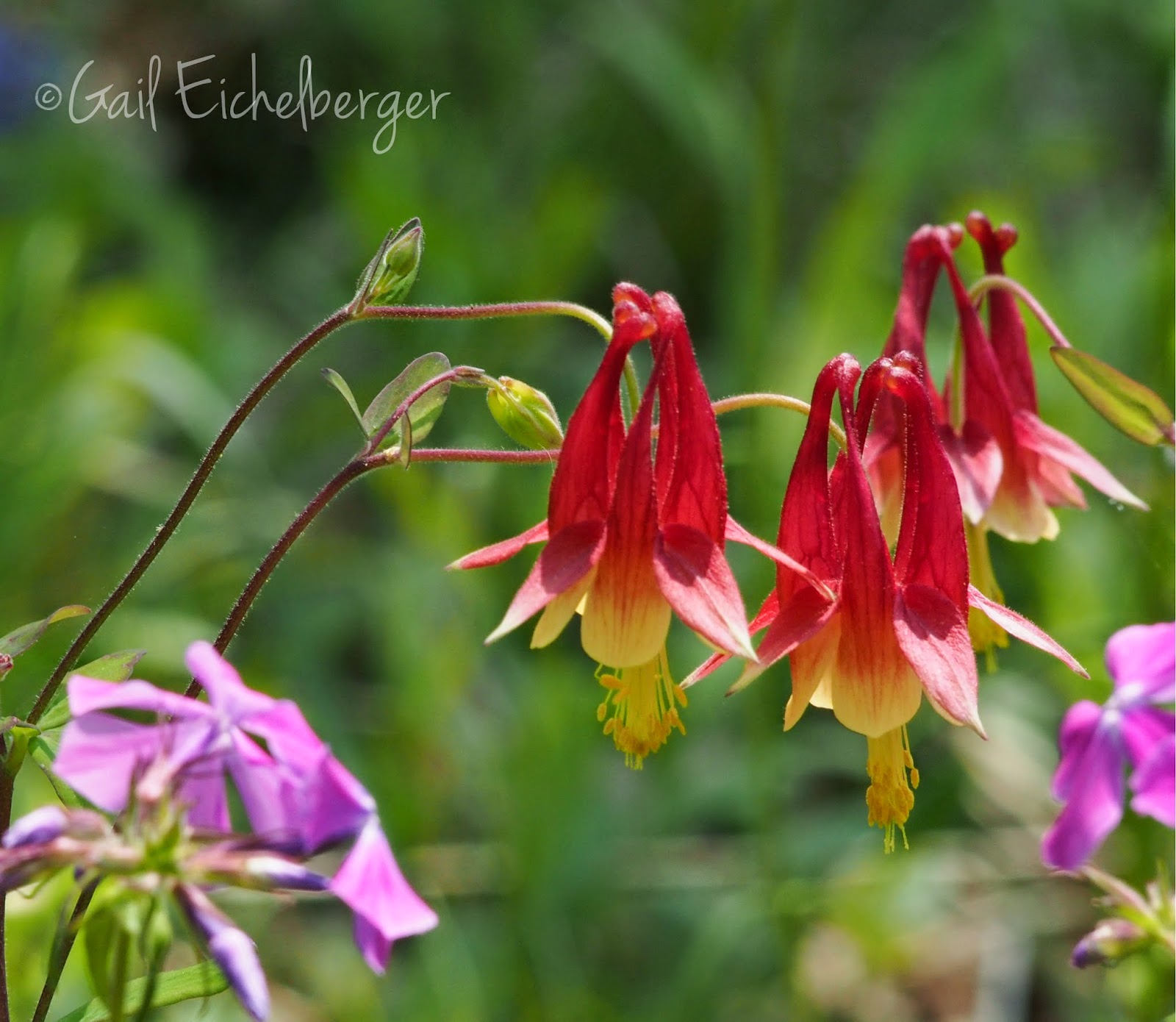
Clay and Limestone has its own trio of flowering beauties~Golden Ragwort, Columbine and Downy Phlox ~ that make the garden a colorful and tasty treat each spring.
Clay and Limestone is a small side dish of this delicious mixture (photo 2011)
All three are native to the Nashville Basin. The Basin is an elongated mixing bowl of land where Mother Nature has tossed cedar glade and Tennessee native plants into a unique and delicious mixture. Our tasty dish is never the same year to year, like local cooking, the proportions all depend upon the weather and what nature makes available!
 The Happy Trinity have been liberally sprinkled about the garden
Let's take a look at these special plants that combine wonderfully to make this garden's flavor base for Wildflower Wednesday.
notice a few aphids~I leave them for the beneficial insects to gobble up
Golden Ragwort or Packera aurea is a bright daisy with evergreen basil foliage. It makes a wonderful groundcover if the conditions are right~even moisture year round. Strangely enough, that may be why many people don't add it to their gardens~fear of a plant making too big a statement. I like big statement plants, after all, this is the home of rough and tumble wildflowers!

I think it's absolutely beautiful. The small daisy like golden flowers on tall stems are chock full of pollen and nectar for small bees, flies and butterflies. Occasionally, aphids show up on a few plants, but, I leave them for the ladybugs. There are no cultivars of this beauty, the straight species is perfect!

Family: Asteraceae
Native Range: Eastern North America to Texas
Zone: 3 to 8
Height: 0.50 to 2.50 feet Spread: 0.50 to 1.50 feet
Bloom Time: April Bloom
Sun: Full sun to part shade
Water: Medium to wet
Pollinators: Small bees and butterflies
How does one describe Aqiulegia canadensis! I think of it as bright lanterns that sway in the slightest breeze sending a signal to pollinators that there's nectar in those spurs!  Here's a good reason to plant more Columbine! "Ornithologists have discovered that the ruby-throated hummingbirds tend to follow the blossoming of Aquilegia canadensis on its journey north in spring, since the flowers are the first to provide nectar for the birds." (source)

Columbine thrives in part to full shade, in any well-drained soil. I find it happiest in cracks and crevices, really, it grows anywhere a seed falls and the drainage is good! Plants tolerate full sun if temperatures are cool, but they grow better in my garden in partial shade. Red columbine is found in rocky woods from Nova Scotia to the Northwest Territories south to Florida and Texas.
growing between the flagstone in the Garden of Benign Neglect
Family: Ranunculaceae
Native Range: Eastern North America
Zone: 3 to 8
Bloom Time: April to May (even earlier after a gentle Middle South winter)
Sun: Full sun to part shade
Water: Medium
Pollinators: Hummingbirds, bees, butterflies, and hawk moths feed on columbine necta

...and finally
Practically Perfect Pink Phlox Pilosa

Long time readers already know about her charms...PPPP has an exceptionally long bloom time (six weeks or longer), fantastic pink flowers, grows in sun and part sun, tolerates clay soil that's wet all winter and dry all summer, has a marvelous ground covering effect, and has the sweetest fragrance that wafts all over the garden on warm days. You'll have to agree, a plant like that is practically perfect!
P pilosa is a stoloniferous, semi-evergreen native wildflower found naturally growing in open woodlands, meadows, prairie remnants and limestone glades through out the central and eastern US and Canada. Although, I've never heard anyone call PPPP a thug, some gardeners may not appreciate how quickly it can spread in rich soil. Colonizing is a plus for me and unlike some colonizing plants, it's easy to lift and transplant. I am especially pleased at how well it's growing in the shallow soil over the bedrock in the Susan's Bed....That says a lot about a plant.

PPPP with River Oats
Family: Polemoniaceae
Native Range: Eastern and central United States (also Canada)
Zone: 4 to 9
Bloom Time: April to June (in my garden)
Sun: Full sun
Water: Medium
Pollinators:  Hummingbirds, Butterflies, Bees, Flies

So what do you think? Is this trio a tasty and delicious treat?
xoxogail

Welcome to Wildflower Wednesday! It's time to share your wildflowers no matter where you garden~the UK, tropical Florida, Europe, Australia, Africa, South America, India or the coldest reaches of Canada. It doesn't matter if we sometimes show the same plants, how they grow and thrive in your garden is what matters most. I hope you join the celebration..It's always the fourth Wednesday of the month!


Gail Eichelberger is a gardener and therapist in Middle Tennessee. She loves wildflowers and native plants and thoroughly enjoys writing about the ones she grows at Clay and Limestone. She reminds all that the words and images are the property of the author and cannot be used without written permission.