Home of the Practically Perfect Pink Phlox and other native plants for pollinators
Showing posts with label Hamamelis vernalis. Show all posts

Wednesday, February 26, 2025

Wildflower Wednesday: A Winter Blooming Treasure-Hamamelis vernalis

 I am not shy about sharing photos of my blooming Ozark witch hazel. Nor do I shy away from making it a Wildflower Wednesday star every few years. It it deserves the attention. I wish more people grew this beauty instead of the non-native hybrids that most nurseries sell; especially when you consider that it's a host plant to 69 moths and butterflies. 

You'll love its sweet fragrance wafting toward you on a warm winter day (in the 50s). You'll delight in the yellow/orange crepe paper streaming petals that unfurl as the day warms and furl back up when the temperature drops. Walking by this plant in full bloom is a treat with the cool flowers, the wonderful scent and visiting pollinators.

 Hamamelis vernalis is a lovely native shrub/small tree that blooms when you have just about given up hope that winter will end and warmth will return to the world. In my Middle Tennessee garden it often begins blooming in mid January and it's not unusual for it to continue blooming all through February and often into March. 

Petals furled and unfurled

Ozark witch hazel's flowers are an unusual reddish color with four yellow/orange crepe paper streaming petals that unfurl as the day warms and furl back up when the temperature drops. This is a marvelous adaptive behavior that insures that the spidery blooms will survive the fluctuating winter weather and be in bloom for several months.  

We've had some wicked cold weather and just as expected the petal furled in the freezing temps and and unfurled with the warm temps. You've got to love that in a winter blooming plant.


They're spectacular in my mostly brown winter garden. It's planted in the native Hydrangea bed under two oak trees so that anyone using the front path to the porch can get a close up view of the flowers and smell their delicious scent. Planted at its base are Carex, Trilliums, Green and Gold groundcover and self planted Phacelia. It's a lovely spring sight.

Ozark witch hazel is more of a multi-trunked shrub than a tree which makes it perfect for planting near you patio or anywhere where you can get a close up view of the flowers and a good sniff of its fragrance. Btw, the fragrance is honey sweet. 

It's known to sucker so it would make a fine hedge. I've not experienced the suckering but, the soil at Clay and Limestone is not moist year round. I do give this plant a big gulp of water during any summer droughts.

Just before they burst open

It's no accident that most winter blooming plants have some fragrance. Nature had to insure that insect pollinators could easily find their way to a plant that blooms when most of the garden is fast asleep. On days where the temperatures are above 50˚ I've seen honeybees,  small gnats and flies visiting these beautiful fragrant flowers!

Clues that Witch hazels are insect pollinated:

  • the long, bright-yellow strap like petals are conspicuous visual cues
  • sweet smelling nectar that attracts owlet moths (known pollinator)
  • the closer an insect get the stronger the scent...Humans love that, too.
  • their stamens (pollen-bearing male bits) are right next to the nectar source
  • there's not much competition blooming mid winter so any pollinators out will find it
  • its long bloom time means the pollen remains receptive to pollinators for a long time


Yes, researchers have been curious about winter pollination. Bernd Heinrich discovered that winter moths are responsible for pollinating witch hazels. These owlet moths (Noctuidae) have a remarkable ability to heat themselves by using energy to shiver, raising their body temperatures by as much as 50 degrees in order to fly in search of food.  (source).  Also, any fungus gnats, parasitic wasps, and hoverflies that are out will visit the flowers.

Nature and its critters are amazing!

 If you want to grow this Central South/Southern native shrub just give it a partially shady location with good morning sun, moist acid soil and decent drainage. Be sure to give it some space; during its early years, it grows taller than wide, but mature specimens are usually wider than tall. It tolerates Clay and Limestone's more neutral soil, so, I am pretty sure you can have success with it, too.


 The Particulars

Hamamelis vernalis
Common Name: Ozark witch hazel


Family: Hamamelidaceae

 
Type: Deciduous shrub or small tree


Native Range: Southern and central United States in rocky stream banks, in moist open woodlands.


Zone: 4 to 8


Height: 6.00 to 10.00 feet
Spread: 8.00 to 15.00 feet


Bloom Time: January to April
Bloom Description: Yellow with red inner calyx


Sun: Full sun to part shade


Water: Medium, consistently moist. NOT drought tolerant


Maintenance: Low, does not need to be pruned but you might need to remove suckers.
 

Suggested Use: Rain Garden, along creek banks, near a walkway to catch the scent.
 

Flower: Showy, Fragrant


fruits

Fruits September–October; a hard, woody, elliptical capsule ½ inch long, splitting down a 2-parted tip/ending in 4 sharp, curved points. Capsule pops open, forcibly discharging seeds to a distance of up to 30 feet. Seeds large, hard, black, 1 or 2 per capsule. (source)


Leaf: Good Fall color-yellow gold 

Usage: Please plant them where you will be sure to appreciate them during the winter months. They can colonize and would make an effective screen along property boundary.  Use in mixed border or as a specimen.

Wildlife value: Habitat value for insects and for birds that come to nest in their branches. The seeds and flowers are eaten by turkey and ruffed grouse. Host plant to 69 moths and butterflies. Owlet moths are known winter pollinators.

Comments: An important medicinal plant for many native American tribes. Twigs, leaves and bark are the basis of witch hazel extract. In the Ozarks and elsewhere, forked switches of this plant and its close relatives have long been used by "witch wigglers" or "water witches" (water finders) to find the best places to dig wells. (source) It has great fall leaf color, attracts pollinators, and blooms for two months.

 
Tolerates: Deer, Erosion, Clay Soil 


It's happy in the garden, it gets pollinated by visiting critters and that makes me happy.


Long time readers know I have garden guidelines that I strive to follow. My goal is to plant a mixture of Central Basin natives that have good to excellent wildlife value and that provide bloom as close to year round as is possible in a middle south garden. I've planted a few perennials and shrubs that are native to adjacent states or that grow in conditions similar to my habitat. Hammaelis vernalis is found growing in Arkansas, Oklahoma, Texas and Missouri. I planted them ( I have several) for the earliest visiting pollinators, for its beautiful flowers, delightful perfume and as a memory tree for my mom. 

When asked what tree I would like as a memorial gift for my mother I told my friends that Hamamelis vernalis was the perfect tree because it bloomed in winter. My mom bloomed in the winter of her life and I thought she would love having a tree that's as unique as she was. To read a post about it go here. 

A friend made this sign that reads "for bernice xoxo"

 I love that not only does Hamamelis vernalis flower for months, it has a lovely fragrance. How clever of Mother Nature to give winter bloomers that something special to insure that moths, a little fly, gnat or bee will follow the scent and pollinate the flower.
xoxogail 


Welcome to Clay and Limestone's Wildflower Wednesday celebration. On the fourth Wednesday of each month I share information about wildflowers and other native plants. Please join in if you like. You can write a blog post or share your favorite wildflower on social media. Remember, it doesn't matter if they are in bloom or not, and, it doesn't matter if we all share the same plants. It's all about celebrating wildflowers.

Gail Eichelberger is a gardener, Tennessee Naturalist and nature writer in Middle Tennessee. She loves wildflowers and native plants and thoroughly enjoys writing about the ones she grows at Clay and Limestone. She reminds all that the words and images are the property of the author and cannot be used without written permission.

Wednesday, January 25, 2023

Wildflower Wednesday: Hamamelis vernalis and the WW Challenge


Welcome to Clay and Limestone and the first Wildflower Wednesday post of 2023. Our star is vernal witchhazel and she's a beauty! I say her because the one in my garden is named Bernice...No, not a cultivar, but that story is for another time. 


I've decided to continue the WW Challenge into 2023 and beyond. It's a call for doing at least one thing a month to support nature/garden critters/etc. I will include an idea list each month. Long time readers know that I've been an advocate of gardening with native plants and the critters that visit and live in our gardens since my early blogging days. Back then I fell in love with the bumbles that were visiting my garden and wrote many posts about pollinators of all kinds. I also loved sharing posts about the native wildflowers that supported those critters and began Wildflower Wednesday. It's been at least a dozen years since  that first Wildflower Wednesday meme post. I invited others to share their wildflower star of the month and many did. I continue to use the Wildflower Wednesday posts to call attention to our native plants that have co-evolved with critters in a mutually dependent manner. Co-adaptation is easiest to see with insects/pollinators and flowering plants in our gardens. Researchers have found at least three traits that flowering plants have evolved to attract pollinators: (source)

  • Distinct visual cues: flowering plants have evolved bright colors, stripes, patterns, size  and colors specific to the pollinator. For example, flowering plants seeking to attract insect pollinators are typically blue an ultraviolet, whereas red and orange are designed to attract birds.     
  • Scent: flowering plants use scents as a means of instructing insects as to their location. Since scents become stronger closer to the plant, the insect is able to hone-in and land on that plant to extract its nectar.     
  • Some flowers use chemical and tactile means to mimic female insect species to attract the male species.


Let's consider our January star with co-evolution in mind.

Hamamelis vernalis is a lovely native shrub/small tree that blooms when you have just about given up hope that winter will end and warmth will return to the world. In my Middle Tennessee garden it began blooming the first week in January. It's not unusual for it to continue blooming into February and sometimes March.


Ozark witch hazel's flowers are an unusual reddish color with four yellow/orange crepe paper streaming petals that unfurl as the day warms and furl back up when the temperature drops. This is a marvelous adaptive behavior that insures that the spidery blooms will survive the fluctuating winter weather and be in bloom for almost two months. This is super important in ensuring that any pollinating critters that are out and about on warmer days will find their way to the lovely flowers.


They perfume the garden with their sweet clove vanilla scent on warm days. It's no accident that most winter blooming plants have some fragrance...Nature had to insure that insect pollinators could easily find their way to a plant that blooms when most of the garden is fast asleep. I've seen honeybees in the garden on days where the temperatures are above 50˚, but, have only seen small gnats and flies visiting the beautiful fragrant flowers of vernal witchhazel.


Witch hazels are indeed insect pollinated flowers, just check these clues out: They have long, bright-yellow petals, sweet smelling nectar and their stamens (pollen-bearing male bits) are right next to the nectar source. But, how you wonder is insect pollination possible in mid winter? Bernd Heinrich discovered that winter moths are responsible for pollinating witch hazels. These owlet moths have a remarkable ability to heat themselves by using energy to shiver, raising their body temperatures by as much as 50 degrees in order to fly in search of food.  (source).

Nature and its critters are amazing!

The flowers are deep to bright red, rarely all yellow, with four ribbon-shaped petals 7–10 mm (0.28–0.39 in) long and four short stamens, and grow in clusters

I do have garden guidelines that I strive to follow. Simply stated I like to plant a mixture of Central Basin natives that have good to excellent wildlife value and that provide bloom as close to year round as is possible in a middle south garden. I have occasionally pushed the envelope and planted perennials and shrubs that are native to adjacent states or that grow in conditions similar to Clay and Limestone*.  I pushed that envelope when I decided to plant Hamamelis vernalis/Ozark witch-hazel. It's found growing in Arkansas, Oklahoma, Texas and Missouri.  I planted them for the earliest visiting pollinators and for its delightful perfume. It's happy in the garden, it gets pollinated by visiting critters and that makes me happy.

That's my story and I am sticking to it! Although, there is another reason I planted Bernice! I planted her as a memorial to my mother, who bloomed in the winter of her life, too. xoxo

 If you want to grow this Central South/Southern native shrub just give it a partially shady location with good morning sun, moist acid soil. It tolerates Clay and Limestone's more neutral soil, so, I am pretty sure you can have success with it, too. It has great fall leaf color, attracts pollinators, and blooms for two months.

 The Particulars

Hamamelis vernalis
Common Name: Ozark witch hazel
Family: Hamamelidaceae
Type: Deciduous shrub or small tree
Native Range: Southern and central United States in rocky stream banks, in moist open woodlands. Although not listed as a Tennessee native I found this quote on the Illinois Extension Center site "A near native species, the vernal witch hazel (Hamamelis vernalis) is native to streambanks and wet woodland of the southern US, from parts of Texas and Florida north to Missouri, as well as most of the eastern US."
Zone: 4 to 8
Height: 6.00 to 10.00 feet
Spread: 8.00 to 15.00 feet
Bloom Time: January to April if weather remains cool.                                                                      Bloom Description: Yellow with red inner calyx
Sun: Full sun to part shade
Water: Medium, consistently moist. NOT drought tolerant
Maintenance: Low, does not need to be pruned
Suggested Use: Rain Garden, along creek banks,
Flower: Showy, Fragrant
Leaf: Good Fall color
Usage: Please plant them where you will be sure to appreciate them during the winter months. They can colonize and would make an effective screen along property boundary.  Use in mixed border or as a specimen.

Wildlife value: Habitat value for insects and for birds that come to nest in their branches. The seeds and flowers are eaten by turkey and ruffed grouse.

Comments: An important medicinal plant for many native American tribes. Twigs, leaves and bark are the basis of witch hazel extract.
Tolerates: Deer, Erosion, Clay Soil 

I love that not only does Hamamelis vernalis flower for months, it has a lovely fragrance. How clever of Mother Nature to give winter bloomers that something special to insure that moths, a little fly, gnat or bee will follow the scent and pollinate the flower.
 

xoxogail

 ...and now for something really special!


Welcome to Clay and Limestone's Wildflower Wednesday celebration. On the fourth Wednesday of each month I share information about wildflowers and other native plants. Please join in if you like. You can write a blog post or share your favorite wildflower on social media. Remember, it doesn't matter if they are in bloom or not, and, it doesn't matter if we all share the same plants. It's all about celebrating wildflowers.

Gail Eichelberger is a gardener and therapist in Middle Tennessee. She loves wildflowers and native plants and thoroughly enjoys writing about the ones she grows at Clay and Limestone. She reminds all that the words and images are the property of the author and cannot be used without written permission.

Wednesday, July 27, 2022

Wildflower Wednesday: Clematis viorna


I love Clematis and when I discovered that there were native Clemmies I had to have one or two or more. So far I've planted three in my garden: Clematis virginiana, C pitcheri and C viorna. I wasn't surprised to find out that like other Clematis they can be placed in groups that determine how and when to prune. Clematis viorna is our star and it fits in group 3, which means it blooms on new growth and you need to give it a hard pruning in late winter. Be sure you've harvested seeds or enjoyed their frothy fall look before pruning.

But, I digress, let's start with getting you acquainted with this delightful herbacious vine native to rich wooded banks and thickets throughout the north, central and eastern United States.

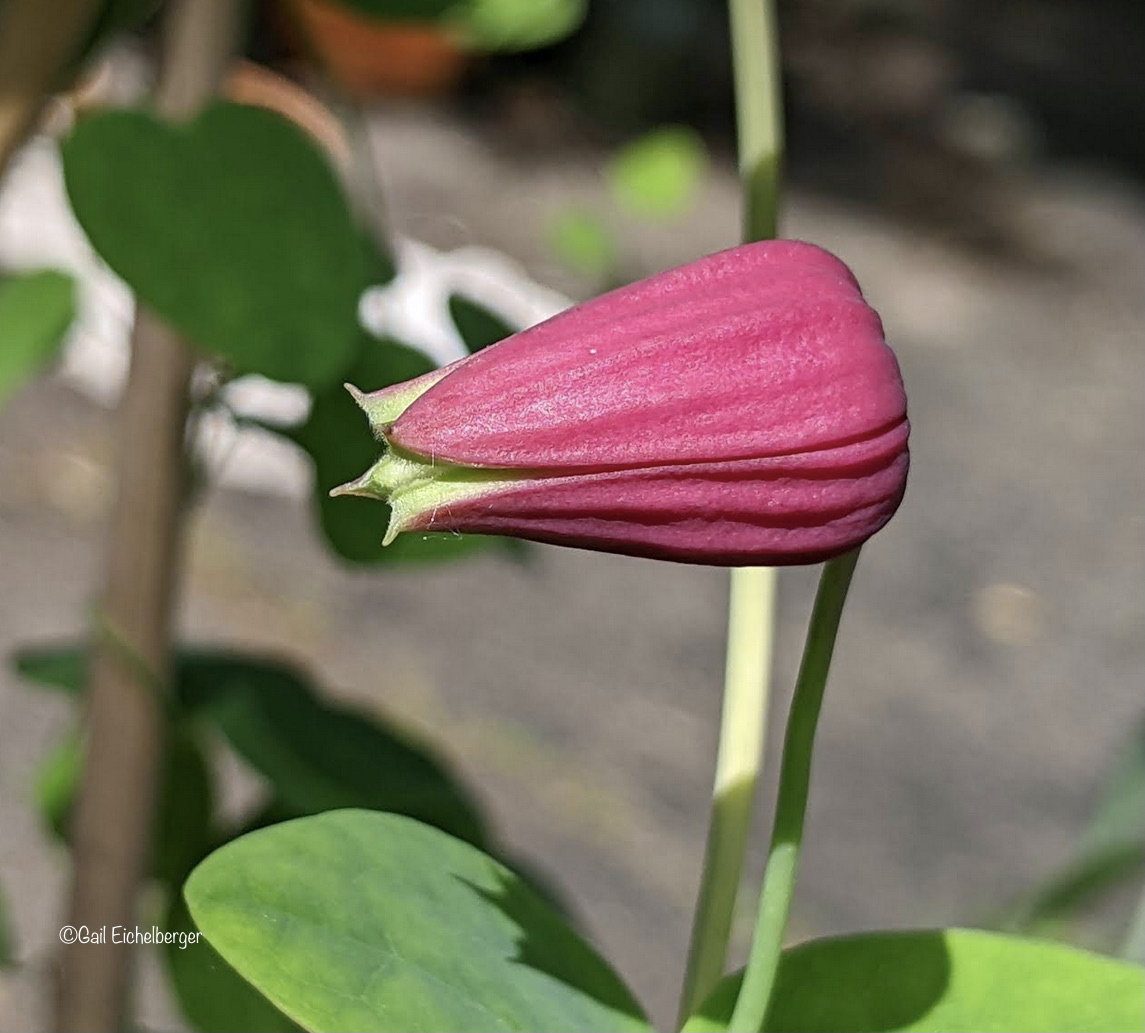
Clematis viorna has many common names, but the one I am most familiar with is Leatherleaf. It's a delicate looking vine given to irregular branching that will scramble across the woodland floor looking for someplace to climb. Expect it to reach ten to twelve feet in your garden when given a sturdy structure. "The scattered 1 inch flowers are mostly solitary at a branch tip or a leaf axil. Each is purple-rose in color, the usually 4 sepals (no petals) being very thick and fleshy (leathery) with the shape of the flower being a "closed-looking" vase or urn with slightly turned up sepal tips, usually facing downward." The tips are creamy white. (source)

Photo by Fritz Flohr Reynolds

One of the many characteristics that I love about Leatherleaf is its long bloom time. The first bloom at Clay and Limestone was May 26 and it still has buds today. That's three months of charming flowers, cool buds and delicate twining stems.

last week in July 2022

 It climbs by twining petioles/leaf stalks, so give it a structure or even a shrub to climb on that will accommodate its mature growth. The flowers attract hummingbirds, bees and butterflies and then mature to become beautiful, dramatic seed heads for birds to enjoy. The achenes with their feathery tails extend the attractiveness of the vine into the fall, so hard prune it once the seeds have been collected, eaten or wind dispersed. (source)

Seeds starting to feather fluff up which helps the wind disperse them

It's happily growing in a large container in morning sun where I can see it every day and keep it well watered. It likes moist, rich soil that is well-drained. Clematis viorna is a classic woodland plant and would have gotten lost in my habitat of rough and tumble wildflowers which I manage by letting them go to battle for garden dominance. Also, it needs to be watered regularly in what has turned out to be a brutal summer of drought and heat.

I plan to collect and sow seeds, eventually planting them among the smooth Hydrangeas and Hamamelis vernalis.  I think it will look smashing scrambling along the ground and eventually climbing into the shrub's branches. Planted in that bed assures that this delicate Clemmie will get the filtered sunlight and moist soil that makes it happy. 

I sure hope you give this sweet Clematis a try. It's worth the hassle of trying to locate one online! Nashvillians try GroWild. While you are looking try a few other native Clemmies. Thanks for stopping by.

xoxogail

 The Particulars

Scientific Name: Clematis viorna L.
Common Names: Leatherflower, Vasevine, Northern Leatherflower
Family Name: Ranunculaceae (Buttercup Family)
Plant Type:  A small, mostly non-woody, herbaceous perennial vine.
Light Requirement: Full sun, Partial/sunny, Partial/shady
Bloom Times: May, Jun, Jul, Aug
Flowers (or reproductive structures): Single, bell-shaped, perfect flowers 1" across by 2" long, in various shades of pink, violet to dull purple, with thick, fleshy, reflexed, petal-like sepals (no petals), creamy white interior. 
Flower Color: Pink/rose
Soil Conditions: Moist, well-drained soil with a neutral to a slightly alkaline pH. 
Fruit: Large seed head with many individual seeds, each seed attached to a fuzzy plume of a tail for wind distribution. 

Natural Distribution: rich woods, thickets 


USDA Hardiness Zone: 4 to 9 
Comments: Great for naturalizing, meadows. Showy fruit, with great fall interest
Wildlife value: Bumblebees pollinate the flowers. Other insects (thrips, midges) feed destructively on the flowers. Butterfly, moth and fly larvae feed on the foliage and stems. The foliage is probably poisonous to mammalian herbivores. All Clematis provide useful cover and nesting habitat for many songbirds in open wooded areas.  Attracts bees, Attracts Hummingbirds, Attracts birds, Showy fruit, 
Pharmacology: All parts of this plant are toxic, causing internal bleeding of the digestive tract if ingested in large amounts. Foliage has bitter taste and is therefore safe from pets. It is also reported to be deer resistant.  
Propagation: From seed/Achene (dry, flat seed, in this case dark brown) or, by semi-hardwood cuttings, or by layering.     


Gail Eichelberger is a gardener and therapist in Middle Tennessee. She loves wildflowers and native plants and thoroughly enjoys writing about the ones she grows at Clay and Limestone. She reminds all that the words and images are the property of the author and cannot be used without written permission.

Wednesday, January 15, 2020

Vernal Witchhazel


I always think of my mother when ever I see the vernal witchhazels blooming in my garden.
Vernal witchhazels bloom in the winter of life and that is how it was with my mother. That may sound odd to you, but, my mother was a late bloomer. She bloomed in the winter of her life. In fact, it wasn't until she sold her house and moved into a retirement community that she really blossomed. It seemed perfectly natural that a memory tree for her would be Hamamelis vernalis. It is blooming beautifully right now.

 This is from the post I wrote when I planted it.
 
I planted it for my Mother
the spring she passed away.
For remembrance,
For honoring,
and because planting a witch hazel was
a funny nod to our complicated and loving relationship.

Hamamelis vernalis  blossoms in the winter
When we have just about given up hope
that spring will ever arrive.

On warm days
the crepe paper streamer petals unfurl and
its sweet scent drifts about.

Believe me when I tell you this~
I know that my mother is somewhere laughing
that her remembrance tree is a witchhazel.

xoxogail

I'm smiling thinking about her...and I'll be smiling tomorrow when I walk the garden and see those spidery blooms unfurled on a warm winter day.
 
In case you aren't familiar with this lovely small tree that is native to Oklahoma, Texas, Missouri and Arkansas, its flowers are an unusual orange/yellow/reddish color with four crepe paper streaming petals that unfurl as the day warms and furl back up when the temperature drops. This is a marvelous adaptive behavior that insures that the spidery blooms will survive the fluctuating winter weather and be in bloom for almost two months. A plant like that needs to be in every garden!


Gail Eichelberger is a gardener and therapist in Middle Tennessee. She loves wildflowers and native plants and thoroughly enjoys writing about the ones she grows at Clay and Limestone. She reminds all that the words and images are the property of the author and cannot be used without written permission.

Wednesday, January 23, 2019

Wildflower Wednesday: Winter Blooming Witch Hazel


Hamamelis vernalis is a lovely native shrub/small tree that blooms when you have just about given up hope that winter will end and warmth will return to the world...In my Middle Tennessee garden it often begins blooming in early to mid January and it's not unusual for it to continue blooming into February and sometimes March.
Petals furled and unfurled
Ozark witch hazel's flowers are an unusual reddish color with four yellow/orange crepe paper streaming petals that unfurl as the day warms and furl back up when the temperature drops. This is a marvelous adaptive behavior that insures that the spidery blooms will survive the fluctuating winter weather and be in bloom for almost two months.

On a 50˚ day they perfume the air
They perfume the garden with their sweet clove vanilla scent on warm days. I planted them for the earliest visiting pollinators and for that unforgettable fragrance. Once you smell them, you will, want them in your garden, too.

I think they're spectacular in my mostly brown winter garden and I planted one along the front walkway so visitors can enjoy the blooms and their sweet scent.
Just before they burst open

It's no accident that most winter blooming plants have some fragrance...Nature had to insure that insect pollinators could easily find their way to a plant that blooms when most of the garden is fast asleep. I've seen honeybees in the garden on days where the temperatures are above 50˚, but, have only seen small gnats and flies visiting these beautiful fragrant flowers!

Witch hazels are indeed insect pollinated flowers, just check these clues out: They have long, bright-yellow petals, sweet smelling nectar and their stamens (pollen-bearing male bits) are right next to the nectar source. But, how you wonder is insect pollination possible in mid winter? Bernd Heinrich discovered that winter moths are responsible for pollinating witch hazels. These owlet moths have a remarkable ability to heat themselves by using energy to shiver, raising their body temperatures by as much as 50 degrees in order to fly in search of food.  (source). 

Nature and its critters are amazing!
The flowers are deep to bright red, rarely yellow, with four ribbon-shaped petals 7–10 mm (0.28–0.39 in) long and four short stamens, and grow in clusters
Long time readers know I have garden guidelines that I strive to follow. Simply stated I like to plant a mixture of Central Basin natives that have good to excellent wildlife value and that provide bloom as close to year round as is possible in a middle south garden. I have occasionally pushed the envelope and planted perennials and shrubs that are native to adjacent states or that grow in conditions similar  to Clay and Limestone*.  I pushed that envelope when I decided to plant Hamamelis vernalis/Ozark witch-hazel. It is not native to any where in Tennessee. It's found growing in Arkansas, Oklahoma, Texas and Missouri. I planted them for the earliest visiting pollinators and for its delightful perfume. It's happy in the garden, it gets fertilized by visiting critters and that makes me happy.

That's my story and I am sticking to it!

If you want to grow this Central South/Southern native shrub just give it a partially shady location with good morning sun, moist acid soil. It tolerates Clay and Limestone's more neutral soil, so, I am pretty sure you can have success with it, too. It has great fall color, attracts pollinators, and blooms for two months. Mine are species but, there are marvelous cultivars if you are so inclined!


The Particulars

Hamamelis vernalis
Common Name: Ozark witch hazel
Family: Hamamelidaceae
Type: Deciduous shrub  or small tree
Native Range: Southern and central United States in rocky stream banks, in moist open woodlands.
Zone: 4 to 8
Height: 6.00 to 10.00 feet
Spread: 8.00 to 15.00 feet
Bloom Time: January to April
Bloom Description: Yellow with red inner calyx
Sun: Full sun to part shade
Water: Medium, consistently moist. NOT drought tolerant
Maintenance: Low, does not need to be pruned
Suggested Use: Rain Garden, along creek banks,
Flower: Showy, Fragrant
Leaf: Good Fall color
Usage: Please plant them where you will be sure to appreciate them during the winter months. They can colonize and would make an effective screen along property boundary.  Use in mixed border or as a specimen.
Wildlife value: Habitat value for insects and for birds that come to nest in their branches. The seeds and flowers are eaten by turkey and ruffed grouse.
Comments: An important medicinal plant for many native American tribes. Twigs, leaves and bark are the basis of witch hazel extract.
Tolerate: Deer, Erosion, Clay Soil 

I love that not only does Hamamelis vernalis flower for months, it has a lovely fragrance. How clever of Mother Nature to give winter bloomers that something special to insure that moths, a little fly, gnat or bee will follow the scent and pollinate the flower.
xoxogail


Welcome to Clay and Limestone and Wildflower Wednesday.  This day is about sharing wildflowers and other native plants no matter where one gardens~the UK, tropical Florida, Europe, Australia, Africa, South America, India or the coldest reaches of Canada. It doesn't matter if we sometimes share the same plants. It doesn't matter if they're in bloom (think winter sharing), how they grow and thrive in your garden is what matters most.


*If you're new to C and L, my garden is a Central Basin woodland (there are some sunny areas) with dryer, heavier, shallow and neutral clay soil. I've unearthed enough limestone rocks to build several small walls and there's still more. Not too far below my plants is a thick layer of Ordovician limestone that makes for challenging gardening experiences. The native plants I've chosen are adapted to the environment and conditions at Clay and Limestone and provide food, nesting and/or shelter for mammals, reptiles, birds and insects. Humans seem to appreciate it, too.


Gail Eichelberger is a gardener and therapist in Middle Tennessee. She loves wildflowers and native plants and thoroughly enjoys writing about the ones she grows at Clay and Limestone. She reminds all that the words and images are the property of the author and cannot be used without written permission.

Wednesday, February 22, 2017

Wildflower Wednesday: A Fine Native Hydrangea


It's hard for me to believe that I've never written about Hydrangea arborescens, it's my favorite hydrangea and the first shrub I planted in this garden 30 years ago. I first saw wild hydrangea while hiking a ridge not too far from my house and thought it was charming and just what was needed in my garden. It was clinging to the side of a slope and towering above it were hardwood trees like the ones at Clay and Limestone.
the sterile flowers stay attached after flowering has finished
Hydrangea arborescens, commonly known as smooth hydrangea or wild hydrangea is a gangly limbed deciduous shrub with large, opposite, toothed leaves and grayish stems. It is native to woodland slopes, hillsides and streambanks in the Eastern US from New York to Florida, west to Iowa, Missouri, Kansas, Oklahoma and Louisiana and as I shared earlier in middle Tennessee woodlands. Some maps show it growing as far west as New Mexico and Arizona, but, I can't corroborate that information. In warmer climates it's happiest in dappled shade with moist soil, but, it is tolerant of damp soil, dry soil and even rocky soil. The fact that it grows so well on slopes indicates to this gardener that drainage is important! So keep that in mind when you plant it. Adequate moisture is an ongoing issue in a middle Tennessee garden all summer long, be prepared to give this plant a big gulp of water every now and then, it can tolerate some dry spells, but don't expect it to flourish if it's dry all the time.
 
planted with Hypericum

Hydrangea arborescens is planted in three different beds. My favorite is the one planted with witch hazels, Hamamelis vernalis and a non native H x intermedia 'Diane'. Also in that section of the bed is a Fothergilla, Oakleaf hydreangea 'Ruby Slippers' and a cultivar H arborescens 'White Dome' they're underplanted with Seersucker sedges, camassias, ex-asters, Trilliums and Green and Gold.
Flat-topped clusters of white flowers (corymbs to 2-6”across) are produced in early summer.
What do I like about this hydrangea and why would I recommend it for your garden?

For lots of little reasons and for two big ones.
Dehiscent seed capsules ripen in October-November
First, I am wild about its "lacecap flowers". They're not as lacy as non native Hydrangea, but there's enough sterile flowers to make me smile. The flat topped clusters of creamy-white fertile and sterile flowers start out pale green and turn to a creamy white and eventually fading to brown in late summer.

The white flowers appear on tips of new growth, so you don't have to worry about winter's harsh blast killing the flower buds. Feel free to cut it back to control growth and encourage stronger stems in early spring.

It took me years to learn to appreciate winter browns, now that I do, I never want to cut back my garden until the very last minute in spring! Just look at what I would miss if I cut the stems of this Hydrangea to nubs in late fall!
nectar and pollen attract pollinators
The second reason I recommend wild hydrangea is for its wildlife value. Planting native plants that have high wildlife value is one of the guiding principles of this garden. Lots of plants are critter friendly, but some are absolutely better than others and those are the ones I plant.

Wild hydrangea has great wildlife value. It's a pollen and nectar source for pollinators and a host plant for two moths, Darapsa versicolor/Hydrangea Sphinx Moth and Olethreutes ferriferana/Hydrangea leaf-tier moth. I keep watching for them, but so far have missed their offspring and the moths.
bees across the flower making it hard to get them and the flower into focus
If you've ever watched a bee race over/work this flower you would guess it has a lot to offer. I love that little carpenter bees (Ceratina spp.), Halictid bees, masked bees (Hylaeus spp.), miscellaneous wasps, mosquitoes, Syrphid flies, thick-headed flies, Muscid flies, dance flies (Empis spp.), tumbling flower beetles, and long-horned beetles (source) also visit the flowers.
Hydrangea arborescens 'White Dome'
Some gardeners think Smooth Hydrangea cultivars are more attractive than the species, they usually like the larger flower heads over the straight species, but, a big flowered cultivar like 'Annabelle' does nothing for me, nor does it look right in my woodland garden. But, if that's one you like go ahead a add it to your garden. If you can't find the straight species, you won't be disappointed with Hydrangea arborescens 'White Dome'. The flower head is also a "lacecap" shape with sterile and fertile flowers and it's equally attractive to pollinators.
 The yellow color of the wild hydrangeas are a perfect complement to the other fall tones
I think of Wild Hydrangea as offering year round appeal, except for very late in winter when I've cut the stems back. But, before long it's greening up and setting buds. The large serrated leaves and tall stems stand up straight and tall in my garden with flowers on every tip. As i shared earlier, they start out green, then they're turn a creamy white and once they're pollinated they fade to a sweet parchment color that lasts all winter.

Wild hydrangea has a nice yellow in the fall, that helps light up a dark corner in a woodland garden and acts as a supporting player to the more dramatic fall gold, reds and oranges. It looks charming with blues, even if it's only a container.
What do you think about its yellow leaves when planted with lilac ex-asters and the red leaves of a Japanese maple and Florida dogwood?

I love it.

source
Do give this native shrub a chance, it's really quite special.

It's a lovely, easy care,  year round pretty shrub.
It tolerates winter's cold blast.
It's a pollinator magnet and host plant.
It makes sense for a woodland garden.
xoxogail

The particulars

Common Name: smooth hydrangea, Wild hydrangea
Type: Deciduous shrub
Family: Hydrangeaceae
Native Range: Eastern United States from New York, into the mid-western states, south to Texas and Florida
Zone: 3 to 9
Height: 3.00 to 5.00 feet, occasionally to ten feet
Spread: 3.00 to 5.00 feet
Bloom Time: May/June to September
Flower: Flat-topped clusters (4 to 6 inches across) of small white flowers, larger sterile flowers may be present along edges of cluster, appearing in early summer. Flowers on new growth.
Fruit: Dry, light brown capsules appearing in early fall
Sun: Part shade, dappled sunlight, full sun with moist soil 
Water: Medium
Soil: clay soil, wet, dry, shallow and/or rocky soil. Acid to neutral ph.
Maintenance: Low, prune in late spring to control growth, can colonize
Suggested Use: Naturalize, Rain Garden, woodland garden, edge of woods, massing, stabilizing a hillside or slope.
Comments: Showy cultivars that I like 'Ryan Gainey' and 'White Dome', check to make sure you get a cultivar that is not just showy sterile flowers. There are two pink cultivars, but, I am not sure if they are just sterile flower heads. Its roots have been used for hundreds of years in folk and Native American medicine for the treatment of various ailments

Thank you for stopping by and welcome to Clay and Limestone's Wildflower Wednesday celebration. WW is about sharing and celebrating wildflowers from all over this great big, beautiful world. Join us on the fourth Wednesday of each month. Remember, it doesn't matter if they are in bloom or not; and, it doesn't matter if we all share the same plants. It's all about celebrating wildflowers. Please leave a comment when you add your url to Mr Linky.


Gail Eichelberger is a gardener and therapist in Middle Tennessee. She loves wildflowers and native plants and thoroughly enjoys writing about the ones she grows at Clay and Limestone. She reminds all that the words and images are the property of the author and cannot be used without written permission.