Home of the Practically Perfect Pink Phlox and other native plants for pollinators
Showing posts with label witch hazel. Show all posts

Thursday, November 27, 2025

Wildflower Wednesday: Hamamelis virginiana

Today I am thankful for family, friends and my wildflower garden. I am thankful for time I spend outdoors, for the critters that live and visit my garden, for the last blooming flowers and for the gnats, flies, moths and bees that are out and about on warm days. 

 I am grateful for all of you who read my Wildflower Wednesday posts and don't mind that I am posting this one on Thanksgiving Day instead of on the fourth Wednesday! 

unfurled crepe papery petals on a very warm November afternoon. 
Today, I celebrate Hamamelis virginiana our Wildflower Wednesday star. Witch-hazel is a fall flowering understory tree with sweetly fragrant small yellow flowers. It is native to woodlands, forest margins and stream banks in eastern North America (including OK and TX)  where it's found growing in moist well drained soil in sunny to partial shade conditions.
That's where it's found in natureand i
t's a darn shame that it is overlooked by most nurseries in favor of selling the flashier non-native witch-hazels. Dear readers, step away from those Chinese witch-hazels and ask for Hamamelis virginiana! You won't be disappointed and that's a promise.* If you can't find it locally there are good online nurseries that sell seedlings.
Hamamelis virginiana starts blooming in October at Clay and Limestone and blooms for at least a month. In outstanding weather you can expect to find a few flowers in early December! Every branch is covered with fragrant spidery crepe paper flowers that never fail to charm as they furl on cold days and unfurl on warm ones!
 
 
I can't imagine gardening without a few witch hazels trees in my garden. On warm days its honey scent wafts around the garden on the slightest breeze.
 

It's growing in a small woodland garden beneath the swaying branches of a shagbark hickory and The Dancing Tree/Ostrya virginiana that I rescued from the strangling wisteria when we first moved here. It's perfect for woodland gardens and generously shares the ground beneath with woodland favorites like Christmas ferns, wild ginger, Phacelia bipinnatifida, Trilliums, Dutchman's Breeches and other spring ephemerals.
 

 I love the  textured deep green leaves that turn a golden yellow in the fall.  Sometimes the flowers bloom before the leaves drop and the stem-hugging clusters of bright yellow flowers are hidden.


Pollinator visiting the last blooms of the year
But, that gives me an opportunity to get a close look at each flower and at any pollinators who happen to stop by for a bit of nectar.  Witch-hazel is also known to attract robins, juncos, titmice and cardinals. I love having a tree with pretty flowers, a sweet scent and  with good wildlife value.
stem-huggin

 H virginiana is a great all around small tree/shrub for most gardens. Those of you who garden for wildlife might consider planting it for the good wildlife value it adds to a shady garden.

In case you are still thinking non-native because it's easy to find. Check this list out!

  • A tough, adaptable plant suitable for a variety of garden settings (Hardiness Zones: 4-9)
  • Tolerates clay soil and poor drainage  
  • Since it's often the last blooming plant found in most woodlands it's invaluable for providing nectar to late visiting pollinators
  • It's upright spreading branches are good nesting sites for birds. 
  • Some moth caterpillars predate on it
  • The dispersed seeds are eaten by birds and small rodents. Now don't turn your nose up at the mere mention of rodents, yes, they are pesty, but, they are also extremely important critters for hungry owls and hawks.
  • Lovely fragrant, bright yellow flowers that bloom from October through November.
  • Great fall foliage color 
  • It's native to eastern North American, including Louisiana and Texas. 


Except for a few native ex-aster that might have survived a killing frost, witch-hazel is probably the last blooming plant found in most woodlands.  I treasure it for providing one last stop for nectar gathering pollinators and for all those characteristic listed above. It's a wonderful specimen plant, but because it colonizes, it does make a wonderful screening plant or hedge. Spring ephemerals, native sedges, ferns and shade tolerant perennials are great companions.

fruit and exploded seed capsule
 

Ooh, ooh, ooh~One more cool factoid!  The seeds are expelled with a loud pop that sends them yards away from the parent plant. I've been looking for offspring but, so far none. The seeds must be tasty to my garden critters. 

 The Particulars:

Botanical name: Hamamelis virginiana

Common Name: common witch hazel  

Type: Deciduous shrub 

Family: Hamamelidaceae 

Native Range: Eastern North America 

Zone: 3 to 8

 Height: 15.00 to 20.00 feet 

Spread: 15.00 to 20.00 feet 

Bloom Time: October to December 

Bloom Description: Golden yellow centers tinged a light red

Sun: Full sun to part shade 

Water: Medium 

Maintenance: Low Suggested

Cultivation: Light shade to partial sun, mesic conditions, and sandy or loamy soil. More flowers are produced in response to greater amounts of sunlight. 

Comments: Useful as a hedge, let it naturalize in a woodland garden, useful in a rain garden and it has lovely fall color.

Wildlife value: Birds, pollinators and mammals (Illinois Wildflowers to see moth table)

Tolerate: Deer, Erosion, Clay Soil

 
How any one could think this tree unlovely or unworthy of a place in their garden is beyond my understanding! The crepe papery blooms look especially enchanting with a backdrop of golden Shagbark hickory and Hophornbeam leaves and the Autumn blue sky!
 
For those of you celebrating Thanksgiving...I wish you a joy filled day with loved ones and calorie free foods!

Warmest thoughts of you.

xoxoGail

*If you want this lovely tree you'll need to check with a native plant nursery. We are fortunate that we have several native plant nurseries not too far away that carry beautiful native trees, shrubs and perennials. Check with Joy at Wonder Gifts and Gardens and Terri at GroWild 
Welcome to Clay and Limestone's Wildflower Wednesday celebration. I am so glad you stopped by. WW is about sharing and celebrating wildflowers from all over this great big, beautiful world. Join us on the fourth Wednesday of each month. Remember, it doesn't matter if they are in bloom or not; and, it doesn't matter if we all share the same plants. It's all about celebrating wildflowers.
 
Gail Eichelberger is a gardener, Tennessee Naturalist and nature writer in Middle Tennessee. She loves wildflowers and native plants and thoroughly enjoys writing about the ones she grows at Clay and Limestone. She reminds all that the words and images are the property of the author and cannot be used without written permission.

Wednesday, January 23, 2019

Wildflower Wednesday: Winter Blooming Witch Hazel


Hamamelis vernalis is a lovely native shrub/small tree that blooms when you have just about given up hope that winter will end and warmth will return to the world...In my Middle Tennessee garden it often begins blooming in early to mid January and it's not unusual for it to continue blooming into February and sometimes March.
Petals furled and unfurled
Ozark witch hazel's flowers are an unusual reddish color with four yellow/orange crepe paper streaming petals that unfurl as the day warms and furl back up when the temperature drops. This is a marvelous adaptive behavior that insures that the spidery blooms will survive the fluctuating winter weather and be in bloom for almost two months.

On a 50˚ day they perfume the air
They perfume the garden with their sweet clove vanilla scent on warm days. I planted them for the earliest visiting pollinators and for that unforgettable fragrance. Once you smell them, you will, want them in your garden, too.

I think they're spectacular in my mostly brown winter garden and I planted one along the front walkway so visitors can enjoy the blooms and their sweet scent.
Just before they burst open

It's no accident that most winter blooming plants have some fragrance...Nature had to insure that insect pollinators could easily find their way to a plant that blooms when most of the garden is fast asleep. I've seen honeybees in the garden on days where the temperatures are above 50˚, but, have only seen small gnats and flies visiting these beautiful fragrant flowers!

Witch hazels are indeed insect pollinated flowers, just check these clues out: They have long, bright-yellow petals, sweet smelling nectar and their stamens (pollen-bearing male bits) are right next to the nectar source. But, how you wonder is insect pollination possible in mid winter? Bernd Heinrich discovered that winter moths are responsible for pollinating witch hazels. These owlet moths have a remarkable ability to heat themselves by using energy to shiver, raising their body temperatures by as much as 50 degrees in order to fly in search of food.  (source). 

Nature and its critters are amazing!
The flowers are deep to bright red, rarely yellow, with four ribbon-shaped petals 7–10 mm (0.28–0.39 in) long and four short stamens, and grow in clusters
Long time readers know I have garden guidelines that I strive to follow. Simply stated I like to plant a mixture of Central Basin natives that have good to excellent wildlife value and that provide bloom as close to year round as is possible in a middle south garden. I have occasionally pushed the envelope and planted perennials and shrubs that are native to adjacent states or that grow in conditions similar  to Clay and Limestone*.  I pushed that envelope when I decided to plant Hamamelis vernalis/Ozark witch-hazel. It is not native to any where in Tennessee. It's found growing in Arkansas, Oklahoma, Texas and Missouri. I planted them for the earliest visiting pollinators and for its delightful perfume. It's happy in the garden, it gets fertilized by visiting critters and that makes me happy.

That's my story and I am sticking to it!

If you want to grow this Central South/Southern native shrub just give it a partially shady location with good morning sun, moist acid soil. It tolerates Clay and Limestone's more neutral soil, so, I am pretty sure you can have success with it, too. It has great fall color, attracts pollinators, and blooms for two months. Mine are species but, there are marvelous cultivars if you are so inclined!


The Particulars

Hamamelis vernalis
Common Name: Ozark witch hazel
Family: Hamamelidaceae
Type: Deciduous shrub  or small tree
Native Range: Southern and central United States in rocky stream banks, in moist open woodlands.
Zone: 4 to 8
Height: 6.00 to 10.00 feet
Spread: 8.00 to 15.00 feet
Bloom Time: January to April
Bloom Description: Yellow with red inner calyx
Sun: Full sun to part shade
Water: Medium, consistently moist. NOT drought tolerant
Maintenance: Low, does not need to be pruned
Suggested Use: Rain Garden, along creek banks,
Flower: Showy, Fragrant
Leaf: Good Fall color
Usage: Please plant them where you will be sure to appreciate them during the winter months. They can colonize and would make an effective screen along property boundary.  Use in mixed border or as a specimen.
Wildlife value: Habitat value for insects and for birds that come to nest in their branches. The seeds and flowers are eaten by turkey and ruffed grouse.
Comments: An important medicinal plant for many native American tribes. Twigs, leaves and bark are the basis of witch hazel extract.
Tolerate: Deer, Erosion, Clay Soil 

I love that not only does Hamamelis vernalis flower for months, it has a lovely fragrance. How clever of Mother Nature to give winter bloomers that something special to insure that moths, a little fly, gnat or bee will follow the scent and pollinate the flower.
xoxogail


Welcome to Clay and Limestone and Wildflower Wednesday.  This day is about sharing wildflowers and other native plants no matter where one gardens~the UK, tropical Florida, Europe, Australia, Africa, South America, India or the coldest reaches of Canada. It doesn't matter if we sometimes share the same plants. It doesn't matter if they're in bloom (think winter sharing), how they grow and thrive in your garden is what matters most.


*If you're new to C and L, my garden is a Central Basin woodland (there are some sunny areas) with dryer, heavier, shallow and neutral clay soil. I've unearthed enough limestone rocks to build several small walls and there's still more. Not too far below my plants is a thick layer of Ordovician limestone that makes for challenging gardening experiences. The native plants I've chosen are adapted to the environment and conditions at Clay and Limestone and provide food, nesting and/or shelter for mammals, reptiles, birds and insects. Humans seem to appreciate it, too.


Gail Eichelberger is a gardener and therapist in Middle Tennessee. She loves wildflowers and native plants and thoroughly enjoys writing about the ones she grows at Clay and Limestone. She reminds all that the words and images are the property of the author and cannot be used without written permission.

Friday, November 10, 2017

The witch-hazel is blooming and that makes me happy

That it's the best bloom in years adds to my delight.

Every branch is covered with fragrant spidery crepe paper flowers that never fail to charm as they furl on cold days and unfurl on warm ones!

It's a darn shame that it is overlooked by most nurseries in favor of the flashier non-native witch-hazels. Just step away from those Chinese witch-hazels and ask for Hamamelis virginiana! You won't be disappointed and that's a promise.


H virginiana is a great all around small tree/shrub for most gardens and those of you who garden for wildlife might consider planting it for the good wildlife value it adds to a shady garden.

In case you are still thinking non-native!
  • A tough, adaptable plant suitable for a variety of garden settings (Hardiness Zones: 4-9)
  • Tolerates clay soil and poor drainage  
  • Since it's often the last blooming plant found in most woodlands it's invaluable for providing nectar to late visiting pollinators
  • It's upright spreading branches are good nesting sites for birds. 
  • Some moth caterpillars predate on it
  • The dispersed seeds are eaten by birds and small rodents. Now don't turn your nose up at the mere mention of rodents, yes, they are pests, but, they are also extremely important critters for hungry owls and hawks.
  • Lovely fragrant, bright yellow flowers that bloom from October through November.
  • Great fall foliage color 
  • It's native to eastern North American, including Louisiana and Texas. 

 xoxogail

Gail Eichelberger is a gardener and therapist in Middle Tennessee. She loves wildflowers and native plants and thoroughly enjoys writing about the ones she grows at Clay and Limestone. She reminds all that the words and images are the property of the author and cannot be used without written permission.

Friday, November 6, 2015

Dear Friends, won't you come out and play...

We can wander the garden and see the last of the fall blooms.
One of my favorites is a little witch hazel tree that never fails to bloom the first week of November. It lights up the shade and glows when in bloom.
flower visitors are rewarded with sugary nectar and sticky pollen
If we stand very close and the day is warm, we'll catch a slight sweet scent. That sweet scent attracts the small gnats, flies and bees that pollinate it.
I've shared this before, but, just in case you're a new visitor~This garden wasn't a garden when we moved here. We live on land that was at one time a forest of hardwoods that was the source of building material for a growing Nashville. A woodland of secondary growth oaks, hickories and ash trees replaced the old growth forest. Many years later (mid-fifties) developers carved roads, built houses and created deep lots with expansive lawns. My yard has shallow soil and exposed limestone. It's not a cedar glade (too far from them to be one) but, it has some cedar glade characteristics that make gardening a challenge. It also had some very charming wildflowers in the woodland edges, declining redbuds, several lovely Ostry virginianas and absolutely no shrubs.

It took me a few years to figure out and then plant the shrubs and small trees that would make sense (survive) on the shallow, clay soil that was wet all winter and dry most of the summer. Hamamelis virginiana was one of the first to be planted. It's a slow grower, but flowered that first autumn. I love them so much I added one more and then, a few years ago, I planted three Hamamelis vernalis in the Garden of Benign Neglect (back yard) and one in the front garden to honor my mother. The Ozark witch hazels bloom in late winter for the earliest pollinators.  

 The question I ask you gentle readers is this: "Can there ever be too many beautiful late fall or early blooming small trees/shrubs in a garden? I think not! There's always room for flowering plants that offer a sweet scent to the garden and food for pollinators.
If you walk with me in the garden, I might wax poetically about witch hazels. Would you mind if I tell you how much I love them?

I love the odd little flower that blooms every autumn.
I love its spidery petals that curl open on warm days and curl up on cold ones.
I love it's soft sweet scent.
I love that it rewards pollinator visitors with sweet nectar and sticky pollen.
I love that it blooms as the rest of the garden is going to seed and shutting down for the winter.

I love the leaf shape and how it yellows up in autumn. 


I love that the fruit ripens into little capsules that pop open to expel the seeds in fall.
I love that the branches were once used as divining rods to find underground water sources.
I love that it's happy in my garden!
If you take a walk with me we'll stop and admire the yellow blooms against November's beautiful blue sky, we'll look for pollinators and we'll get close enough to smell its fragrant flowers. I am sure you'll agree with me when I sigh and exclaim, "Nature is brilliant and amazing."

xoxogail

It bears repeating...If you want to have pollinators in your garden and visiting your witch hazels and other fall blooming flowers you must never, ever, ever, ever, ever use pesticides. I mean never!


Gail Eichelberger is a gardener and therapist in Middle Tennessee. She loves wildflowers and native plants and thoroughly enjoys writing about the ones she grows at Clay and Limestone. She reminds all that the words and images are the property of the author and cannot be used without written permission.

Thursday, February 19, 2015

They called the winter storm Octavia

 She's blew into town and left a frozen world in her wake.
ice not snow
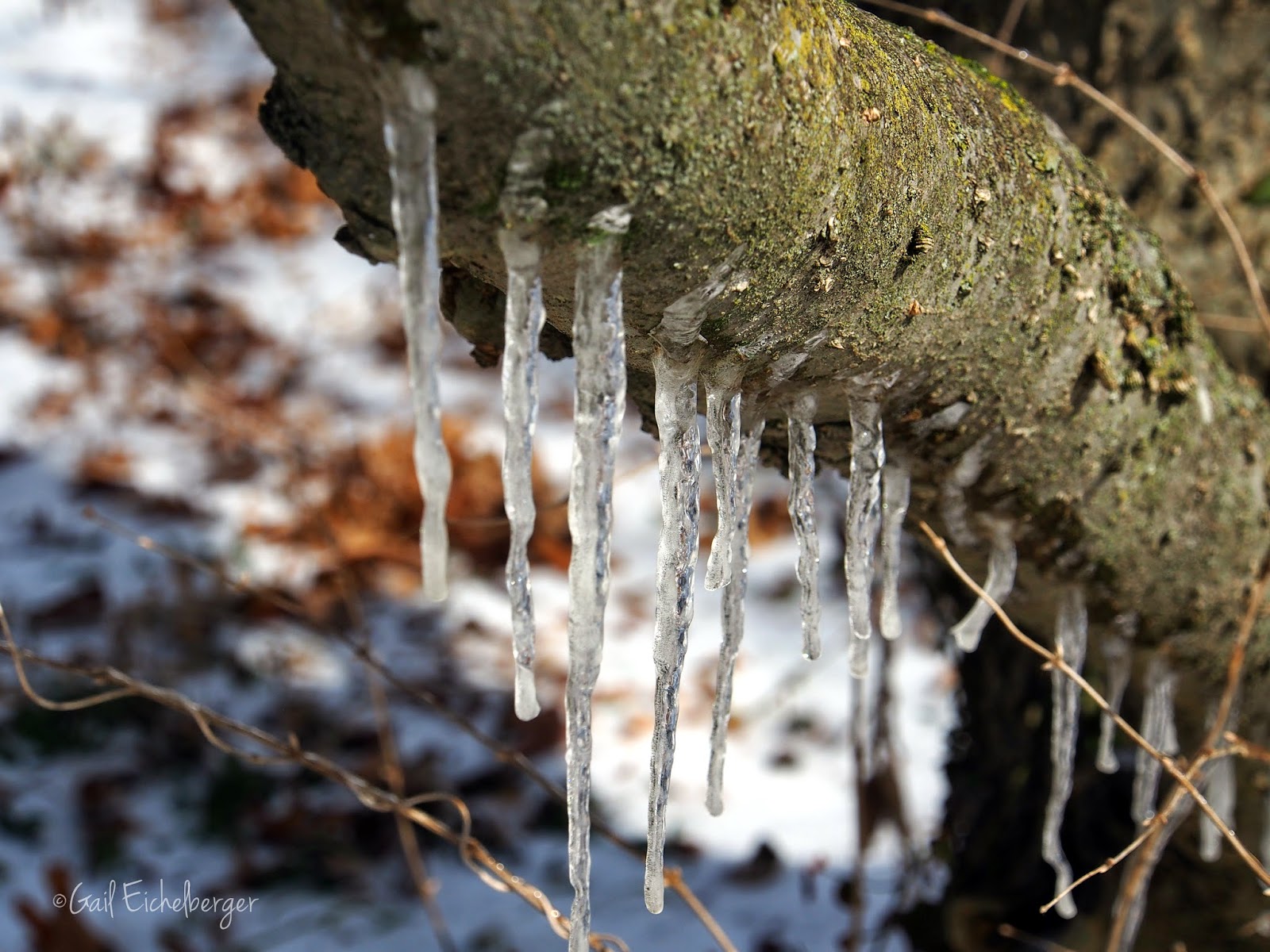
I hoped the snow that was forecast would arrive and protect the garden from subzero temperatures that threatened. We got ice instead. It looked like snow, but, it was ice. A dangerous ice that brought the city to a halt, closed schools and downed power lines.
It sparkled and beckoned me to explore, so I bundled up, grabbed my camera and ventured out.

Ice coated everything.

Trees, shrubs, grasses and power lines.
Itea virginica

Panicum virgatum

It was stunningly beautiful.
 I was shocked to find perfect Hamamelis vernalis/Ozark witch-hazel blooms under the ice.

They appeared to be waiting until the sun would release them from their winter prison!
At the risk of sounding melodramatic, I could relate to feeling like a prisoner trapped in winter ice!
heart warming blooms under the ice
But, what a delight to see those witch-hazel blooms on my Mom's memory tree! The promise of warmer days in those ice covered blooms was enough to melt my resentment towards this mean winter weather!  Yes, I will lose plants, but, others will endure, that's what life is like in a garden.
Soon the ice will melt and the witch-hazel flowers will unfurl their spidery petals and send their spicy sweet scent wafting through the garden.

That's enough for right now!

xoxogail

Gail Eichelberger is a gardener and therapist in Middle Tennessee. She loves wildflowers and native plants and thoroughly enjoys writing about the ones she grows at Clay and Limestone. She reminds all that the words and images are the property of the author and cannot be used without written permission.

Wednesday, November 5, 2014

An almost Wordless Wednesday: Hamamelis virginiana

Is blooming in my Middle Tennessee garden right now.

It's a splendid little native tree that is too often overlooked for its flashier Asian relatives. How any one could think this tree unlovely or unworthy of a place in their garden is beyond my understanding!

The crepe papery blooms look especially enchanting with a backdrop of golden Shagbark hickory and Hophornbeam leaves and the Autumn blue sky!

xoxogail

PS I've written about witch hazels several times and you can read their story at Wildflower Wednesday: In praise of a native tree and When a tree blooms in Autumn.

Gail Eichelberger is a gardener and therapist in Middle Tennessee. She loves wildflowers and native plants and thoroughly enjoys writing about the ones she grows at Clay and Limestone. She reminds all that the words and images are the property of the author and cannot be used without written permission.

Monday, November 25, 2013

Wildflower Wednesday: In Praise of A Native Tree

When we moved to this property there was a canopy of secondary growth shagbark hickories, oaks, a Slippery Elm and a few hackberries all growing in a weedy lawn. Other than a diseased redbud and a lovely Ostry virginiana that was being smothered by a white wisteria vine there was absolutely no understory.
blooms from October to November
It took me a few years to figure out that any shrubs or small understory trees that were going to be planted needed to be able to thrive in heavy, neutral, clay soil that is soggy wet in winter and dry all summer. Surprisingly, there are more available than one might think and one of the first ones I added was a native witchhazel, Hamamelis virginiana. (go here for a post about understory trees for Middle Tennessee)

Hamamelis virginiana is a small multi-stemmed slow to moderate growing deciduous tree or large shrub with arching branches and fragrant yellow flowers that bloom in October and November. It's native to eastern North American, including Louisiana and Texas.
it has wonderful qualities that would appeal to every gardener
That was many years ago and it's still one of my favorites. It's growing in a small woodland garden beneath the swaying branches of a shagbark hickory and The Dancing Tree, the little Ostrya virginiana that I rescued from the strangling wisteria. It's perfect for woodland gardens and generously shares the ground beneath with woodland favorites like Christmas ferns, wild ginger, phacelia, trilliums, Dutchman's Breeches and other spring ephemerals.
There's more to witch hazel than a pretty face
It's a darn shame that it is overlooked by most nurseries in favor of the flashier non-native witchhazels. Perhaps, the problem is that the flowers aren't as large and can be missed in a landscape filled with glowing autumn leaves. But, there's so much to be seen when you take a close look at its bloom.
I might have missed the nectaring bee mimic/hover fly had I not climbed into the woodland bed to look into the pretty flower face.
it takes a year for the seeds to mature
If you don't take a close look you'll miss seeing the marvelous seed capsules. They explode when mature, sending the seeds more than 20 feet away from the parent tree to ensure the seed's best chance for germination.

You certainly don't want to miss their delightful, fragrant spidery crepe paper flowers that never fail to charm as they furl on cold days and unfurl on warm ones!

H virginiana is a great all around small tree/shrub for most gardens and those of you who are wildlife gardeners might consider planting it for the good wildlife value it adds to a shady garden...
  • A tough, adaptable plant suitable for a variety of garden settings (Hardiness Zones: 4-9)
  • Tolerates clay soil and poor drainage  
  • Since it's often the last blooming plant found in most woodlands it's invaluable for providing nectar to late visiting pollinators
  • It's upright spreading branches are good nesting sites for birds. 
  • Some moth caterpillars predate on it
  • The dispersed seeds are eaten by birds and small rodents. Now don't turn your nose up at the mere mention of rodents, yes, they are pests, but, they are also extremely important critters for hungry owls and hawks.
  • Lovely fragrant, bright yellow flowers in late fall
  • Great fall foliage color 
You can't go wrong with a Hamamelis virginiana. I've loved this plant since I first saw it and my affection has never wavered. Yours won't either if you decide to add it to your garden.

xoxogail

It's a holiday this week and company is arriving at my house on Tuesday, so I am posting Wildflower Wednesday on Monday and it will be up all week.  Feel free to join in at any time. 

Welcome to Clay and Limestone's Wildflower Wednesday celebration. WW is about sharing and celebrating wildflowers from all over this great big, beautiful world. Join us on the fourth Wednesday of each month. Remember, it doesn't matter if they are in bloom or not, and, it doesn't matter if we all share the same plants. It's all about celebrating wildflowers. Please leave a comment when you add your url to Mr Linky. 


 Gail Eichelberger is a gardener and therapist in Middle Tennessee. She loves wildflowers and native plants and thoroughly enjoys writing about the ones she grows at Clay and Limestone. She reminds all that the words and images are the property of the author and cannot be used without written permission.