Home of the Practically Perfect Pink Phlox and other native plants for pollinators
Showing posts with label small garden. Show all posts

Friday, August 9, 2019

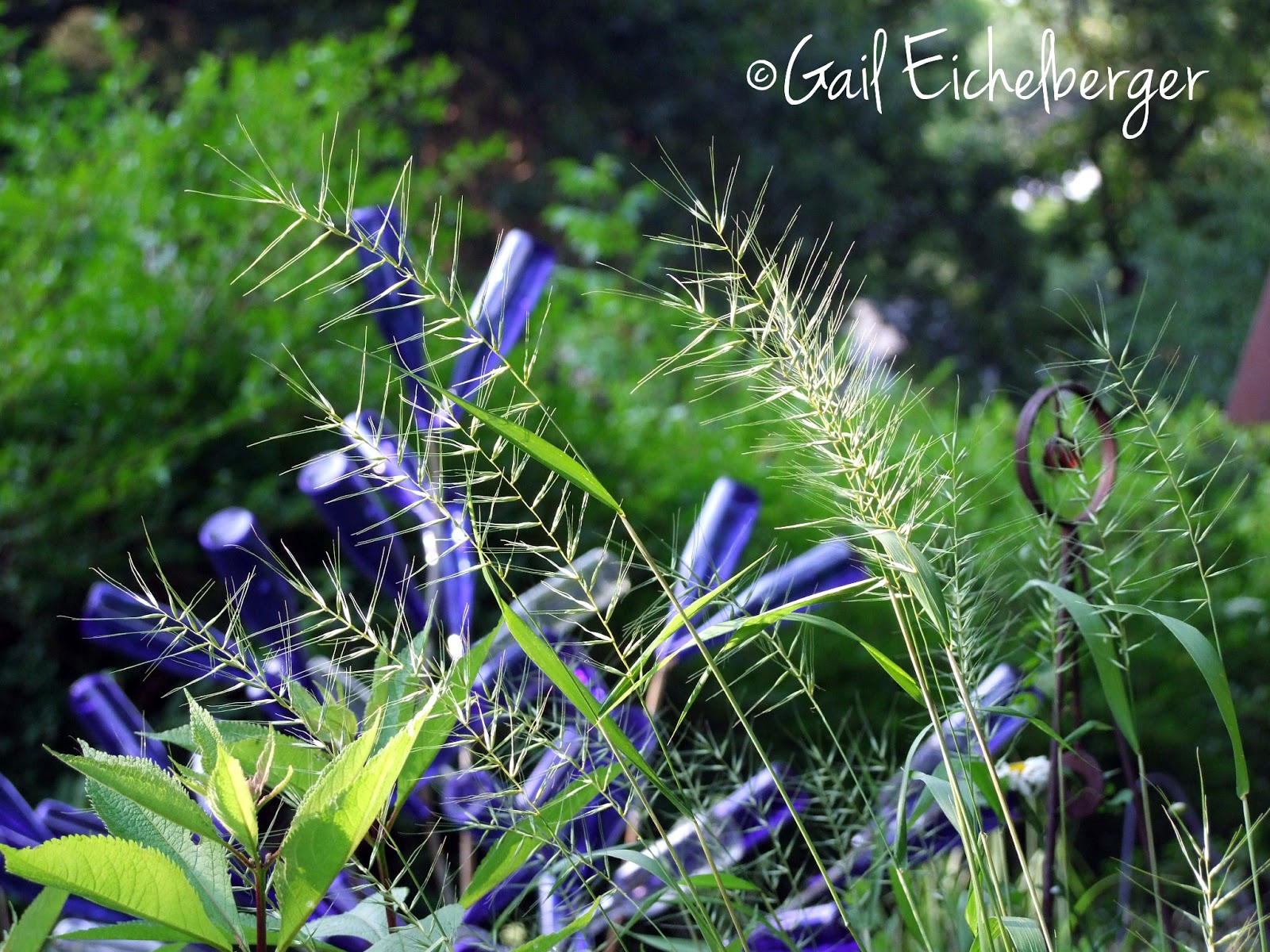
Native rye, Oh you beautiful thug!

Perhaps thug is too strong a word for this lovely grass, after all, it's not too difficult to transplant.
I really do like this grass. It has an interesting loose structure which fits nicely into a jam packed garden like mine.
But, there's the rub! When do you pull it out?
Certainly not once those lovely bottle brush seedheads begin to brown.
I

You wouldn't dare cut them down when the bristly seedheads look like this when backlit against the purple chairs.
Each of these will germinate!
You'll want to enjoy this beauty as long as you can, but still have time to collect seeds.
shade and drought tolerant
It's time for me to decide where I'd like a big stand instead of letting nature have her way...again!
It's a see through plant
It's August and the seedheads are a lovely beige and ripe for saving.

The Bottle brush seedhead is so good looking I often wait too long and the seeds gets dispersed by a late summer thunderstorm. They blow all over the place and germinate where ever they fall. When they show up in every container and in the middle of all the shrubs you might think it's a thug. 

Did I tell you we had a late summer thunderstorm the other day?

Oh you beautiful thug, I can't wait to see where you show up next spring!
xoxogail

PS


Gail Eichelberger is a gardener and therapist in Middle Tennessee. She loves wildflowers and native plants and thoroughly enjoys writing about the ones she grows at Clay and Limestone. She reminds all that the words and images are the property of the author and cannot be used without written permission. 

Friday, November 10, 2017

The witch-hazel is blooming and that makes me happy

That it's the best bloom in years adds to my delight.

Every branch is covered with fragrant spidery crepe paper flowers that never fail to charm as they furl on cold days and unfurl on warm ones!

It's a darn shame that it is overlooked by most nurseries in favor of the flashier non-native witch-hazels. Just step away from those Chinese witch-hazels and ask for Hamamelis virginiana! You won't be disappointed and that's a promise.


H virginiana is a great all around small tree/shrub for most gardens and those of you who garden for wildlife might consider planting it for the good wildlife value it adds to a shady garden.

In case you are still thinking non-native!
  • A tough, adaptable plant suitable for a variety of garden settings (Hardiness Zones: 4-9)
  • Tolerates clay soil and poor drainage  
  • Since it's often the last blooming plant found in most woodlands it's invaluable for providing nectar to late visiting pollinators
  • It's upright spreading branches are good nesting sites for birds. 
  • Some moth caterpillars predate on it
  • The dispersed seeds are eaten by birds and small rodents. Now don't turn your nose up at the mere mention of rodents, yes, they are pests, but, they are also extremely important critters for hungry owls and hawks.
  • Lovely fragrant, bright yellow flowers that bloom from October through November.
  • Great fall foliage color 
  • It's native to eastern North American, including Louisiana and Texas. 

 xoxogail

Gail Eichelberger is a gardener and therapist in Middle Tennessee. She loves wildflowers and native plants and thoroughly enjoys writing about the ones she grows at Clay and Limestone. She reminds all that the words and images are the property of the author and cannot be used without written permission.

Wednesday, December 25, 2013

Wildflower Wednesday 2013 Roundup


Welcome to Clay and Limestone's December's Roundup!

Wildflower Wednesday is about sharing wildflowers no matter where you garden~the UK, tropical Florida, Europe, Australia, Africa, South America, India or the coldest reaches of Canada. It doesn't matter if we sometimes show the same plants, how they grow and thrive in your garden is what matters most. I hope you join the celebration...It's always the fourth Wednesday of the month!

Without further ado, here are the best and brightest of Clay and Limestone's 2013 wildflowers.


January 2013 The  Rare Alabama Croton
Croton alabamensis

I am singing my happy song and dancing my happy dance. After years of searching for this rare shrub that is endemic to a few counties in Alabama, one county in Middle Tennessee (Coffee) and three counties in faraway Texas (Croton alabamensis var. texensis/Texabama croton). I now have one of my very own.

Alabama Croton is a semi-evergreen, thicket forming shrub which can easily grow between six to ten feet tall and forms a lose rounded shaped shrub at maturity. It produces very few leaves, but, the ones it has are noted for their oval-shape and glistening silver scales and stunning autumn color.  In milder winters the leaves hang on and flutter green and orange until spring.

Alabama Croton is the bees knees.  It's not deterred by dry, poor, limey soil, easily braves hot summers like we've been having the past few years, will grow in decent garden soil that is well draining, grows in the full sun, but, can appreciate a semi-shady location, is native to Middle Tennessee, is locally sourced, and it has year round interest.

February 2013 Harbinger of Spring
Erigenia bulbosa
It's the earliest and smallest of the spring flowers. So small, no more than 4 inches tall, that it is easily over looked among the brown leaves on a woodland hillside. The pure white flowers and chocolate colored anthers contrast beautifully and, are clearly, the reason for one of the common names, Pepper and Salt. It blooms early in our woodlands and I wondered if any pollinators are awake to sup on its nectar. According to research, little Carpenter bees, Mason bees, and flower flies visit. It grows in rich moist deciduous woodlands in dappled shade. (Found in: AL, AR, DC, GA, IL, IN, KS, KY, MD, MI, MO, MS, NC, NY, OH, OK, PA, TN, VA, WI, WV)

It is a tiny member of the Carrot (Apiaceae) family, growing from a round tuber and I count myself fortunate when it showed up in my garden a few years back. I dearly wish it were commercially available~it's a lovely little flower and should be in more of our woodland gardens and there should be more in my garden!

March A Side of Mustard
Cardamine diphylla
 Of the four toothworts  found in Tennessee, the cutleaf toothwort is the happiest in my garden.  It has formed small colonies and usually begins blooming in late February here in my Zone 7 garden, elsewhere in it's native range (Eastern US and parts of southern Canada) it might not appear until April. It prefers moist forested woodlands with lots of decaying leaves and dappled sunlight. It plays well with other spring ephemerals and quietly disappears by early summer leaving space for summer blooming plants to do their thing.

April: Practically Perfect Pink Phlox pilosa
Phlox pilosa
Long time readers already know about her charms...PPPP has an exceptionally long bloom time (six weeks or longer), fantastic pink flowers, grows in sun and part sun, tolerates clay soil that's wet all winter and dry all summer, has a marvelous ground covering effect, and has the sweetest fragrance that wafts all over the garden on warm days. A plant like that is practically perfect! It's found naturally growing in open woodlands, meadows, prairie remnants and limestone glades through out the eastern US and Canada.

Seriously, you must have this plant in your garden!

May: Scentless Mock Orange
Philadelphus inodorus
I love this plant and want it to step out of the shadows of the woodlands and from the corners of old gardens into the spotlight. Even if you haven't the space in your garden for a shrub this large, you can spread the word and encourage native plant enthusiasts to think about adding Scentless Mock-Orange to their gardens.

It's a wonderful shrub for the back of the border, at the edge of the woods, as a good basic hedge/screen, a specimen in a large border or in a cottage garden. Scentless Mock-Orange has clusters of small flowers with a marvelous amount (60 to 90) stamens in each flower. The entire plant can reach a height of 10'. The mature bark is often gray, but can become more of a mahogany color over time. It is more floriferous in full sun, but grows well in part shade with at least four hours of sun. It prefers calcareous or neutral soils (my garden) and can be found in nature from Canada to Florida and weest to Missouri, Arkansas and Louisiana. (source)  It's a beautiful flowering shrub that's not only easy to grow, but, takes very little maintenance....I never water it. Trust me here, it has survived in the Garden of Benign Neglect for almost 30 years.

June: Bottle Brush Grass

Elymus hystrix is a graceful ornamental grass that I only noticed about six years ago. It just appeared in my garden, a gift on the wind and I have loved it ever since. It's hard not to appreciate any plant, especially a grass that actually prefers the shade and is tolerant of dry soil.

While other ornamental native grasses are barely showing life, cool season Bottlebrush Grass is green and beginning to sway in the garden. It's a grass with medium green coloring and an interesting loose structure.  It's not at all like Panicums or River Oats that command a lot of space in your garden, in fact, I find the loose structure makes it a perfect grass to fit into a smaller space....perfect for jam packed gardens.

July: Rough and Tumble Cup Plant
Silphium perfoliatum
Cup Plant is a native wildflower of tall grass prairies where it grows in moderately rich, moist well drained neutral to alkaline soil. Expect it to make itself at home in your garden by setting down a central taproot and shallow rooted rhizomes. Site it carefully, once that tap root is settled in there's no moving it! It can and will spread vegetatively (and by seed) to form a large and tall colony that makes a striking statement in the back of a garden. Plant it with other prairie forbs and grasses to create a pocket prairie.

Once it blooms there are dozens of bumblebees, carpenter bees, honeybees and butterflies stopping by to feed on the nectar and pollen that the daisy like flowers produce from late July till early fall. Come fall the seed heads are a tasty treat for Goldfinches.  

August: Hardy Blue Mist Flower
Conoclinium coelestinum
Blue mist flower is a tall, graceful, eastern North American native wildflower that begins blooming in late August (Middle South) and continues through early fall. The lilac-blue flowers add a softness to late  summer and fall gardens when rough and tumble flowers like the Susans, Goldenrods, Cup Plant, Verbesinas, Joe-Pye weeds and Ironweeds are making a large and loud scene. It's especially beautiful when allowed to naturalize and make its own big statement. There's the rub, you have to be willing to let this plant do its thing to get the big effect of it's lovely misty presence. That means living with the rough, but not unattractive leaves until the summer wains and the blooming begins.

Butterflies and bees are drawn to the nectar-rich flowers, while birds eat the seeds. If you want more, and once you see it massed you will, it's easily propagated from seeds, cuttings, rootball divisions or layering. It thrives best in a well-drained acidic to neutral soils in a sunny environment. If you want easy care this is a great wildflower, but, it does naturalize easily, spreading by rhizome and seed (and is pulled out just as easily).

September: False Dragonhead
Physostegia virginiana

Mother Nature designed False Dragonhead with bumblebees in mind. The tubular flowers are perfect for plump little bee bodies to slip right in to find the sweet spots of nectar and while pollinating the flowers. Although, Bumbles are the primary pollinators of False Dragonhead, it's visited by many other pollinators. Swallowtail Butterflies and Silver spotted skippers with long proboscis can reach far into the corolla for nectar and Carpenter bees, although, much too large to fit into the corolla, cleverly drill directly into the flower side to get at the nectar.

It's a clump-forming North American native perennial that is found in fields, prairies, thickets, woodland openings and borders, along rivers and streams and lake sides in much of the eastern and central United States, as well as eastern Canada.  In other words, it prefers a moist spot in full sun or part shade! This member of the mint family typically grows 2-4' tall on stiff, square stems and features spikes of pinkish, tubular, lipped, snapdragon-like flowers which bloom in my garden during September and early October, just in time for late arriving pollinators which are making a mad dash to collect as much nectar and pollen for their last brood.

October: A Different Kind of Aster
Ampelaster carolinianus is well worth breaking my garden rules
Carolina Climbing Aster  has sweet honey scented pink lilac flowers that bloom in late fall~October in my garden and November in warmer climates. Each flower is about one inch wide, and like other composite members of the Asteraceae family, each of the flowers has many tiny disk and ray flowers that make nectar and pollen for late visiting pollinators. Pretty flower faced Climbing Aster is a wonderful addition to a pollinator garden with its sweet honey scent, late season nectar and pollen source and most delightful of all, it's a host plant for the American Painted Lady butterfly caterpillar. What makes this aster especially unique is that it's the only woody perennial scandent (climbing) aster in North America. 

Because it's a southeast coastal native of freshwater marshes or other damp places, it can take a saturated soil, but, it's equally happy in good garden soil that is well mulched to keep the roots moist. It does bloom best when the summers are wet (and we've had a good wet summer), but, to be honest, I need to water it weekly most July and August. I am happy it has survived 4 years of crazy Middle South summers and winters.

November: In Praise of a Native Tree
Hamamelis virginiana
Hamamelis virginiana is a small multi-stemmed slow to moderate growing deciduous tree or large shrub with arching branches and fragrant yellow flowers that bloom in October and November. It's native to eastern North American, including Louisiana and Texas.  It's perfect for woodland gardens and generously shares the ground beneath with woodland favorites like Christmas ferns, wild ginger, phacelia, trilliums, Dutchman's Breeches and other spring ephemerals. It's a darn shame that it is overlooked by most nurseries in favor of the flashier non-native witchhazels. Perhaps, the problem is that the flowers aren't as large and can be missed in a landscape filled with glowing autumn leaves. But, there's so much to be seen when you take a close look at its bloom....H virginiana is a great all around small tree/shrub for most gardens and those of you who are wildlife gardeners might consider planting it for the good wildlife value it adds to a shady garden...

Merry Christmas and thank you all for a marvelous year of wildflower celebrations! Your enthusiasm and support make it all the more fun to indulge in one of my favorite past times~talking and sharing information about wildflowers! See you January 22, 2014 when it's once more time time to get our wildflower on.

xoxogail


Gail Eichelberger is a gardener and therapist in Middle Tennessee. She loves wildflowers and native plants and thoroughly enjoys writing about the ones she grows at Clay and Limestone. She reminds all that the words and images are the property of the author and cannot be used without written permission.

Wednesday, June 26, 2013

Wildflower Wednesday: Bottlebrush Grass

I love the swaying movement of ornamental grasses in a garden, but, don't have the space to support them in the sunnier parts of my garden, instead I use Bottlebrush Grass, a wild grass of the open forests and woods.
Elymus hystrix is a graceful ornamental grass that I only noticed about six years ago. It just appeared in my garden, a gift on the wind and I have loved it ever since. It's hard not to appreciate any plant, especially a grass that actually prefers the shade and is tolerant of dry soil.
While other ornamental native grasses are barely showing life, cool season Bottlebrush Grass is green and beginning to sway in the garden. It's a grass with medium green coloring and an interesting loose structure.  It's not at all like Panicums or River Oats that command a lot of space in your garden, in fact, I find the loose structure makes it a perfect grass to fit into a smaller space....perfect for jam packed gardens.
I use it very much like others use "see through" perennials and annuals
As a grass it's really nothing to get overly excited about until the greenish, bristly flower heads that resemble old fashioned bottle brushes begin to form. They rise above the foliage in early June (here) and are one of the grasses most attractive features. I find the tall seed heads (topping out at 5 feet) and loose structure make it an ideal candidate to use as a see through plant! It's a win-win, the garden gets a much needed grass presence without a heavy grass blocking light to other plants.
They tolerate sunny gardens, too.
Bottlebrush Grass works beautifully in my garden. The tall swaying seed heads provide texture, interest, movement and a change of pace from most ornamental grasses.
Elymus hystrix is an easy plant that tolerates shade, dry soil, does not spread aggressively and has beautiful seed heads that mature to a warm brown and persist until late fall. It will grow beautifully under deciduous trees (including Black walnut) and you can expect it to grow 3 to 5 feet tall. Don't worry if you can only find seed sources, this is a grass that will grow quite well from seed. It can be found growing naturally in the Eastern half of North America including the prairie states down to Oklahoma.
See the spider waiting for dinner
Like other native grasses, Bottlebrush grass has good wildlife value, it provides cover for birds, insects and small mammals and is a host for the caterpillars of the Northern Pearly Eye butterfly and several moths. I think it's a good candidate for a pollinator garden, especially in shady conditions.
The seed heads persist till the fall and are easy to collect for scattering to other parts of the garden
If you're looking for a good plant that shines in dry shade~this is it! You can take my word for it!

xoxogail

Welcome to Clay and Limestone's Wildflower Wednesday celebration. WW is about sharing and celebrating wildflowers from all over this great big, beautiful world. Join us on the fourth Wednesday of each month. Remember, it doesn't matter if they are in bloom or not; and, it doesn't matter if we all share the same plants. It's all about celebrating wildflowers. Please leave a comment when you add your url to Mr Linky and stop by the gardens of the other wildflower enthusiast!


Gail Eichelberger is a gardener and therapist in Middle Tennessee. She loves wildflowers and native plants and thoroughly enjoys writing about the ones she grows at Clay and Limestone. She reminds all that the words and images are the property of the author and cannot be used without written permission.

Wednesday, December 19, 2012

Wordless Wednesday: Chickadee


Gail Eichelberger is a gardener and therapist in Middle Tennessee. She loves wildflowers and native plants and thoroughly enjoys writing about the ones she grows at Clay and Limestone. She reminds all that the words and images are the property of the author and cannot be used without written permission.

Monday, December 3, 2012

A Garden Clean Up Reminder

Late winter is clean up time for wildflowers and grasses. By then the goldfinches have striped the rudbeckias, coneflowers, and agastaches bare of their seeds, the fluffy seed heads of the ex-asters have blown about the garden and the grasses which provide winter cover for small critters are looking ratty from the rain, wind and occasional snow falls.
Phlox paniculata's fall color
But, I never, ever, leave the summer Phloxes standing all winter. Once they've been flash frozen I cut them to the ground and trash all the cuttings.


Phlox after a frost is still pretty, but it has to go. There might be bug eggs hiding!
Trashing the dead leaves and stalks is an essential first line defense against the Phlox Plant Bug Lopidea davisi is a plant juice/sap sucking insect that feeds mainly on perennial phlox. This is not a pest to ignore. I found out the hard way! They can form dense populations and suck the life juices (sap) out of your plants. The clever little adults lay white-colored eggs in the fall in stems of the plant, behind the leaf petioles. The eggs overwinter  and nymphs emerge in early May. Two or more generations could develop in a season.


Phlox Plant Bugs are tiny and fast moving critters that hide underneath leaves and make it hard to see and smush! So far they don't seem to be a tasty treat for the beneficial insects or birds that visit my garden. Perhaps, their orange and black coloration signals stay away to most insect eating critters.
The Phlox Bug~soon the leaves with turn yellow and die
It's easy to see how they could get established in the garden if we're not vigilant.  That's what happened here a few years back. I'm glad to say that I've finally gotten it under control.


 Phlox paniculata is a foundation plant at Clay and Limestone. The Bumbles, butterflies, skippers and a variety of pollinators rely on it for nectar and pollen during our dry and droughty summers. I count on it for color and beauty. It's a tough plant, but it needs help when challenged by a pest like Phlox Bug.

Here's what you can do starting right now to make sure it never gets a proboscis near your phlox!
  • Practice good sanitation. Cut back and dispose of infested stems and leaves. Clean up stem and leaf litter in the winter. I cut back every stem I find and threw them in the trash, not the compost. Compost works if yours gets hot enough to cook bugs! Mine doesn't.
  • Scout for nymphs and treat. Apply insecticidal soap to both the upper and underside of the leaves. Use a light horticultural or sunspray oil. I haven't had to up my treatment to this.


You might not have this pest in your garden, but, cutting back and disposing of the stems and leaves will go a long way to insure that you won't ever see one of these nasty pests on your Phlox.

Just in case you forget, I'll post about this next fall, too. I pinky swear!

xoxogail

PS Of course you know that I never, ever, ever, ever use pesticides in my garden. I love my bees and other pollinators and don't want to risk causing them harm.

xxoogail

Gail Eichelberger is a gardener and therapist in Middle Tennessee. She loves wildflowers and native plants and thoroughly enjoys writing about the ones she grows at Clay and Limestone. She reminds all that the words and images are the property of the author and cannot be used without written permission.

Wednesday, October 10, 2012

I Am Not All About Wildflowers!

But, I am a lot about them!
I'm also pretty fond of the native shrubs and trees that make up the understory and canopy at Clay and Limestone.
They are ornamenting the garden with their brilliant costumes as the entire garden prepares for the annual Clay and Limestone Autumn Dance.
Not yet dressed in her golden ball gown

No one will argue that the Queen of the garden is the Dancing Tree. She is guarded over by the tallest oaks and hickories. She has a graceful presence matched by no other at C and L.
The King of the garden,  Rusty is waiting patiently for the Dancer to make her entrance. He's donned his famous rusty red fall dinner jacket and is wearing a drupe boutonnière.


Soon the Queen and King will lead the procession across their small garden kingdom. Rusty and the Dancing Tree will dance the last dance before the long winter rest. She will be adorned in golden yellows and he will sport a deep burgundy suit with hints of green.


The crowd will  bow to their beauty.
xoxogail


Gail Eichelberger is a gardener and therapist in Middle Tennessee. She loves wildflowers and native plants and thoroughly enjoys writing about the ones she grows at Clay and Limestone. She reminds all that the words and images are the property of the author and cannot be used without written permission.

Monday, September 17, 2012

Garden Blogger's Bloom Day At Owl's Hill


It was a marvelous golden day to be in the garden and if I couldn't spend time in my own, then spending time at Owl's Hill with a group of nature lovers was the second best thing that could happen.

Owl's Hill is a 160 acre nature sanctuary and their mission is conservation, restoration, research, and species protection. (here and here) Set among the rolling hills of Williamson County, on land that was heavily farmed for hundreds of years, Owl's Hill founders set about almost two decades ago to restore the land to a natural habitat.

There are enormous 300-year-old trees, vestiges of the great eastern deciduous forest that once covered Tennessee, among the pioneer trees, seasonal wildflowers and ponds and wetlands. Owl's Hill is home to more than a dozen amphibian species, 125 species of birds and almost all the mammals found in Middle Tennessee.
It is also the site of my Tennessee Master Naturalist classes...Lucky me, I was accepted into the second training session and over the next ten months the class lessons will be touching upon the major components of Tennessee's natural biological systems.

You couldn't ask for a better place to study nature.
Gray Hairstreak dropping by to hear instructor Steve Murphree
Saturday was bug day! To be accurate, it was pollinators, predators, pests and parasitoids day!  Steve Murphree, a Belmont University professor gave an excellent and informative talk and then we headed out to the garden of native plants.
Verbesina virginica and nectaring friends
After all, that's where all the flowering plants and critter action can be found.

So join me in a Bloom Day celebration of a few of the marvelous flowers in bloom at Owl's Hill (a few of the critters we saw, too) and don't forget to stop by May Dreams Gardens and take the Mr Linky magic carpet ride to more gardens than you can imagine seeing in one day!

Verbesina alternifolia was blooming all over the place! When I say blooming all over the place, I mean it was a major player along the pond where it has the moist soil it prefers.

More often known as 'Wingstem', it was marvelous and golden against the blue skies. I don't know about you, but, I have a special place in my heart for rough and tumble wildflowers and these rough looking golden flowers really fit the bill!


Also in bloom is a close relative, Verbesina virginica.  It's another of the rough and tumble wildflowers that has captured my heart! It's known as 'Frostweed' because of the unique frost flowers that develops on cool mornings (Have You Seen The Frost Flowers and Frost Flowers Blooming the Garden), but, there's more to these beauties. They are true pollinator magnets.
'Frostweed' always has pollinator visitors (I can save seeds for you)
They bloom for an extraordinarily long time and attract every pollen and nectar seeking moth, skipper, soldier beetle, honey bee or bumble bee.  That's a lot to get from a flower. Don't you agree?
It's a host plant for one of my favorite butterfly, the Silvery Checkerspot
If your heart is open to rough and tumble wildflowers, I have another flower to share! This one may surprise you, although, not my good friend Frances of Fairegarden...She feels the same way about them.

Thistles were making a beautiful and dramatic statement in the wilder places at Owl's Hill.


Possibly Circium muticum/Swamp thistle
They were stunning in the sunlight and utterly and completely charming to look at.

Yes, I did use stunning and charming to describe thistles!


They were. I fell for their good looks when I saw them standing tall among a field of Solidago, Verbesina, Asclepias and Vernonia. I am guessing they might be Circium muticum, a biennial that grows in moist fields. But, the name matters not, their real charm required an up close and personal look into their beautiful rose pink flower faces.


They were lovely and the flower heads were quite soft, and bees, beetles, skippers and other critters crawled in, on and around with ease.

I will suggest that if you want to get close, that you be careful where you hold on to the stem,  they are thistles after all.

xxoogail

PS If you live in Middle Tennessee, call Owl's Hill to make an appointment to stop by and see the wildflowers and the owls!  Yes, they have owls!

Gail Eichelberger is a gardener and therapist in Middle Tennessee. She loves wildflowers and native plants and thoroughly enjoys writing about the ones she grows at Clay and Limestone. She reminds all that the words and images are the property of the author and cannot be used without written permission.