Home of the Practically Perfect Pink Phlox and other native plants for pollinators
Showing posts with label Phlox paniculata. Show all posts

Wednesday, July 22, 2020

Wildflower Wednesday: Summer Blooming Phlox


I've been waiting for the summer Phlox to bloom. The garden seems to come alive when the various shades of pink, magenta and white pop open. They bloom in full sun, part sun and even shade.
this cross has the brightest eyes that may have come form P' Laura'

The first Phloxes in this garden were here when I arrived. They were the offspring of whatever the previous gardeners might have planted 35+ years ago and were all wonderful magenta flowered beauties. Many of those original plantings are still here. The offspring of the offspring are here and after years of letting species and cultivars go to seed, real treasures have been produced in the crossings of the crossings.


Over the years I've added others, including a few hybrids. The ones that have survived and thrived are in bloom right now.

Here's Phlox 'David' which is a stunning white. There are  several groupings of pure white seedlings, none that I planted.


Phlox 'Jeana' has smaller flowers than other summer phlox, but she's big on nectar and draws the most pollinators.


Phlox 'Wanda' blooms all summer if deadheaded. You have to love that in a flower and yes, bees do visit this hybrid.

An unknown seedling from a cross.

Another unknown cross in a luscious color.


Some of the seedlings are brightly colored and others are pale pinks.


All of them are beautiful to me.
Practically Perfect Pink Phlox pilosa demonstrating butterfly attracting qualities
Phlox flowers are the classic butterfly plant with  landing pads of deliciousness (flared petals), a narrow tube that is accessible to the long proboscis of butterflies and fragrant flowers that occur in loose, rounded clusters. The long bloom time means there's plenty of nectar for pollinator visitors from July into August. I've seen butterflies, skippers, bumblebees, Minor bees, carpenter bees, flower flies and Snowberry Clearwing Moth visiting. I've read that Hummers visit as well and I hope they might stop by, too.

Phlox has all the characteristics of a classic butterfly nectar flower.

  • clustered flowers with a landing platform
  • brightly colored
  • open during the day
  • ample nectar producer 
  • nectar deeply hidden in corolla


If you want to attract butterflies, moths, skippers and other pollinators to your garden, then plant more Phlox! That's what I've been doing. Phlox paniculata 'Jeana' was planted several years ago and she rocks as a butterfly magnet. I add at least one plant a year, more if I can find them in 3 inch pots. They do better in spring planting if they're smaller.
These moths hover and stabilize their flight by resting their front legs on P 'Jeana's' blossom

But, right now I am wondering what happened to all the butterflies that usually flock to my Phloxes?

There have been rare sightings this spring/summer. I just saw a Yellow Sulphur on the Partridge pea and the Phlox, but it zipped by too fast to pose for a photo. Yesterday, a  Swallowtail was nectaring on  'Jeana'.

 It's been disappointing and disconcerting to say the least. Here we are in  the fourth week in July and the butterflies and skippers are missing in action. I'm not alone in this wondering what's going on, other gardeners have been asking "Where have  the butterflies have gone?" Thankfully, Phlox are able to do their thing despite the missing butterfly.

What is their thing?

Looking pretty! Well, that's a given, but..

P paniculata sps
More importantly, Phlox provides nectar for pollinators during this critical time.

Critical time!

Yes, critical! Mid-to-late summer is usually one of the toughest times for nectar and pollen-feeding insects. Plants like Phlox are very important producers of nectar.

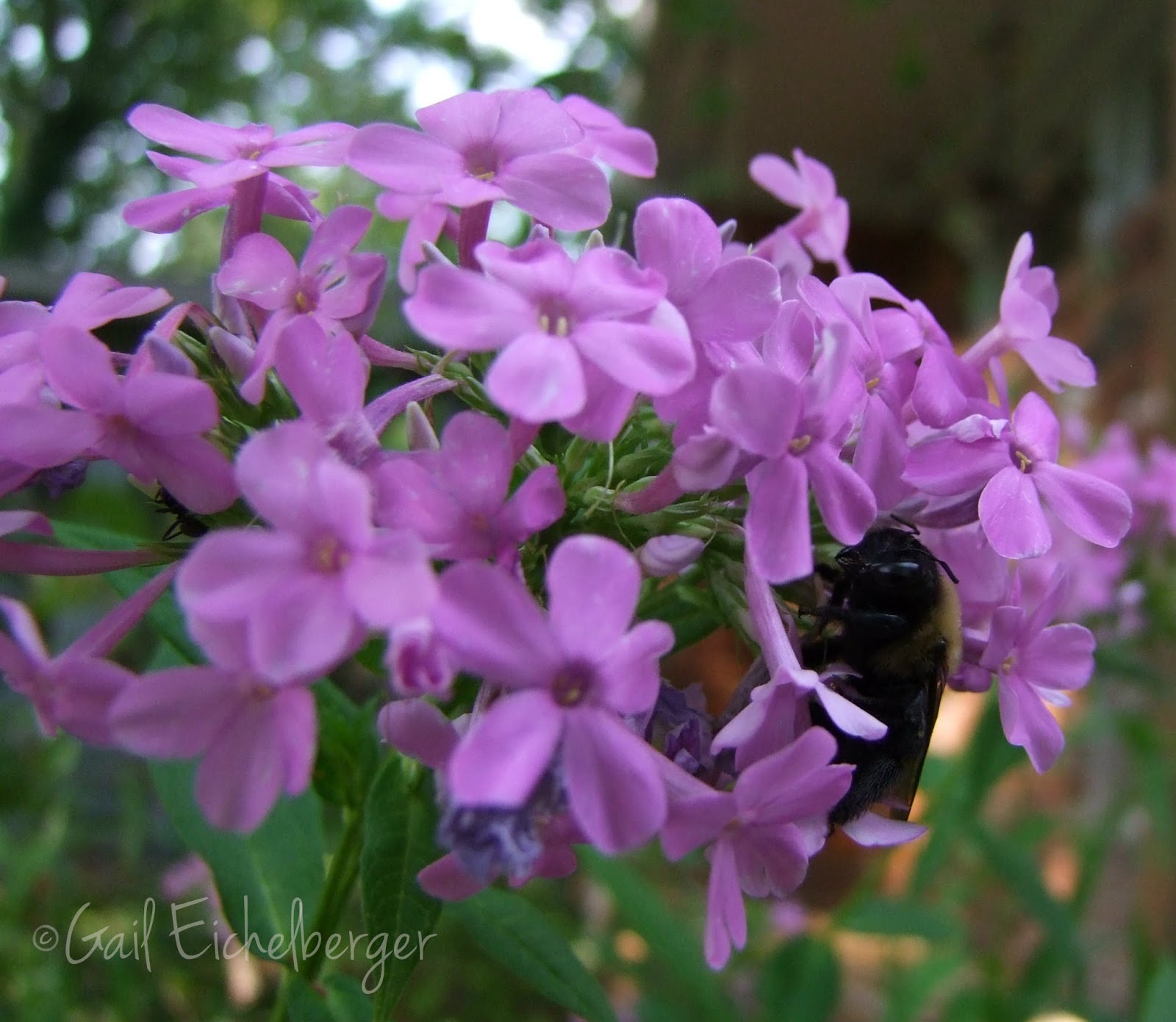
Nectar robbing Carpenter bee

That's good to know. Is there anything else you can tell me about phlox?

I don't think one can have too many Phlox

I'm glad you asked!

Phloxes are native to North America and found growing in diverse habitats from the coldest alpine tundras to prairies, woodlands and meadows. With over 65 different species in North America there are options for many habitats.

They're all beautiful and fragrant.

Phlox will grow in partial shade or full sun~
Phlox paniculata sps and cultivars love moist, rich, well draining soil and flower best in full sun. What they get here is shallow, summer dry, clay soil that's been amended with leaf mold and compost. I do give them a nice big drink if we don't get rain. If you can keep them relatively moist and provide decent drainage you'll have good success (hardiness zones 3 to 8) and keep the pollinators well supplied with nectar.
More robbing!
If you want to see what kind of offspring you can get from all the cross pollination that will be happening, then don't deadhead your plants, let them go to seed and self sow. The parent plants always bloom true, but seedlings will be a pleasant surprise of mixed colors for your garden.

P paniculata 'David' and unknown mother= A pleasant pinkish surprise.
Isn't this seedling adorable? I need to remember to thank the pollinators
xoxogail

7-25-2020 Spicebush swallowtail! So excited!


The particulars
Botanical name: Phlox paniculata
Common Name: garden phlox, summer phlox
Family: Polemoniaceae  
Type: Herbaceous perennial
Native Range: Eastern United States
Zone: 4 to 8
Height: 2.00 to 4.00 feet
Spread: 2.00 to 3.00 feet
Bloom Time: July to September
Bloom Description: Pink-purple to white
Sun: Full sun to part shade
Water: Medium
Maintenance: Medium
Flower: Showy, Fragrant Attracts: Birds, Hummingbirds, Butterflies
Tolerate: Deer, Clay Soil, Black Walnut

Phlox Wanda. (info/source)
Phlox hybrid ‘Wanda’
Type: Herbacious perennial
Family: Polemoniaceae 
Native range: same as Summer phlox
Zone: Hardy in zones 5-10
Size: 18" to 24″
Bloom: Spring through summer, deadhead for continued bloom
Bloom description: Bright pink flowers
Water: requires moist well-drained soil
Maintenance: deadhead
Sun: Full sun and semi shade 
Comments: Wanda is thought to be a hybrid, and some speculate that the genes of Phlox divaricata might be in there along with P. pilosa. The plentiful flowers are a strong fuchsia, perhaps magenta, and may vary a bit on whether you place her in full sun or partial shade.  (info/source)
Tolerant: Heat and humidity tolerant

Phlox paniculata 'Jeana' 
Type: Herbacious perennial
Family: Polemoniaceae 
Native range: same as Summer phlox
Zone: Hardy in zones 5-10
Size: 5′ tall beauty
Bloom description: impressive floral display and fragrant
Bloom: from mid-July through early September.
Maintenance: Water when droughty
Sun: Full sun
Comments: This cultivar was discovered growing along the Harpeth River near Nashville, Tennessee and named after its discoverer, Jeana Prewitt. ‘Jeana’ attracted more butterflies than any other garden phlox in the entire  Mt. Cuba trial. With a top rank in both horticultural and ecological evaluations, Phlox paniculata ‘Jeana’ is hard to beat. (source)

Disease/insects: PS The biggest problem I have had has been an attack of Phlox Bug~A nasty creature that sucks the plant juices and disfigures the plant. I cut the plant back after the first frost and trash the stalks....Never composting them. Phlox bug over winters in the stalks and this takes care of most of them. You can read about my battle with them here.

Posts about Phlox
Nectar Robbers are at it again
Early Summer Pollinator magnets
Summer Phlox


Welcome to Clay and Limestone's Wildflower Wednesday celebration. I am so glad you stopped by. WW is about sharing and celebrating wildflowers from all over this great big, beautiful world. Join us on the fourth Wednesday of each month. Remember, it doesn't matter if they are in bloom and, it doesn't matter if we all share the same plants. It's all about celebrating wildflowers. Please leave a comment when you add your url to Mr Linky.


Gail Eichelberger is a gardener and therapist in Middle Tennessee. She loves wildflowers and native plants and thoroughly enjoys writing about the ones she grows at Clay and Limestone. She reminds all that the words and images are the property of the author and cannot be used without written permission.

Wednesday, October 10, 2018

Wordless Wednesday: Last and First


The last of the summer Phlox and the first of the woodland ex-asters, both stalwart wildflowers at Clay and Limestone. I can't imagine gardening without either of them. This may be the only photo I have of an ex-aster without pollinators!

xoxogail

PS I think one of the ex-asters will be the October Wildflower Wednesday star (October 24, 2018).

Gail Eichelberger is a gardener and therapist in Middle Tennessee. She loves wildflowers and native plants and thoroughly enjoys writing about the ones she grows at Clay and Limestone. She reminds all that the words and images are the property of the author and cannot be used without written permission.

Monday, July 11, 2016

The nectar robbers are at it again.

Carpenter bees are notorious nectar robbers. That big body makes it hard to fit into many flowers and they will drill or cut into the corolla of a plant to get at the nectar. It looks like the stinkers are getting nectar without a pollen transfer which messes with the mutualism that one expects with pollination.

Today, as I watched a beautiful carpenter bee work its way around the flowers of  Phlox 'Jeane', I wondered if the nectar of that flower could be depleted and what effect that might have on pollination and other visitors?
I wondered what affect this would have on pollination

So I did a little research.

It was always assumed that nectar robbers had a negative impact on the plants that they visited, but that is not necessarily true. The authors of a paper published in the Ecological Society of America Oct 2000 examined the last 50+ years of research on this subject and concluded that nectar robbing could have a beneficial or neutral effect. Here's what they said, "The effects of nectar robbers are complex and depend, in part, on the identity of the robber, the identity of the legitimate pollinator, how much nectar the robbers remove, and the variety of floral resources available in the environment." If you want to read more follow my highlighted link above.
Carpenter bee zeroing in on the nectar machine P paniculata 'Jeana'

I have no idea what effect nectar robbing will actually have on P paniculata 'Jeana'. She is after all a nectar machine! Last summer she was covered with Swallowtail butterflies, skippers, hummingbird moths and bees for almost 6 weeks.

I am hoping that a little nectar robbing now doesn't rob me of the pleasure of watching all her pollinator visitors the rest of this summer!

xoxogail

Gail Eichelberger is a gardener and therapist in Middle Tennessee. She loves wildflowers and native plants and thoroughly enjoys writing about the ones she grows at Clay and Limestone. She reminds all that the words and images are the property of the author and cannot be used without written permission.

Wednesday, June 22, 2016

Wildflower Wednesday: Early Summer Pollinator Magnets

It's National Pollinator Week and Wildflower Wednesday. Could there be a better time than now to showcase my favorite wildflower pollinator magnets while discussing pollinator gardening?
Coreopsis attracts small and large bees
As a wildflower loving, native plant fan who gardens for wildlife, the plants in my garden need to be more than just pretty faces, they must be helpful for the critters that visit and live here. The Wildflower Wednesday stars of the month fit that description to a T~they have pretty faces and great wildlife value.
"Cedar Lane' Lonicera sempervivens is a hummingbird magnet
I am often asked to help friends plan their garden. The first thing I do when anyone asks me what they should plant in their garden is to share my gardening philosophy, then I say this: "It's your garden, you can plant what ever you want, but, please remember to plan for all the critters that live and visit your garden."
 Asclepias tuberosa is a magnet for bees and butterflies
I tell them that they will never be sorry! Pollinators will thank them by hanging around pollinating flowers and vegetables/fruits; beneficial insects will raise offspring that will gobble up harmful insects; and songbirds and spiders will keep the insects in check. The more you plan and plant for critters...crawling, flying and even digging ones, the healthier and more diverse your garden will be.

Eastern Bluebirds eat insects
 I tell them that it's important that anything they put as much work and effort into as they put into a garden should bring joy and that gardening for critters adds to that joy.
Hypericum frondosum attracts small and large bee.
We've been convinced by advertising that a garden should be perfect and that insects are harmful and must be eliminated or they will damage our flowering plants and make them ugly. I encourage anyone who asks for my help to reconsider beauty and to begin to appreciate the insect damaged plant as providing food for a critter that may in turn be food for a spider, another insect or a song bird.  See bluebird photo above.
Assassin bug waiting on a coreopsis
I encourage these gardeners to look at their plants very closely to find insects that might be living on them.  A friend told me she use to pull the caterpillars off her fennel before she knew they were Swallowtail butterfly cats. New gardeners need to make sure ugly bugs aren't beneficial insects before you pluck them off or squish them. Some of the "good bugs" include lacewings, lady beetles, minute pirate bug, soldier bugs, assassin bugs, braconid wasps, tachinid flies, flower flies and aphid mites.
 Insect  nibbled petals of Echinacea purpurea don't deter pollinators
I ask them to consider the bigger picture, that their garden might be an oasis of food and shelter in a sea of over fertilized and pesticide treated lawns.
Liatris spicata attracts small and large bees and butterflies
 I garden in a sea of lawns and know how important a wildlife friendly garden is to pollinators and other critters.
Monarda fistulosa is a magnet for bees, hummingbird moths and hummers
 My personal goal is to make a lovely garden that provides nectar and pollen for bees and butterflies from late winter until late fall. Clay and Limestone is a garden for all critters to find food and shelter and to raise their offspring. It's also a stopping off place for water and food (seeds and berries) to migrating birds. When I say all critters, that includes pesky rodents and mammals.

Phlox paniculata and nectar robbing Carpenter Bee

If you're a new gardener and want to create a pollinator friendly garden or want to add more pollinator friendly plants to your garden, I urge you to take time to figure out what plants make sense for your garden conditions. Invest in a good wildflower identification guide for your part of the country, join a native plant society and visit your local botanical garden and arboretum. If you are lucky enough to have garden centers that sell native plants shop there and not big box stores.
Echinacea tennesseensis is endemic to Central Basin cedar glades
It took me years to figure out that gardening would be a lot more fun and successful if I gardened with Middle Tennnessee/ Central Basin natives, after all they evolved with our wet winters and dry summers. Now they are my go to plants.
'Solar Eclipse' and 'Cherry Brandy' are two Rudbeckia hirta cultivars that attract pollinators to an early summer garden
Native annuals/short lived perennials like Rudbeckia hirta cultivars are wonderful additions to a pollinator garden. Lavender, sweet alyssum and herbs are also good additions to a pollinator friendly garden. Beneficial insects love many of them and we want beneficials in our gardens.
Hydrangea arborescens is a pollinator friendly native shrub
When you're creating your beautiful pollinator garden, be sure to include trees and shrubs, you might be surprised to learn that many of the woodies are far more important to insects than flowering plants.
Elymus hystrix is a host for the caterpillars of the Northern Pearly Eye butterfly and several moths
When you think about ornamental grasses, and I know you will, please consider planting one of our fine native grasses. Grasses like early blooming Bottle Brush grass fill the garden with movement and beauty all year long, while providing food and shelter for visiting mammals, birds and insects.
 Stokesia laevis is a major butterfly, Bumblebee, hoverfly and beetle attractor
 Fill your garden with native plants that are pollinator magnets! You'll never be sorry.
Pycnanthemum muticum attracts bees, wasps, flies, small butterflies, and beetles

Here's the nitty gritty for creating a pollinator friendly garden.
  • plant a lot of nectar and pollen producing plants, lots and lots; swathes work, so does repetition (Central Basin natives make sense in a Middle Tennessee garden)
  • don't forget trees, shrubs and grasses in your garden plan
  • plant host plants~so the offspring of butterfly, beetles and other pollinators can feed
  • plan for bloom from late spring to early winter
  • include water for bees
  • provide nesting sites near your garden for a variety of visitors: Build a pollinator condo, leave some bare ground for earth nesting bees and pile decaying logs for beetles who like to tunnel.
  • practice peaceful coexistence. Bees sometimes choose to nest in inconvenient places. Rather than exterminating them, think of it as an opportunity to watch and learn about them up close.
  • take the pledge to never, ever, ever use pesticides in your gardenI really do mean never!  
Phlox 'Wanda'
If this post helps you have as much fun as I have gardening for pollinators and other wildlife then I will consider myself successful.

Happy Wildflower Wednesday.
xoxogail

Welcome to Clay and Limestone's Wildflower Wednesday celebration. I am so glad you stopped by. WW is about sharing and celebrating wildflowers from all over this great big, beautiful world. Join us on the fourth Wednesday of each month. Remember, it doesn't matter if they are in bloom or not; and, it doesn't matter if we all share the same plants. It's all about celebrating wildflowers. Please leave a comment when you add your url to Mr Linky.

Gail Eichelberger is a gardener and therapist in Middle Tennessee. She loves wildflowers and native plants and thoroughly enjoys writing about the ones she grows at Clay and Limestone. She reminds all that the words and images are the property of the author and cannot be used without written permission.

Monday, August 24, 2015

Is it a hummingbird? Is it a bee? No, it's a moth!


The first time I saw a Snowberry Clearwing Moth in the garden I wasn't entirely sure what it was. It had several hummingbird characteristics, it was fast moving (they can reach speeds of 35 mph), it had fast beating wings that hummed, and, it hovered over blossoms while it sipped nectar, but, its coloring, antennae, six legs and long, butterfly-like proboscis clearly said "this is an insect in the butterfly/moth family"! It didn't take long to identify it as Hemaris diffinis, a day-flying moth in the sphinx family.
These moths hover and stabilize their flight by resting their front legs on the flower blossom
The Snowberry Clearwing Moth is a mid to late summer visitor to my garden. They're really quite interesting looking moths and have the same yellow and black coloration as bumblebees. They have large eyes and a long tongue/proboscis perfectly adapted for reaching deep down in tubular flowers like summer phloxes, verbena and monarda for hidden nectar. They're good pollinators and like bees, pollen sticks to their hairy bodies and is transferred to other flowers as they move about the plant community.

Now, that I've just typed that paragraph, I'm not sure why I thought it was a hummer when it clearly resembles a bumblebee! Hemaris diffinis's bee mimicry worked on me and it probably does a pretty good job insuring it isn't an easy meal for a fast moving bird! Oh isn't nature amazing and oh so clever!

while the photo isn't the best, you can see the clear wings!
Now that summer is sort of winding down here in the Mid-South, I've been checking the Arrowwood viburnums, Southern bush honeysuckles and the Loniceras (host plants) for any of its emerald green eggs. So far I haven't found any, but,  I'll continue to keep a look out for them and any green hornworms as they search for the right spot in the leaf litter to pupate and wait the winter out. Maybe, I'll get lucky and see the moth emerge in the Spring!
bumble bee mimicry reduces predation
Until then, I'll enjoy them on warm summer days as they hover and dart about the garden.

xoxogail

Some Snowberry Clearwing Moth particulars:

Caterpillar Hosts: Snowberry/Symphoricarpos, honeysuckle/Lonicera, dogbane/Apocynum, Viburnum, hawthorn, cherry, plum and dwarf bush honeysuckle/Diervilla lonicera

Adult Food: Nectar from flowers including phlox, monarda, coreopsis, lantana, dwarf bush honeysuckle, snowberry, orange hawkweed, thistles, lilac, and Canada violet...Any good nectar source.
Habitat: A wide variety of open habitats, streamsides, fields, gardens, and suburbs....with plenty of leaf litter to hide in all winter!

Distribution map of Hemaris diffinis source


Gail Eichelberger is a gardener and therapist in Middle Tennessee. She loves wildflowers and native plants and thoroughly enjoys writing about the ones she grows at Clay and Limestone. She reminds all that the words and images are the property of the author and cannot be used without written permission.

Wednesday, July 22, 2015

Wildflower Wednesday: Summer Phlox

I count on the different species of Phlox for several seasons of delightful color starting in early spring.
Right now Summer Phlox is blooming in various shades of pink and magenta.
There are even a few of the white flowered 'David',
a lovely striped 'Peppermint Twist' that wants to revert to a favorite parent color, and
a newer cultivar, 'Jeana' that is an absolute delight. I am not alone in thinking she's a marvelous addition to the garden, every Swallowtail in the neighborhood has stopped by for nectar.
The first Phloxes in this garden were here when I arrived. They were the offspring of whatever the previous gardeners might have planted 30+ years ago and were all wonderful magenta flowered beauties. They are still here, well, the offspring of the offspring are still here and after years of letting species and cultivars go to seed, real treasures have been produced in the crossings of the crossings.
a crossing produced this gentle pink
 What do you think of these two very different pinks? (photos above and below) I adore them and, in case you wondered when I would get around to pollinators, they love them, too.
This is a luscious color
Speaking of pollinators. Carpenter bees are frequent phlox visitors, but, their big bodies makes it hard to fit into the flowers so they will drill or cut into the corolla of the phlox to get at the nectar.
look out for the nectar robbers
They are cheating the pollination process when they get the nectar without a pollen transfer! They're robbing the nectar, but there's still plenty for other pollinator visitors.
Butterflies, moths (including Hummingbird and Sphinx moths) and skippers are the primary pollinators of phlox. Their proboscis are long enough to reach the nectar at the base of the narrow phlox corolla and pollen is carried to the next flower.  

Phlox has all the characteristics of a classic butterfly nectar flower.
  • clustered flowers with a landing platform
  • brightly colored
  • open during the day
  • ample nectar producer 
  • nectar deeply hidden in corolla


If you want to attract butterflies, moths, skippers and other pollinators to your garden then plant more phlox! That's what I've been doing. Phlox paniculata 'Jeana' was planted this spring and I have every intention of planting more of that cultivar. She rocks as a butterfly magnet. You can find species Phlox paniculata at many native plant nurseries including GroWild here in Middle Tennessee or from mail order nurseries like Prairie Moon.
Hummingbird clearwing moth

 If you want to see what kind of offspring you can get from all the cross pollination that will be happening, then don't deadhead your plants, let them go to seed and self sow. The parent plants always bloom true, but seedlings will be a pleasant surprise of mixed colors for your garden.
Have fun out there and keep cool!
Happy Wildflower Wednesday
xoxogail

The particulars
Type:  Herbaceous
Sun Exposure:  Full Sun to partial Shade
Bloom Color: Jewel box of colors
Bloom Time:  Mid Summer to late Summer/Early Fall
Hardiness: From Minneapolis to the Gulf Coast. They've escaped from gardens and naturalized
Wildlife Value: This plant is attractive to bees, butterflies, moths and skippers
Flowers: Fragrant
Water Needs: Water regularly, good drainage
Soil: Rich, moist, well draining. Enrich clay soil with humus and compost.
Care: Divide occasionally. Phlox are susceptible to mildew and phlox bugs make sure they have good air movement and each fall, after the first killing frost cut it to the ground and trash the cuttings, this will keep the mold spores in check since they can over winter in the stalks as well as  eliminating any phlox bugs that might be over wintering in the stalks. 

Welcome to Clay and Limestone and Wildflower Wednesday.  This day is about sharing wildflowers and other native plants no matter where one gardens~the UK, tropical Florida, Europe, Australia, Africa, South America, India or the coldest reaches of Canada. It doesn't matter if we sometimes share the same plants. How they grow and thrive in your garden is what matters most.


Gail Eichelberger is a gardener and therapist in Middle Tennessee. She loves wildflowers and native plants and thoroughly enjoys writing about the ones she grows at Clay and Limestone. She reminds all that the words and images are the property of the author and cannot be used without written permission.