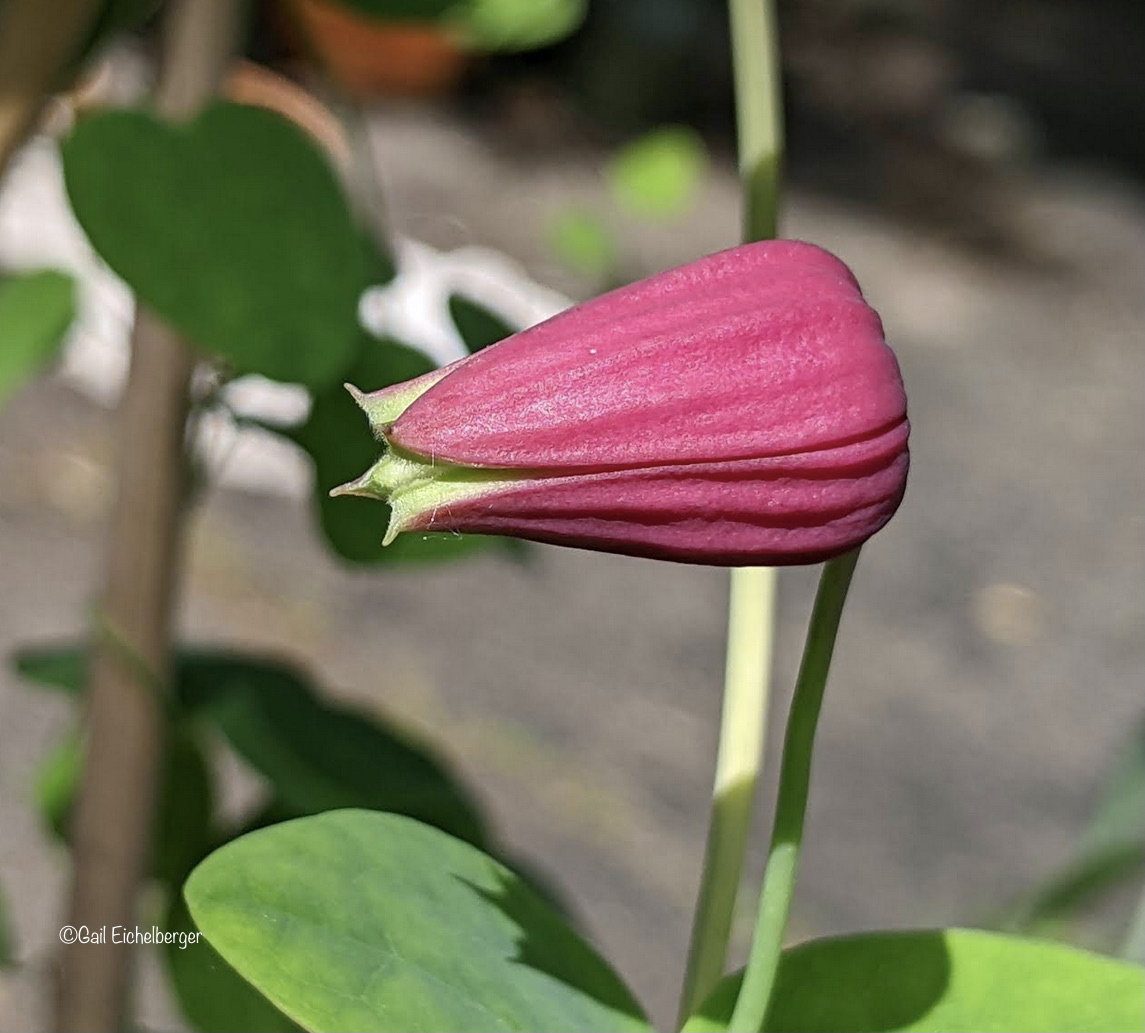
I love Clematis and when I discovered that there were native Clemmies I had to have one or two or more. So far I've planted three in my garden: Clematis virginiana, C pitcheri and C viorna. I wasn't surprised to find out that like other Clematis they can be placed in groups that determine how and when to prune. Clematis viorna is our star and it fits in group 3, which means it blooms on new growth and you need to give it a hard pruning in late winter. Be sure you've harvested seeds or enjoyed their frothy fall look before pruning.
But, I digress, let's start with getting you acquainted with this delightful herbacious vine native to rich wooded banks and thickets throughout the north, central and eastern United States.

Clematis viorna has many common names, but the one I am most familiar with is Leatherleaf. It's a delicate looking vine given to irregular branching that will scramble across the woodland floor looking for someplace to climb. Expect it to reach ten to twelve feet in your garden when given a sturdy structure. "The scattered 1 inch flowers are mostly solitary at a branch tip or a leaf axil. Each is purple-rose in color, the usually 4 sepals (no petals) being very thick and fleshy (leathery) with the shape of the flower being a "closed-looking" vase or urn with slightly turned up sepal tips, usually facing downward." The tips are creamy white. (source)
 |
| Photo by Fritz Flohr Reynolds |
One of the many characteristics that I love about Leatherleaf is its long bloom time. The first bloom at Clay and Limestone was May 26 and it still has buds today. That's three months of charming flowers, cool buds and delicate twining stems.
 |
| last week in July 2022 |
It climbs by twining petioles/leaf stalks, so give it a structure or even a shrub to climb on that will accommodate its mature growth. The
flowers attract hummingbirds, bees and butterflies and then
mature to become beautiful, dramatic seed heads for birds to enjoy. The
achenes with their feathery tails extend the attractiveness of the vine
into the fall, so hard prune it once the seeds have been collected, eaten or
wind dispersed. (source)
 |
| Seeds starting to feather fluff up which helps the wind disperse them |
It's happily growing in a large container in morning sun where I can see it every day and keep it well watered. It likes moist, rich soil that is well-drained. Clematis viorna is a classic woodland plant and would have gotten lost in my habitat of rough and tumble wildflowers which I manage by letting them go to battle for garden dominance. Also, it needs to be watered regularly in what has turned out to be a brutal summer of drought and heat.

I plan to collect and sow seeds, eventually planting them among the smooth Hydrangeas and Hamamelis vernalis. I think it will look smashing scrambling along the ground and eventually climbing into the shrub's branches. Planted in that bed assures that this delicate Clemmie will get the filtered sunlight and moist soil that makes it happy.
I sure hope you give this sweet Clematis a try. It's worth the hassle of trying to locate one online! Nashvillians try GroWild. While you are looking try a few other native Clemmies. Thanks for stopping by.
xoxogail
The Particulars


Don't forget our Wildflower Wednesday monthly challenge! The first part of this challenge is to do something every month during 2022 that supports native wildflowers, pollinators, and the critters that visit and rely on our gardens. The second part of the challenge is to post about it somewhere: Your blog, Instagram, Facebook, Twitter or even your neighborhood listserve.
Why post it? Because positive publicity is needed to educate our friends, neighbors and communities about how important even the smallest changes we make as gardeners can be for pollinators, birds, insects and mammals that live all around us.
An incomplete list of things you might consider doing or changing in your garden
Shrink your lawn and make your planting beds larger.
Plant your favorite native perennials and shrubs. Leave them standing after they've gone to seed to continue to provide for wildlife. What you plant in your yard makes a difference to wildlife. I garden for wildlife so every tree, shrub and plant is chosen with wildlife in mind.
Plant more natives and then consider planting even more. "A typical suburban landscape contains only 20-30% native plant species. Try reversing that trend in your own landscape by using 70-80% native species." (source)
Commit to never, ever, ever, ever using pesticides in the garden.
Stay away from native plant hybrids and cultivars that are double flowered. They are sterile and have no pollen or nectar for insects and no seeds for the birds. If possible plant “true open-pollinated native wildflowers”
If you want to garden for wildlife and pollinators, don't let lack of
space stop you! Plant your favorite wildflowers in large containers.
You just might have the prairie or woodland garden you've always wanted...in a pot!
Create a water feature. Provide water year round that is accessible to birds, bees and other critters.
Show some soil! Our native ground nesting bees nest in bare soil, so don't mulch every square inch of your garden.
Invite bugs into your garden. Plant annuals that attract beneficial bugs.
Learn to tolerate damaged plants. Imperfection is the new perfect.
Leave a layer of leaves as a soft landing material under trees for moths and butterflies to over winter. Many caterpillars drop to the ground from the trees in the fall.
Make a brush pile. Stack fallen brush, cut tree limbs, broken pots for ground beetles. Ground beetles are excellent at eating "bad bugs'. They're also good bird, toad and small critter food.
Rethink what you consider a pest. Lots of good bugs eat aphids. Spiders are important predators and bird food!
Add nesting boxes for birds.
Plant shrubs and small trees that provide berries and nuts.
Keep a nature journal: Observe visitors to the water feature, make note of when they visit. Notice which flowers attract the most pollinators and which ones are just pretty faces.
Volunteer to remove invasives in a local part or natural area.
Join your state native plant society.
Join WildOnes even if there's no local group.
Take an online course on tree, fungi and wildflower id.
Take a walk in your neighborhood and observe nature. To quote Joanna Brichetto in Sidewalk Nature "Look Around. Nature is here, is us, our driveways, our baseboards, parks, and parking lots."
Buy the best wildflower, butterfly and bird id books for your state.
Read nature books to your children and grandchildren.
Read! There are hundreds of books on gardening for wildlife, the environment, and rewilding our world. There are delightful blogs with wonderful and informative articles.
Turn off your porch lights, eave lights and uplights to help mammals, birds, critters that live in the dark survive.

Gail Eichelberger is a gardener and therapist in Middle Tennessee. She loves wildflowers and native plants and thoroughly enjoys writing about the ones she grows at Clay and Limestone. She reminds all that the words and images are the property of the author and cannot be used without written permission.


