Home of the Practically Perfect Pink Phlox and other native plants for pollinators
Showing posts with label small gardens. Show all posts

Wednesday, July 23, 2014

Wildflower Wednesday: In Praise of a Rather Tall Wildflower!

Silphium perfoliatum is one tall wildflower!

Some would say that this beauty is a beast of a plant and I might have agreed several years ago when it stood 9 feet tall and 3 foot wide in my little sunny Susan's Bed! I've since learned to cut it back at the same time I clip the ex-asters. I suggest you do the same, because banning this beauty from your garden because it's tall and colonizing would be a shame.

You just can't beat the composite flowers when it comes to wildlife value, but, there's something especially wonderful about Cup Plant. Once the flowers open the pollinators descend upon the garden and they stay until the last petal falls from the plant and then the birds eat the seeds. But, even before it blooms, the wasps, Bumble bees, flies and small birds stop by to drink the rain and dew that has collected in the fused leaves that form a cup around the plants square stems. It's a very cool plant.

Cup Plant is a native of tall grass prairies where it grows in moderately rich, moist well drained neutral to alkaline soil. Expect it to make itself at home in your garden by setting down a central taproot and shallow rooted rhizomes. First year seedlings are easily transplantable from where you don't want them to where you do. It can and will spread vegetatively (and by seed) to form a large and tall colony that makes a striking statement in the back of a garden. Plant it with other prairie forbs and grasses to create a pocket prairie. 
Big plant,
good looking flowers,
spreads assertively,
a rough and tumble wildflower,
tons of happy pollinators,
great wildlife value...
A tattered beauty in the garden July 22, 2014
Only you can decide if this beauty is a beast!

xoxogail

Some particulars you might want to know about Cup Plant!
Asteraceae family
Perennial
Growth: Can grow to as much as 9 ft. tall by 3 ft. wide...I am not kidding!
Bloom Color: Yellow
Bloom Time: Jul, Aug, Sep
Distribution USA: AL , AR , CT , GA , IA , IL , IN , KS , KY , LA , MA , MD , ME , MI , MN , MO , MS , NC , ND , NE , NJ , NY , OH , OK , PA , SD , TN , VA , VT , WI , WV Canada: ON Native Distribution: S. Ont. to NC, w. to e. Great Plains
Native Habitat: Moist woods; prairies; low ground
Growing Conditions: Wet to mesic soils. Will tolerate clay soil. It grows in my garden, it will grow in yours!
Comments: Unstoppable urge to reproduce, they will pop up everywhere; very little care needed. (source)

Thank you for stopping by and welcome to Clay and Limestone's Wildflower Wednesday celebration. WW is about sharing and celebrating wildflowers from all over this great big, beautiful world. Join us on the fourth Wednesday of each month. Remember, it doesn't matter if they are in bloom or not; and, it doesn't matter if we all share the same plants. It's all about celebrating wildflowers. Please leave a comment when you add your url to Mr Linky. 


Gail Eichelberger is a gardener and therapist in Middle Tennessee. She loves wildflowers and native plants and thoroughly enjoys writing about the ones she grows at Clay and Limestone. She reminds all that the words and images are the property of the author and cannot be used without written permission.

Tuesday, April 22, 2014

Wildflower Wednesday: The Happy Flower Trinity

If you're a cook, you know that creating a delicious stock, soup, or stew often starts with basic ingredients and builds from there. The French have their mirepoix of onions, carrots and celery; the Italians have their tomato, garlic and basil; and Cajun cooking has its holy trinity of onions, peppers and celery.  Each of these  flavor bases makes the food tasty and delicious and unique to that region.
Clay and Limestone has its own trio of flowering beauties~Golden Ragwort, Columbine and Downy Phlox ~ that make the garden a colorful and tasty treat each spring.
Clay and Limestone is a small side dish of this delicious mixture (photo 2011)
All three are native to the Nashville Basin. The Basin is an elongated mixing bowl of land where Mother Nature has tossed cedar glade and Tennessee native plants into a unique and delicious mixture. Our tasty dish is never the same year to year, like local cooking, the proportions all depend upon the weather and what nature makes available!
 The Happy Trinity have been liberally sprinkled about the garden
Let's take a look at these special plants that combine wonderfully to make this garden's flavor base for Wildflower Wednesday.
notice a few aphids~I leave them for the beneficial insects to gobble up
Golden Ragwort or Packera aurea is a bright daisy with evergreen basil foliage. It makes a wonderful groundcover if the conditions are right~even moisture year round. Strangely enough, that may be why many people don't add it to their gardens~fear of a plant making too big a statement. I like big statement plants, after all, this is the home of rough and tumble wildflowers!

I think it's absolutely beautiful. The small daisy like golden flowers on tall stems are chock full of pollen and nectar for small bees, flies and butterflies. Occasionally, aphids show up on a few plants, but, I leave them for the ladybugs. There are no cultivars of this beauty, the straight species is perfect!

Family: Asteraceae
Native Range: Eastern North America to Texas
Zone: 3 to 8
Height: 0.50 to 2.50 feet Spread: 0.50 to 1.50 feet
Bloom Time: April Bloom
Sun: Full sun to part shade
Water: Medium to wet
Pollinators: Small bees and butterflies
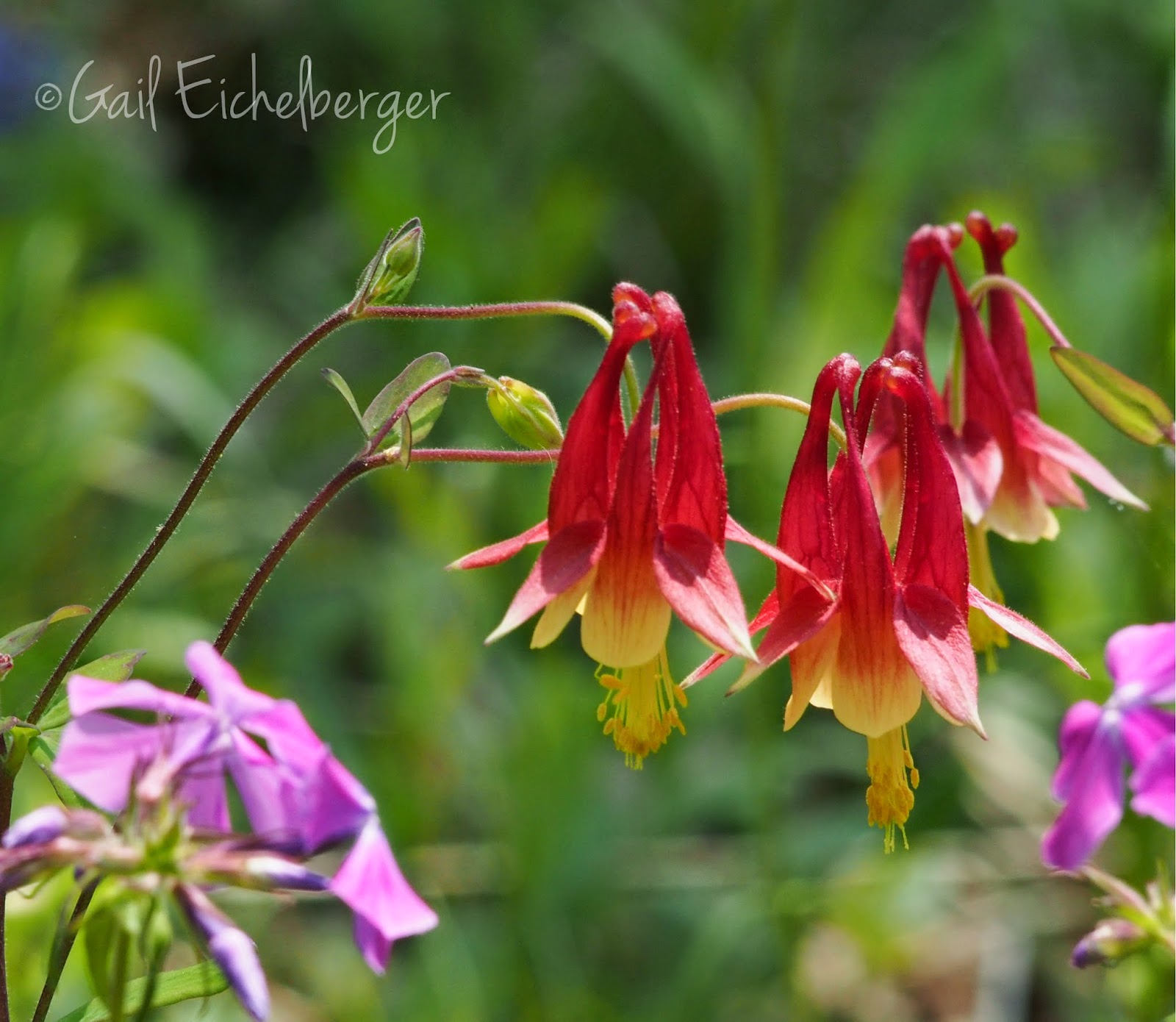
How does one describe Aqiulegia canadensis! I think of it as bright lanterns that sway in the slightest breeze sending a signal to pollinators that there's nectar in those spurs!  Here's a good reason to plant more Columbine! "Ornithologists have discovered that the ruby-throated hummingbirds tend to follow the blossoming of Aquilegia canadensis on its journey north in spring, since the flowers are the first to provide nectar for the birds." (source)

Columbine thrives in part to full shade, in any well-drained soil. I find it happiest in cracks and crevices, really, it grows anywhere a seed falls and the drainage is good! Plants tolerate full sun if temperatures are cool, but they grow better in my garden in partial shade. Red columbine is found in rocky woods from Nova Scotia to the Northwest Territories south to Florida and Texas.
growing between the flagstone in the Garden of Benign Neglect
Family: Ranunculaceae
Native Range: Eastern North America
Zone: 3 to 8
Bloom Time: April to May (even earlier after a gentle Middle South winter)
Sun: Full sun to part shade
Water: Medium
Pollinators: Hummingbirds, bees, butterflies, and hawk moths feed on columbine necta

...and finally
Practically Perfect Pink Phlox Pilosa

Long time readers already know about her charms...PPPP has an exceptionally long bloom time (six weeks or longer), fantastic pink flowers, grows in sun and part sun, tolerates clay soil that's wet all winter and dry all summer, has a marvelous ground covering effect, and has the sweetest fragrance that wafts all over the garden on warm days. You'll have to agree, a plant like that is practically perfect!
P pilosa is a stoloniferous, semi-evergreen native wildflower found naturally growing in open woodlands, meadows, prairie remnants and limestone glades through out the central and eastern US and Canada. Although, I've never heard anyone call PPPP a thug, some gardeners may not appreciate how quickly it can spread in rich soil. Colonizing is a plus for me and unlike some colonizing plants, it's easy to lift and transplant. I am especially pleased at how well it's growing in the shallow soil over the bedrock in the Susan's Bed....That says a lot about a plant.

PPPP with River Oats
Family: Polemoniaceae
Native Range: Eastern and central United States (also Canada)
Zone: 4 to 9
Bloom Time: April to June (in my garden)
Sun: Full sun
Water: Medium
Pollinators:  Hummingbirds, Butterflies, Bees, Flies

So what do you think? Is this trio a tasty and delicious treat?
xoxogail

Welcome to Wildflower Wednesday! It's time to share your wildflowers no matter where you garden~the UK, tropical Florida, Europe, Australia, Africa, South America, India or the coldest reaches of Canada. It doesn't matter if we sometimes show the same plants, how they grow and thrive in your garden is what matters most. I hope you join the celebration..It's always the fourth Wednesday of the month!


Gail Eichelberger is a gardener and therapist in Middle Tennessee. She loves wildflowers and native plants and thoroughly enjoys writing about the ones she grows at Clay and Limestone. She reminds all that the words and images are the property of the author and cannot be used without written permission.

Thursday, March 6, 2014

A Practically Perfect Panicum

Those of us who have been gardening with Panicums probably aren't at all surprised that Panicum virgatum 'Northwind' has become so popular. It's an outstanding native grass with a graceful upright form, year round beauty, deer resistance, cold and heat hardiness, good wildlife value, drought tolerance and soil adaptability. It's been named the 2014 Perennial Plant of the Year™by the Perennial Plant Association* and that's pretty cool!
While P virgatum 'Northwind' is relatively new to the garden scene (1992), Panicum virgatum has a long history on this continent. It's native to the tall grass prairies of the Great Plains from the Rocky Mountains to the Atlantic Ocean and along with big bluestem, little bluestem and Indian grass. It was grazed by herds of bison, deer and elk and can still be found growing in ‘remnant prairies’ and along interstates throughout much of North America.
summer bloom
It's rather ironic that it took European plant breeders to open our eyes to the versatility and beauty of Panicum virgatum. They've brought us lovely cultivars and spurred American breeders to get on the native grass bandwagon, but, that's not the case with 'Northwind'.  Roy Diblik, of Northwind Farms selected it from a population of Panicum virgatum he raised using wild-collected seed. It had wider leaves and a very upright growth habit unlike other panicums that tended to arch. I am very appreciative of his efforts, 'Northwind' is a stellar cultivar!

I love the panicums and have many in my garden. ‘Northwind’ is without a doubt the most upright of all the cultivars that have been introduced in the last dozen years. That's probably been it's best selling feature, a tall grass that fits beautifully into small or larger gardens. What makes this grass especially attractive to me is its color change from summer through late winter.
In my garden it begins to golden up in September just in time to compliment the purple ex-asters, the reds of Iteas and Aronias.
glowing in the afternoon sun
The fall color is especially gorgeous in the late afternoon when it's backlit by the setting sun.
It's a tawny gold for several months, but, by the end of the winter it's a striking pale blonde that looks incredible in my almost brown landscape! It's also the best time to cut it back!
Late winter is the ideal time to cut your ornamental grasses, just before the new shoots emerge and you risk clipping them off with your shears. Please don't be like many of my Nashville neighbors who allow the mow and blow crews to scalp these beautiful plants to a stub in mid fall!

Think of all the marvelous color changes you would miss and besides the critters need the shelter those golden/tawny/blonde blades offer them all winter.


Thank goodness it won't be long before they start greening up! I miss them terribly when I have to cut them back, but, before long the beautiful olive-blue green leaves will be back helping showcase Itea, the ex-asters, Vernonia, Juniperus, Rudbeckia, Phlox, River oats, Hypericums and the other rough and tumble wildflowers that make their home here at Clay and Limestone.

xoxogail

*  (here for more info)

Gail Eichelberger is a gardener and therapist in Middle Tennessee. She loves wildflowers and native plants and thoroughly enjoys writing about the ones she grows at Clay and Limestone. She reminds all that the words and images are the property of the author and cannot be used without written permission.

Wednesday, January 22, 2014

Wildflower Wednesday: Seersucker Sedge

A cold winter has taken its toll on the Seersucker sedges, many of the leaves are brown and it appears more semi-evergreen than evergreen. But, it would take more than a few brown leaves to detract from the over all effect of the rippled and dimpled leaves or the bright spot of color this sedge brings to a landscape.
Also known as Plantained-leaved Sedge
Carex plantaginea has been in my garden for almost a decade, but it wasn't until I saw how beautifully they looked massed along a path (above and below) in Peter and Jasmine Gentling's garden during Asheville Spring Fling that I decided to plant them along the path to the front porch. It's planted with Christmas fern and Camassia bulbs and I think it will make a good show each spring. I don't know about you, but, I am always looking for plants that pop in my woodland shade garden and this sedge does. It looks good year round.
Seersucker Sedge massed in Peter and Jasmin Gentling's garden
Sedges, especially native sedges, have been lumped into the weed category for years! Granted, some are rather weedy and I have a few of those in the wetter parts of my garden, but, I appreciate that they bring more diversity to Clay and Limestone. Native sedges are part of my woodland eco-system, they were here before I started gardening and their seeds and flowers continue to provide food for butterflies, birds, and mammals. 
male and female flowers on a sedge in my garden
Fortunately for us, Seersucker Sedge has been discovered! It's now available at several online nurseries, but  you'll not likely to find it or many other native sedges at your local independent garden center. Once again our natives are overlooked for the showier exotic from the other side of the world. Yes, I will agree, those exotics are lovely variegated beauties, but, I want more than beauty from plants that I add to my garden. I expect plants to feed the critters while they feed my soul. (Gardening For Wildlife)
Male and female flowers on Seersucker Sedge
Sedges are almost always associated with wet, boggy/marshy places, but some do grow in dry, poor soil. Seersucker sedge is not one of those! It's a Goldilocks of a plant and prefers a rich woodland soil that's not too wet or not too dry. Finding the right spot for them in a garden that is often too wet or too dry wasn't nearly the challenge I thought it would be! The soil along the path has been enriched with leaf mold for years and is the perfect medium. The ferns and other natives that are planted with it should make that part of the garden glow this spring. (Not The Climate For Xeric)
I'll clip off the old leaves
It's easy to see why Carex plantaginea is called Seersucker Sedge with those wide, rippled and dimpled, deep-green leaves, it looks just like seersucker material, only green! The first time I saw them at GroWild  I knew it was a keeper! If you're looking to jazz up your shade garden you can't beat the texture that Seersucker Sedge adds to a garden. Just give it good soil, some shade, plant it with ferns, ephemerals, Oakleaf hydrangeas or at the base of a Hamamelis vernalis. You won't be disappointed, I guarantee it.

xoxogail

The particulars:
source

Seersucker Sedge is found growing in meadows and rich woods in the Eastern USA from Minnesota to Maine and south to Alabama and Georgia (Zones 4-8). An evergreen plant with showy foliage, it makes a great texture plant for moist shady places. It will slowly spread to make a nice ground cover; you can speed that process along by dividing your plants every couple of years. Although, the purplish/black flowers aren't  showy, they are interesting when back lit by the setting sun. A very low maintenance plant requires only the removal of the dead leaves in late winter.
Photo by Jacqueline Donnelly (her blog)

Thank you for stopping by and welcome to Clay and Limestone's Wildflower Wednesday celebration. WW is about sharing and celebrating wildflowers from all over this great big, beautiful world. Join us on the fourth Wednesday of each month. Remember, it doesn't matter if they are in bloom or not; and, it doesn't matter if we all share the same plants. It's all about celebrating wildflowers. Please leave a comment when you add your url to Mr Linky.


Gail Eichelberger is a gardener and therapist in Middle Tennessee. She loves wildflowers and native plants and thoroughly enjoys writing about the ones she grows at Clay and Limestone. She reminds all that the words and images are the property of the author and cannot be used without written permission.

Friday, September 6, 2013

'Morning Grace'

Isn't she lovely!
Tradescantia rosea 'Morning Grace' is a pretty little spiderwort that I happened upon when I visited my son  this past summer. We decided to visit the The Van Landingham Glen on the UNC Charlotte campus. The  7-acre Glen is a woodland garden showcasing Carolina native plants and, it's also known for having one of the most diverse rhododendron gardens in the Southeast.

It was early in June and we had missed the big rhodo flowering show, but, there were still lots to see along the winding woodland trails...lilies, ferns and later blooming wildflowers were planted among the azaleas and rhododendrons. That's when I saw what looked like the smallest spiderwort ever. Had the azaleas been in bloom I might have completely overlooked it, as it was, I had to drop to my knees to get a closer look at the tiny lavender-pink blooms with the golden stamens. It was lovely and it was certainly a member of the Tradescantia family, but which one?
 
I didn't have to go far to discover the identity of the sweet Tradescantia. Luckily for me 'Morning Grace' was among the small grouping of Carolina native plants the arboretum was selling. Although, native to coastal states* in the Southeast, I decided to give the diminutive spiderwort a chance and, boy, am I glad.  This little cutie pie has bloomed continually since early June, bonus points for having a steady stream of small pollinator visitors and being rabbit and deer resistant! It's a keeper!

 I hope it stays happy in my garden for a long, long time...

xoxogail

*Southern Appalachian region (USDA hardiness zones 6 to 9) On the whole, Spiderwort prefers a moist, rich, acidic soils in part shade, not in full sun or deep shade.

 Gail Eichelberger is a gardener and therapist in Middle Tennessee. She loves wildflowers and native plants and thoroughly enjoys writing about the ones she grows at Clay and Limestone. She reminds all that the words and images are the property of the author and cannot be used without written permission.

Friday, May 31, 2013

Spotlight on Spigelia

Spigelia marilandica is another one of those wonderful native plants* that you won't find in your local big box store or even in most independent garden centers. Which is a gosh darn shame, it's a fantastic plant that would be an asset in most gardens.
Glossy green, ovate to lance-shaped leaves (to 4" long)
Indian Pink, as it is commonly known, is a clump-forming (boy oh boy, do I wish it colonized) perennial which naturally occurs in moist woods and along stream banks. The attractive upward facing trumpet shaped red flowers, flare at the top to form a five pointed yellow star. The colorful and unusual flowers are an outstanding source of nectar for hummingbirds and would be a marvelous addition to your pollinator friendly garden.  Of course, they are also perfect for your colorful cottage garden, your shady woodland garden or a moist sunny spot in your perennial garden. Once established they can take a less than moist summer garden soil, after all, they do grow well at Clay and Limestone.
When seen from above the flowers look like stars
No, you won't find this uncommon beauty in just any place. You'll have to seek it out from a native plant specialist, but, it's worth the effort to get this hummingbird magnet into your garden. The red and yellow flowers grab attention in a shady garden and when massed in the right spot they can knock your socks off.
Massed in front of the pond in Robyn Brown's garden
 Go on, pull those socks back on and start looking for these beauties for your garden!
Spigelia is pollinated by hummingbirds!
In case you need convincing: Indian Pink is listed as one of the Top Ten plants for attracting hummingbirds. I can't grow everything on the list, but, I sure can get more Spigelia malilandica and maybe a few more on that hummer list!

xoxogail

"Top Ten" Native Hummingbird Plants
 
#1: Trumpet Creeper, Campsis radicans
#2: Beebalm or Oswego Tea, Monarda didyma
#3: Trumpet Honeysuckle, Lonicera sempervirens
#4: Cardinal Flower, Lobelia cardinalis
#5: Spotted Jewelweed, Impatiens capensis
#6: Red Columbine, Aquilegia canadense
#7: Canada Lily, Lilium canadense
#8: Indian Pink, Spigelia marilandica
#9: Red Buckeye, Aesculus pavia
#10: Mountain Rosebay or Catawba Rhododendron, Rhododendron catawbiense


*Habitat: Found in rich woods from New Jersey to Florida and west to Texas and Wisconsin, primarily in the Southern States.

Gail Eichelberger is a gardener and therapist in Middle Tennessee. She loves wildflowers and native plants and thoroughly enjoys writing about the ones she grows at Clay and Limestone. She reminds all that the words and images are the property of the author and cannot be used without written permission.

Wednesday, February 27, 2013

Wildflower Wednesday: Harbinger-of-Spring

It's spring in my garden. It matters not what the calendar says or that we can have frosts until mid-April, it's spring. The light is subtly different, it glows just a bit brighter, and have you noticed that the sky is the bi-color blue of that illusive wildflower Collinsia verna?

It's spring at Clay and Limestone. I know, because it smells like spring...You've smelled it, too, it's the fresh dirt smell that wafts on the breeze on warm spring days. Scientist call the chemical that makes dirt smell fresh geosmin,  I call it delicious. We can thank the plant munching bacteria that live in our soil for making it.


And,  have you heard the birds? They sing louder and more melodious in the spring. 

Oh, it's spring alright! The garden is undergoing a marvelous transformation from brown to green...Over head the elms are budding, the leaves on the St John's wort, Alabama snow wreath and leatherwood are beginning to push out and the spring ephemerals are just about to burst into bloom.

But, let's not rush headlong into a big spring crescendo before we take time to admire our wildflower of the month,  Harbinger-of-Spring.

the diminutive woodland beauty Erigenia bulbosa


It's the earliest and smallest of the spring flowers. So small, no more than 4 inches tall, that it is easily over looked among the brown leaves on a woodland hillside. The pure white flowers and chocolate colored anthers contrast beautifully and, are clearly, the reason for one of the common names, Pepper and Salt. It blooms early in our woodlands and I wondered if any pollinators are awake to sup on its nectar. According to research, little Carpenter bees, Mason bees, and flower flies visit. It grows in rich moist deciduous woodlands in dappled shade.


I love this little carrot family member (source*)


Hardiness Zone:5,6,7 (Eastern Canada, most of eastern US, including OK and AR)
Light: dappled shade
Height: 2"-10"
Leaf Color: green
Bloom Color:white
Bloom Time: Feb, Mar, Apr
Water: moist
Soil: acid, neutral, rich, average loam, think not picky!


It is a tiny member of the Carrot (Apiaceae) family, growing from a round tuber and I count myself fortunate when it showed up in my garden a few years back. I dearly wish it were commercially available~it's a lovely little flower and should be in more of our woodland gardens.

xoxogail

Welcome to Clay and Limestone's Wildflower Wednesday celebration. WW is about sharing and celebrating wildflowers from all over this great big, beautiful world. Join us on the fourth Wednesday of each month. Remember, it doesn't matter if they are in bloom or not, and, it doesn't matter if we all share the same plants. It's all about celebrating wildflowers. Please leave a comment when you add your url to Mr Linky. 

*Britton, N.L., and A. Brown. 1913. An illustrated flora of the northern United States, Canada and the British Possessions. 3 vols. Charles Scribner's Sons, New York. Vol. 2: 653.


Gail Eichelberger is a gardener and therapist in Middle Tennessee. She loves wildflowers and native plants and thoroughly enjoys writing about the ones she grows at Clay and Limestone. She reminds all that the words and images are the property of the author and cannot be used without written permission.
Monday, January 14, 2013

Fascinating Fungi

Auricularia auricula
It really is a fascinating plant family. I'm not sure why a sci-fi author hasn't written a story with Fungi as the focus.

I'm not talking about giant mushrooms or slimy fungi attacking innocent folks out in the woodlands. I'm talking about making Fungi a sentient being with a neural-network that spans the globe. Imagine the fun Doctor Who would have with that one! 
mushrooms are the fruiting body of the mycellium
I don't think I am so very far out there! Especially, when you consider that genetic studies have shown that fungi are more closely related to animals than to plants. 


Boy is there a huge mycellium network under this fairy ring of meadow mushrooms
Mushrooms or which ever fruiting body you see above ground is only part of the story. Underneath is the mycelium, the vegetative network of fungal threads (hyphae) that Paul Stamets calls a neurological network of nature.


It's a huge molecular communication center that can be very small or spread across many acres.  He writes that the membranes are aware, react to change, and collectively have the long term health of their host environment in mind. I think the other sentient beings on this planet could learn something from that, don't you?

 Pretty cool isn't it! But, even my over developed imagination cannot make these wonderful organisms the bad guys. They are far from bad. They are indispensable to life on this planet. Fungi are nature's decomposers and recyclers. Along with bacteria, they are responsible for returning decaying material to the soil in a simpler usable forms ~ nitrogen and carbon. Without them we would soon be covered over with dead plant and animal remains.  Not a pretty sight at all.

Edible Auricularia auricula/Jelly Ear growing on dead  hardwood branch 
I find fungi absolutely fascinating to look at and even more fascinating to ponder.  They're used in medicines (think anti-biotics), for bioremediation of insecticides, heavy metals and tars, they play a vital role ecologically through symbiotic interactions with other plants and insects (mycorrhizal fungi) and are also a valuable food source for humans (cheeses, wines, breads, etc.) animals and many soil invertebrates. But, be careful, some contain toxins that are pathogenic to many plants and animals. 

It's an irreplaceable part of the organic web of life
We still don't know everything there is to know about the Kingdom Fungi. It's been estimated at 1.5 million to 5 million species, with about 5% of these having been formally classified.
Fruiting bodies of turkey tail, Trametes versicolor.
Winter is the best time for Middle Tennesseans to observe fungi.  The ground is littered with decaying wood and the winter rains with periods of warm weather have mushrooms popping up all over. The next time you walk around your garden stop and take a close look on the ground, turn those fallen limbs over and see what you can find. Look for Turkey Tail, Jelly Ears, or Meadow Mushrooms
Jelly Ears growing on a decaying oak limb at Clay and Limestone

You don't have to be a mycologist to appreciate fungi, you just have to be curious, look closely and remember, they're everywhere and communicating with one another!

xxoogail


Paul Stamets on TED Talks


I do not yet know why plants come out of the land or float in streams, or creep on rocks or roll from the sea. I am entranced by the mystery of them, and absorbed by their variety and kinds. Everywhere they are visible yet everywhere occult (veiled or hidden). Liberty Hyde Bailey

Gail Eichelberger is a gardener and therapist in Middle Tennessee. She loves wildflowers and native plants and thoroughly enjoys writing about the ones she grows at Clay and Limestone."