Home of the Practically Perfect Pink Phlox and other native plants for pollinators
Showing posts with label Aquilegia canadensis. Show all posts

Wednesday, April 22, 2020

Wildflower Wednesday: Eastern Red Columbine


Eastern red columbine has bloomed just in time for migrating Ruby-Throated Hummingbirds and that's no coincidence. Hummingbirds and certain flowers have co-adapted over millions of years to form a mutually beneficial relationship. Hummingbirds migrate thousands of miles annually and they're movement north typically coincides with the blooming of these preferred flowers. Eastern red columbine (trumpet honeysuckles, too) hold more nectar than other flowers and are irresistible to hummingbirds. Their co-adapted/mutually beneficial relationship is pretty cool. The long bill and tongue of these hummers fits into the throat of their preferred flowers to easily reach the nectar, and while feeding, grains of pollen spill onto the head of the bird and is carried to other columbines insuring pollination.


The bumblebee is another important pollinator and collects nectar and pollen for their larvae.  Some of our larger queen bumblebees, which are also active in early spring, have proboscises long enough to reach the nectar; others “cheat” (Eastern carpenter bees are known nectar robbers)  by tearing holes in the spurs to steal nectar without performing pollination services.

The co-adaption dance is marvelous and it's happening in gardens all over the Eastern United States.
If I ever capture a photo, I will be eternally appreciative.
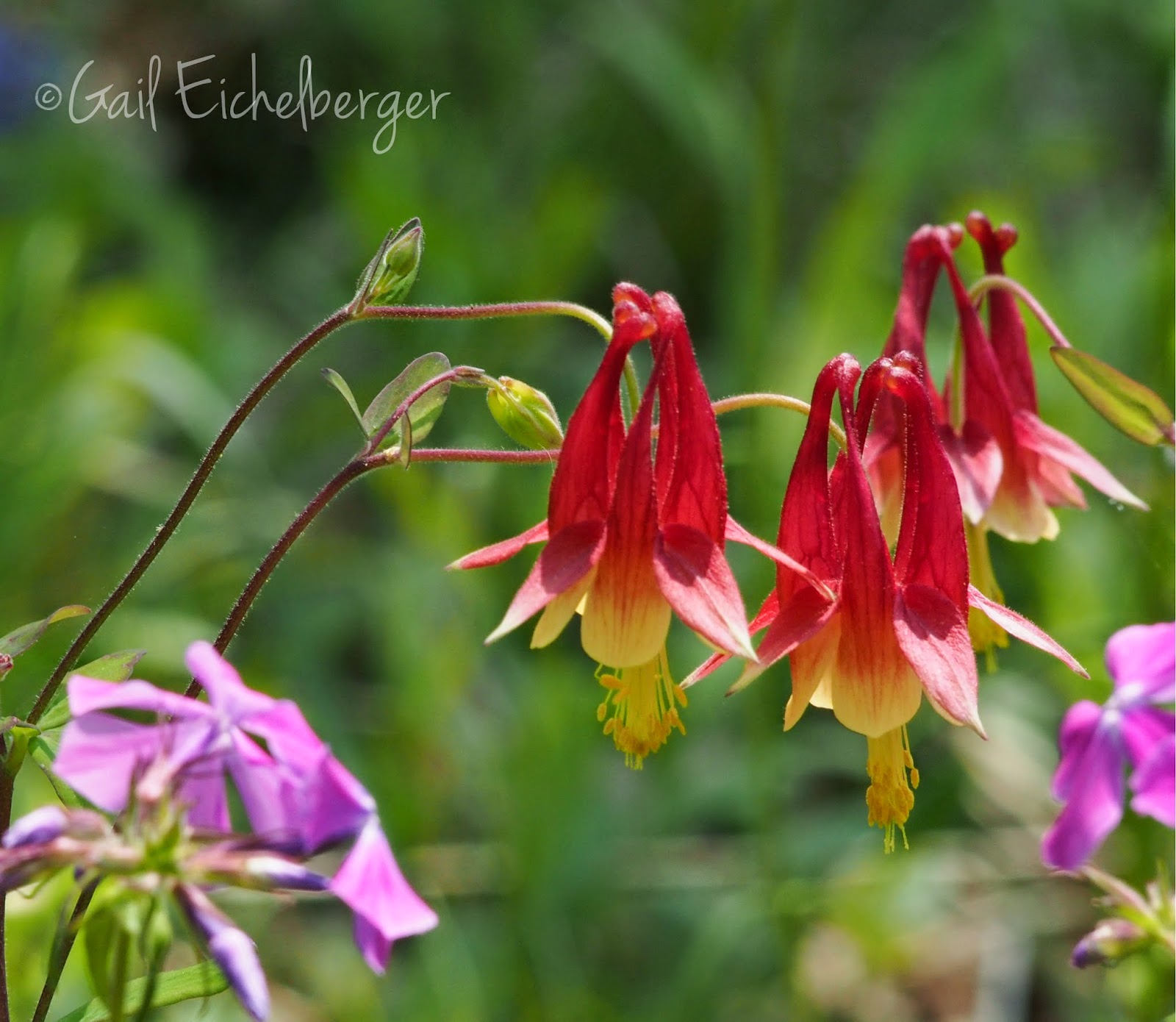
red sepals, yellow-limbed petals, 5 distinctive red spurs and a mass of bushy yellow stamens
I love the unique and beautiful flowers of columbines. The flower is approximately 1.5 to 2 inches long and hangs downward from its stalk. Each flower has five petals, five petal-like sepals and strongly exerted stamens and styles. The petals are yellow at the rounded tip and red to purplish-red at the base of its rounded nectar-spur.

Wild columbines will hybridize with other columbines and you can have a variety of colors from the cross pollination. I only grow Aquilegia canadensis, so I haven't seen this, but, a friend had the cutest delicate pink columbine that she said was a natural cross.

Have you had this happen in your garden? It might be fun to cross pollinate them.


 Aquilegia canadensis is commonly known as wild columbine or eastern red columbine. It occurs naturally in rich rocky woods, north-facing slopes, cliffs, ledges, pastures, bogs, fens and roadside banks. It is very happy in our gardens and asks only for good drainage to survive wet winters.
growing in cracks in stone steps
Erosion is an issue in my sloping garden with its heavy winter rains and I am always tickled to see where columbine seeds germinate. I've scattered seeds for years and the rain must wash the seeds into the rock edges of my beds, because this is where they always seem happiest. They also pop up in every crack and crevice as seen in the above photo.
I've read that you can deadhead the plant for more blooms, but, I have never had much success with that. I let them go to seed, because I love free plants and I think the seedheads are equally delightful! You'll know they are ripe when the it splits open and shiny black pearls spill out. Collect and plant them where ever you want more lanterns to light up your garden.

Eastern  red columbine's bloom period overlaps with Golden ragwort and Phlox pilosa and I dubbed them the Happy Trinity of Clay and Limestone. In my metaphorical mindset, the trio is like a Mirepoix (cuisine)/holy trinity of ingredients and spices that when mixed together make the gardens colorful and tasty each spring. They are the garden's Spring flavor base and it gets even more delicious as Spring progresses. (Happy Flower Trinity)


 I love the way columbine intermingles with the pinks and purples throughout my garden, not to all tastes, but a delicious presentation none the less. With any successful garden recipe there are always plants that provide additional flavor and I will tweak the recipe a little each year, adding new ingredients, adjusting others. It's important to experiment and see what tasty combinations you can create.

I see a few spots that need some eastern red columbine...hoping it will be delicious next spring.
xoxogail

The Particulars

Botanical name: Aquilegia canadensis
Common Name: wild columbine or Eastern red columbine
Family: Ranunculaceae
Native Range: Eastern North America
Zone: 3 to 8
Height: 2.00 to 3.00 feet Spread: 1.00 to 1.50 feet
Bloom Time: April to May
Bloom Description: Light pink/yellow to blood red/yellow
Flower: Showy, Good Cut flower
Sun: Full sun to part shade
Water: Medium
Maintenance: Medium
Attracts: Bumblebees and the Ruby-Throated Hummingbird visit the flowers for nectar; bumblebees may also collect pollen for their larvae. Short-tongued Halictid bees collect pollen from the flowers, but they are less effective at cross-pollination. The larvae of various insects feed on Wild Columbine, including those of Erynnis lucilius (Columbine Duskywing), Papaipema leucostigma (Borer Moth sp.), Pristophora aquiligae (Columbine Sawfly), and several Phytomyza spp. (Leaf Miner Flies).(source)

giant leopard moth or eyed tiger moth (Hypercompe scribonia)

Tolerate: Rabbit, Deer, Drought, Dry Soil Garden locations
Comments: Foliage is toxic and it is little bothered by mammalian herbivores. Excellent garden plant, good in shade gardens, rock gardens, cottage gardens or naturalized areas. The light, airy texture of the stems and flowers combines well with a variety of early bloomers such as Wild Geranium, Foamflower, and Wild Ginger.


Welcome to Clay and Limestone and Wildflower Wednesday.  Thank you all for joining me as we celebrate and share our marvelous and beautiful wildflowers. I hope 2020 is the year we all plant more native wildflowers for the many critters that live in and visit our gardens. Let's be sure we celebrate them every day, not just WW. Remember, it doesn't matter if they are in bloom or not, you can still share them. Please leave a comment and add your name to Mr Linky so others can pop over to see your Wildflower Wednesday post.


Gail Eichelberger is a gardener and therapist in Middle Tennessee. She loves wildflowers and native plants and thoroughly enjoys writing about the ones she grows at Clay and Limestone. She reminds all that the words and images are the property of the author and cannot be used without written permission.

Thursday, February 8, 2018

Blogging Anniversary


PPPP~Practically Perfect Pink Phlox
Ten years ago today, with equal excitement and anxiety, I clicked the publish button on my first blog post. There was no way I could have predicted what was to come or what an adventure it would be. Since that first brief~seven sentence post~a lot has happened. I've made new and dear friends. I've seen more gorgeous gardens than you can possibly imagine. I've even attended a garden bloggers get together in the UK. Along the way, I've grown as a writer, a photographer, a nature lover and a gardener.

I don't for one minute regret the time I've spent sitting at my desk hunting and pecking my way to posts I was never sure anyone would ever read! I've been one fortunate garden blogger...Because of you, dear readers.

I started blogging to connect with other gardeners who felt as passionate about gardening as I did. What I found were generous, kind and supportive people, many of whom have become very dear friends.

Most of us have only been able to visit each other's gardens through our blog photos and posts, but, that doesn't diminish our connections.

A few of us have been able to visit each other's gardens...What a delectable treat that has been.
Quite a few of us have exchanged seeds and plants.

So my dear friends I continue to blog because it's still important to me to connect with other gardeners; it's still important to talk about native plant gardening for wildlife; and, it's still important to showcase wildflowers on Wildflower Wednesday. My friends, you are all dear to me. Thank you for being here for this marvelous and magical experience.

xoxogail


PS I thought you would enjoy seeing Phlox pilosa the the Practically Perfect Pink Phlox again. I love knowing that many of you have a bit of Clay and Limestone in your garden.

 Gail Eichelberger is a gardener and therapist in Middle Tennessee. She loves wildflowers and native plants and thoroughly enjoys writing about the ones she grows at Clay and Limestone. She reminds all that the words and images are the property of the author and cannot be used without written permission.

Thursday, April 6, 2017

Are you ready for the hummingbirds?


Trumpet honeysuckle and Eastern Columbine have bloomed just in time for migrating Ruby Throated Hummers and that's no coincidence. Hummingbirds and certain flowers have coadapted over millions of years to form a mutually beneficial relationship. Hummingbirds migrate thousands of miles annually and they're movement north typically coincides with the blooming of these preferred flowers.
Check out the map below to get a sense of the magnitude of their migration north and you'll understand why they need nectar rich flowers all along the route. By the time they reach our gardens they are hungry and searching for food. 

Hummers hover below these flowers to feed on nectar

 The red tubular and trumpet-shaped flowers of both columbines and trumpet honeysuckles hold more nectar than other flowers and are irresistible to hummingbirds. Their coadapted/mutually beneficial relationship is pretty cool. The long bill and tongue of these hummers fits into the throat of preferred flowers like columbines and trumpet honeysuckle flowers to easily reach the nectar, and while feeding, grains of pollen spill onto the head of the bird and is carried to other Columbines and Trumpet honeysuckle.

It's a marvelous dance that happens in gardens all over the Eastern United States and it's show time in Middle Tennessee.
'Cedar Lane' Trumpet honeysuckle/Lonicera sempervirens
It's not difficult to attract migrating RTH to your Middle Tennessee garden. Like all bird visitors and residents they need food, shelter, water, nesting sites and perching sites.
Columbine/Aquilegia canadensi
Just plant more flowers and shrubs with nectar bearing flowers. The following is a list of plants that you might consider adding to the garden.

red buckeye 
jewelweed 
columbine 
trumpet creeper 
red morning-glory 
wild bergamot/bee- balm  
trumpet (or coral) honeysuckle
cardinal flower 
royal catchfly and  round-leaved catchfly 
fire-pink 
four o’clock (e)
phlox 
salvia and scarlet sage
lilies 
aloes 
penstemons 


 There may not be as many nectar sources available with this crazy up and down spring we've had, so please consider hanging feeders. It's fun to watch the hummers up close and it's an easy way to supplement their nectar needs. You don't have to buy nectar, make your own, it's just sugar and water! There are recipes on the internet. Do not use the red dyed syrups.


this source/link will take you to the website
Have fun and remember this please! Never, ever, ever, ever, ever use pesticides. I mean that now! Never. You really do want insects in your garden. Insects are a primary food of most birds, including hummingbirds.

xoxogail

Gail Eichelberger is a gardener and therapist in Middle Tennessee. She loves wildflowers and native plants and thoroughly enjoys writing about the ones she grows at Clay and Limestone. She reminds all that the words and images are the property of the author and cannot be used without written permission.

Thursday, May 7, 2015

National Wildflower Week: Eastern Columbine

Beloved of hummingbirds and bumblebees, Aquilegia canadensis's flower lanterns are a must have for any wildlife gardener in the Eastern United States.
Red or Eastern Columbine (Aquilegia canadensis L.)
I discovered them in my garden the Spring after we moved here and they have been stars ever since. They're native to the Central Basin where I garden, but, I've always thought of them as a gift of the floral arranger who once lived here.

Eastern Columbine's bloom period overlaps with Golden ragwort and Phlox pilosa and I dubbed them the Happy Trinity of Clay and Limestone. In my metaphorical mindset, the trio is like a Mirepoix (cuisine)/holy trinity of ingredients and spices that when mixed together make the gardens colorful and tasty each spring. They're my garden's Spring flavor base and it gets even more delicious as Spring progresses. (Happy Flower Trinity)
 I love the way it intermingles with the pinks and purples throughout the garden, not to all tastes, but a delicious presentation none the less. With any successful garden recipe there are always plants that provide additional flavor and I will tweak the recipe a little each year, adding new ingredients, adjusting others, but, only when it will help the overall presentation and tastiness! (from an earlier post)

Aquilegia canadensis occurs naturally in rich rocky woods, north-facing slopes, cliffs, ledges, pastures, bogs, fens, roadside banks and good garden soil! They're easy peasy and if you want more let them go to seed...The seedheads are equally delightful! You'll know they are ripe when the it splits open and shiny black pearls spill out. Collect and plant them where ever you want more lanterns to light up your garden.

xoxogail

Gail Eichelberger is a gardener and therapist in Middle Tennessee. She loves wildflowers and native plants and thoroughly enjoys writing about the ones she grows at Clay and Limestone. She reminds all that the words and images are the property of the author and cannot be used without written permission.

Tuesday, April 22, 2014

Wildflower Wednesday: The Happy Flower Trinity

If you're a cook, you know that creating a delicious stock, soup, or stew often starts with basic ingredients and builds from there. The French have their mirepoix of onions, carrots and celery; the Italians have their tomato, garlic and basil; and Cajun cooking has its holy trinity of onions, peppers and celery.  Each of these  flavor bases makes the food tasty and delicious and unique to that region.
Clay and Limestone has its own trio of flowering beauties~Golden Ragwort, Columbine and Downy Phlox ~ that make the garden a colorful and tasty treat each spring.
Clay and Limestone is a small side dish of this delicious mixture (photo 2011)
All three are native to the Nashville Basin. The Basin is an elongated mixing bowl of land where Mother Nature has tossed cedar glade and Tennessee native plants into a unique and delicious mixture. Our tasty dish is never the same year to year, like local cooking, the proportions all depend upon the weather and what nature makes available!
 The Happy Trinity have been liberally sprinkled about the garden
Let's take a look at these special plants that combine wonderfully to make this garden's flavor base for Wildflower Wednesday.
notice a few aphids~I leave them for the beneficial insects to gobble up
Golden Ragwort or Packera aurea is a bright daisy with evergreen basil foliage. It makes a wonderful groundcover if the conditions are right~even moisture year round. Strangely enough, that may be why many people don't add it to their gardens~fear of a plant making too big a statement. I like big statement plants, after all, this is the home of rough and tumble wildflowers!

I think it's absolutely beautiful. The small daisy like golden flowers on tall stems are chock full of pollen and nectar for small bees, flies and butterflies. Occasionally, aphids show up on a few plants, but, I leave them for the ladybugs. There are no cultivars of this beauty, the straight species is perfect!

Family: Asteraceae
Native Range: Eastern North America to Texas
Zone: 3 to 8
Height: 0.50 to 2.50 feet Spread: 0.50 to 1.50 feet
Bloom Time: April Bloom
Sun: Full sun to part shade
Water: Medium to wet
Pollinators: Small bees and butterflies
How does one describe Aqiulegia canadensis! I think of it as bright lanterns that sway in the slightest breeze sending a signal to pollinators that there's nectar in those spurs!  Here's a good reason to plant more Columbine! "Ornithologists have discovered that the ruby-throated hummingbirds tend to follow the blossoming of Aquilegia canadensis on its journey north in spring, since the flowers are the first to provide nectar for the birds." (source)

Columbine thrives in part to full shade, in any well-drained soil. I find it happiest in cracks and crevices, really, it grows anywhere a seed falls and the drainage is good! Plants tolerate full sun if temperatures are cool, but they grow better in my garden in partial shade. Red columbine is found in rocky woods from Nova Scotia to the Northwest Territories south to Florida and Texas.
growing between the flagstone in the Garden of Benign Neglect
Family: Ranunculaceae
Native Range: Eastern North America
Zone: 3 to 8
Bloom Time: April to May (even earlier after a gentle Middle South winter)
Sun: Full sun to part shade
Water: Medium
Pollinators: Hummingbirds, bees, butterflies, and hawk moths feed on columbine necta

...and finally
Practically Perfect Pink Phlox Pilosa

Long time readers already know about her charms...PPPP has an exceptionally long bloom time (six weeks or longer), fantastic pink flowers, grows in sun and part sun, tolerates clay soil that's wet all winter and dry all summer, has a marvelous ground covering effect, and has the sweetest fragrance that wafts all over the garden on warm days. You'll have to agree, a plant like that is practically perfect!
P pilosa is a stoloniferous, semi-evergreen native wildflower found naturally growing in open woodlands, meadows, prairie remnants and limestone glades through out the central and eastern US and Canada. Although, I've never heard anyone call PPPP a thug, some gardeners may not appreciate how quickly it can spread in rich soil. Colonizing is a plus for me and unlike some colonizing plants, it's easy to lift and transplant. I am especially pleased at how well it's growing in the shallow soil over the bedrock in the Susan's Bed....That says a lot about a plant.

PPPP with River Oats
Family: Polemoniaceae
Native Range: Eastern and central United States (also Canada)
Zone: 4 to 9
Bloom Time: April to June (in my garden)
Sun: Full sun
Water: Medium
Pollinators:  Hummingbirds, Butterflies, Bees, Flies

So what do you think? Is this trio a tasty and delicious treat?
xoxogail

Welcome to Wildflower Wednesday! It's time to share your wildflowers no matter where you garden~the UK, tropical Florida, Europe, Australia, Africa, South America, India or the coldest reaches of Canada. It doesn't matter if we sometimes show the same plants, how they grow and thrive in your garden is what matters most. I hope you join the celebration..It's always the fourth Wednesday of the month!


Gail Eichelberger is a gardener and therapist in Middle Tennessee. She loves wildflowers and native plants and thoroughly enjoys writing about the ones she grows at Clay and Limestone. She reminds all that the words and images are the property of the author and cannot be used without written permission.

Wednesday, April 17, 2013

Wordless Wednesday: Hummingbird Ready

Columbine

and

Coral bells

xoxogail


Gail Eichelberger is a gardener and therapist in Middle Tennessee. She loves wildflowers and native plants and thoroughly enjoys writing about the ones she grows at Clay and Limestone. She reminds all that the words and images are the property of the author and cannot be used without written permission.

Monday, April 9, 2012

Gardeners, Do Yourselves A Big Favor

Get the best wildflower book you can find for your part of the gardening world. You won't be sorry.
Phlox pilosa ( Polemoniaceae) and Aquilegia canadensis (Ranunculaceae)
Not only will you learn to identify wildflowers, but, the best wildflower books should also give you a good foundation in plant families,  a description of the plants characteristics and where the plant is found growing. 
Phlox family with it's characteristic fused and perfect five petals
I love wildflowers and love reading about them. So, when friends ask me to identify wildflowers they've seen in the woods or in someone's garden, it's a fun task.  Sometimes it's challenging, but, with a decent photo, my go to books, the internet and being able to place a plant in its family, it's not too difficult to find and id! 
The best wildflower books are chock full of important information and my favorite all around wildflower book has an excellent flower color key and an overview of the geographic regions/physiographic provinces that make up Tennessee.  It even lists plants that have naturalized in our regions, like Lunaria anua, which is a member of the Mustard family.  So are the toothworts~those beautiful spring ephemerals that  didn't last through our hot March weather.

Baptisia australis Bean/pea familywith standards, wings and keel
 I found out early on that I garden in the Central Basin province of Tennessee, with shallow, nearly neutral  clay soil.  Knowing this helps me understand why Frances/fairegarden, who gardens in the Ridge and Valley province and I have very different results with the same plants.  This is even true for my friend Paul's garden which is less than 10 miles from my house.  His garden is on one of the many ridges that surrounds Nashville, it's also on thin, rocky soil, but it can support acid loving plants that I  have to work hard to make happy.

Lily, Phlox, Buttercup, Waterleaf and Mustard family represented
Besides dazzling your family and friends while hiking in local natural areas, having a general knowledge of plant families can help to identify wildflowers that you see and might want to try growing in your garden.

Upper leaves are the standard, middle the wings and the bottom is the keel
That's how I was able to identify Partridge Pea/Chamaecrista fasciculata at Radnor Lake last summer. (here for its story) Partridge Pea is a fab Fabaceae with  characteristic flowers comprised of standards, wings and keels and distinctive compound pinnate leaves! 
Trillium grandiflorum is a member of the Lily Family
Naturally, plants don't always fit into a handy set of characteristics, that would be too easy, but,  getting to know the typical characteristics is a good start.  

Take a look at two Buttercup family members that are endemic to my garden.  All Buttercup family members have colorful sepals instead of petals. 
Enemion biternatum/False rue-anemone has 5 petal like sepals

False rue-anemone has the usual  five colored sepals instead of petals.  Usual is used because not all members have just 5 sepals.  (Sepals are usually part of the calyx).


Rue-anemone/Thalictrum thalictroides has five to ten showy white to pinkish sepals and can be easily confused with False rue-anemone. That's when knowing a plant's leaf shape really helps! (A photograph of all of the plant is helpful for comparisons in your plant books or an Online source.)
Western Daisy/Astranthium integrifolium is a native annual in the Asteraceae family

If you want to learn more about plant families start with a good wildflower book and head out into your own garden. You probably already know many and I am more than sure that you will be able to identify many more in a short period of time.
Monarda bradburiana of the Lamiaceae family


I am pretty sure that you have most of these families represented in your garden! Some of our best flowers are represented in these 8 families!

Ranunculaceae~5 colored sepals instead of petals, lobed leaves.  I always think run when I see ranunculaceae in a name and they do often run wild in a garden!  Columbine and the anemones are shown. Almost all are poisonous.

Fabaceae~Once you get to know this plant family with it's pea like flower, compound, or trifoliate or watermarked leaves and seed pod, you'll be able to spot the medic, clovers, lupines and vetches everywhere!


Polemoniaceae~The phlox family with five flat-petaled flowers with simple undivided flowers. (phlox and Jacobs Ladder)


Asteraceae~Probably the most prevalent family in my garden with ray or disk flowers that shout 'daisy'.


Lily family~Lilies, iris and other relatives (alliums, Iris native and exotic, Blue-eyed grass, etc) including the Genus Trillium with its stalked or stalkless three petaled flowers.

Brassicaceae~Fabulous plant family with 4 sepals, 4 petals and 6 stamens~Count 'em! Together the four petals form a cross which is the source of their other name Cruciferae.  Unfortunately, some of these plants are noxious weeds like Garlic Mustard/Alliari petiolata.  If you see it in your garden~get rid of it.

Lamiaceae~Leaves are simple and opposite,  with a square stem (usually) and 2 lipped corollas.  Bees adore these plants.

Hydrophylloideae-The waterleaf family is duking out with whether or not it should be placed in the Borage family.  I shall let the taxonomists figure this one out!  Suffice it to say these plants are sweet and much appreciated in my garden.  I love the description of this plant family from Thomas Elpel~"The flowers of this family often have a "dainty" appearance because the stamens frequently dangle so far out of the little blossoms. The flowers are typically small and often clustered together. The flower stalks often curl over, much like a scorpion tail." (source)

Phacelia bipinnatifida also known as Scorpionweed
Now have fun and don't make this an onerous task!

xxoogail


Gail Eichelberger is a gardener and therapist in Middle Tennessee. She loves wildflowers and native plants and thoroughly enjoys writing about the ones she grows at Clay and Limestone." She reminds all that the words and images are the property of the author and cannot be used without written permission.