Home of the Practically Perfect Pink Phlox and other native plants for pollinators
Showing posts with label verbesina. Show all posts

Sunday, October 16, 2011

Not The Climate For Xeric


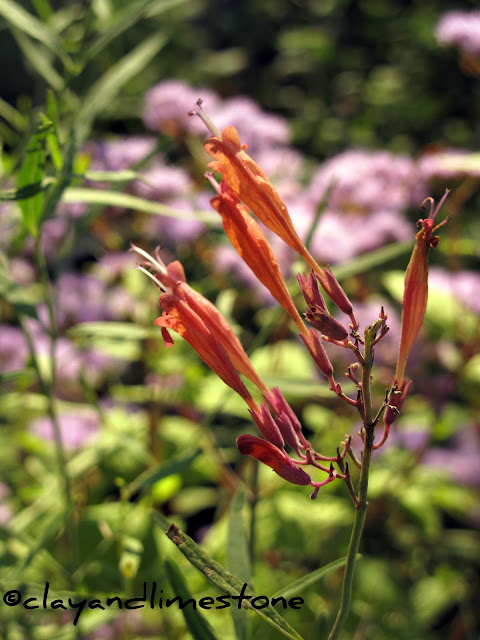
Agastache  rupestris  has survived for several years in a container
Xeric is an iffy prospect in the Central Basin in Middle Tennessee.   Our summers  might be dryer and hotter, but, our winters haven't changed. They are wet, wet, wet! That's typically when we get most of our rainfall.
'Grey Owl' Juniperus and Cotinus 'Grace' prefer dry roots
On average more then 20 inches fall from November to April; that's more then most xeric plants can handle.  It's the main reason for plant loss.  Wet, clay soil over limestone   drowns plants each winter. 
and these are the pieces of limestone I can dig out!
 On the whole, I  no longer buy plants hailed as xeric for this garden.  But, I do have perennials and shrubs that require dry roots during the winter.  Juniperus virginiana "Grey Owl'  likes it on the dry side, so, the soil is raised and  amended with a  shale product that  promotes  drainage.  Some plants that need  sharp drainage might spend their life in a large container~like  Agastache rupestris.  All the rest get planted in the garden and get a good mulching each year with leaf mold. 
Autumn mix of Solidago flexiculis, Amsonia hubrecktii, native ex-asters and Rudbeckia fulgida
If you take a walk around Clay and Limestone you'll see lots of familiar fall faces. That's because  many of our natives are  also natives of the Eastern and Southeastern USA.   But, we have a few special ones that are only native to the cedar glades and if I can meet their requirements I like to give them a try. 


There might be a few friendly exotics and agastaches from the Southwest, but,  this garden is a  Central Basin garden  through and through.  In fact, if you were to visit  a nearby woodland you would see  almost all the same plants in bloom.  Solidagos, Symphyotrichums, Verbesinas, Conoclinium coelestinum, Eupatorium,  Panicums, Little Bluestems and even Chasmanthium latifolium are all  Central Basin natives that thrive on my nearly neutral, shallow clay soil. 


 Goregeous aren't they!


 They're the payoff for our long,  long hot summers.

xxoogail

I am a day late for Bloom Day but, offer up this humble post and the blooming wildflowers for your enjoyment.  Please pop over to May Dreams Gardens, where our delightful hostess has links to more Bloom Day posts then you can imagine.

Tuesday, December 7, 2010

Frost Flowers Blooming In The Garden


The frost flowers are frozen in place at Clay and Limestone this week. With temperatures only reaching about 35F you can find them in the shadier parts of the garden all day long. Pure white, ribbons of ice that have formed on cold nights. Hard to believe that a flower can produce such ice sculptures over and over again.


Several readers have expressed interest in Frost Flowers after a recent post. Sue, from A Corner Garden, thought I might be teasing that such a flower can exist. But exist they do! Those of you with long memories will recognize some of this post~It's a post from last year that I've reworked with new information and photos. I hope you come to love this native as I have.

Verbesina virginica (White Crownbeard) is a stately queen among the rough and tumble flowering natives in my garden. An easy to grow plant that can be found in woodland margins, openings in woodlands, flood plains, thickets, roadsides, stream banks, pastures; damp soils. Beloved of bees and visited by many butterflies, verbesina is rarely munched on by deer or rabbits. I've come to love this plant since I first saw it growing in the wayback backyard~behind the Garden Of Benign Neglect; a tall plant that I decided to watch for a season to see what it could be~This tall asteraceae family member (can reach 6 or more feet) is a plant that most of us wouldn't give a second look~At least not until it bloomed along with other Autumn beauties.
Verbesina with goldenrod, rudbeckia and native aster

So don't get that weed whacker out too fast!
On those first cold and frosty mornings you might be able to see Verbesina virginica (more info here) transformed into Frostweed. A wonderful natural process that happens with just a few plants and Verbesinas are one of them~

Imagine a beautiful late fall day; it's warm and the sun is shining. The verbisina's roots draw water up into the stem and late that night when the temperatures drop well below freezing, the stems freeze, split open, emitting plant juices, which immediately freeze into ribbons of ice that curl around the stem and the base of the plant!

Isn't nature grand!

Everyday there is something of the marvelous to behold.
Now aren't you glad we didn't mow this plant down after one look at those flowers!
The stems are winged so look for this characteristic when id-ing them in the wild.

Frost flowers will continue to form as long as the temperatures are cold and the plant juices are flowing.

Just in case you still need convincing to grow this beauty~

Verbisina with its friend the Pokeweed

White Crownbeard/Verbesina/Frostweed has been selected for monitoring by Monarch Watch because it's an important nectar plant for monarch butterflies.

xxoogail

PS If you don't like the white it does come in yellow!

v alternifolia or Yellow Frostweed


There are two ways to live your life - one is as though nothing is a miracle, the other is as though everything is a miracle. Albert Einstein