Home of the Practically Perfect Pink Phlox and other native plants for pollinators
Showing posts with label frostweed. Show all posts

Wednesday, August 26, 2020

Wildflower Wednesday: Verbesina virginica

It's rough and tumble wildflower time in my garden.

The take care of themselves Autumn beauties are beginning to bloom and our wildflower star, Verbesina virginica is looking its wildflower best, dressed in white flowers and wearing nature's late summer visiting jewels.

If you're new to Clay and Limestone, rough and tumble wildflowers are simple wildflowers that bloom their hearts out and require the easiest of care. Many have never been hybridized, which means they haven't had their best characteristic bred out of them.


Rough and tumble wildflowers, like Frostweed, are doing the job nature intended them to do, which is to make a lot of food (nectar and/or pollen) and bloom exactly when the critters need it. Once bloom is past and the seeds ripen, they become feeding stations for over wintering birds which seek out those seeds.

I know you'll agree with me when I say, nature's design is amazing.
landing pads of deliciousness
Verbesina virginica is a native herbaceous biennial/perennial in the Asteraceae/Sunflower family. It has clusters of white ray florets and white disk florets with noticeably contrasting purplish-black anthers.
Its leaves are dark green with rough surfaces and toothed margins and are oppositely arranged.


Its stem is distinctive in that it has wing-like flanges running along its length. If you live in its native range, you've probably seen it along roadways or in natural areas and parks. It can be found on streams and river banks, bluff bases, bottomland and upland forests, pastures, railroads, roadsides, prairies, and in forest openings. It is most common in areas with neutral or basic soils (Soil which is in the range from slightly acid to slightly alkaline, usually considered to be in the range of pH values from 6.6 to 7.3).
 seed feeding station of Frostweed, Rudbeckias, Cup plant and yet to bloom ex-asters and Goldenrods
 That means it's very happy, maybe, even too happy in my garden.


Verbesina virginica is a blooming magnet for all kinds of insects, including some insects that are themselves food for spiders, birds and other insect eating critters.


Bumble Bees love it. Green Metallic bees love it. Giant Carpenter Bees love it. Butterflies love it. In fact, it's an essential late summer/early fall nectar food for all visiting pollinators and it's an especially important food for the Monarch Butterfly. It's has been selected for monitoring by Monarch Watch an organization devoted to education, conservation and research about/for the Monarch Butterfly.

We all know that adult butterflies depend upon their host plant to raise their larval young.   Caterpillars won’t just eat any leaf and each butterfly species has specific plants that their caterpillars will eat. During migration blooming nectar plants are even more valuable to Monarch butterflies than their non-blooming host plants. Frostweed and other rough and tumble plants provide the nectar they need for energy to fly thousands of miles.
Flattened fruits have winged margins and two awns
Verbesina virginica also provides ripe seeds for over wintering birds that live in and stop by our gardens. So don't be so eager to chop them down in November. Let them stand until late winter or early spring.
Photo courtesy of Meredith O'Reilly

Verbesina virginica has many common names, three of which, Frostweed, Iceplant, Iceweed hint at something wintry about our star.

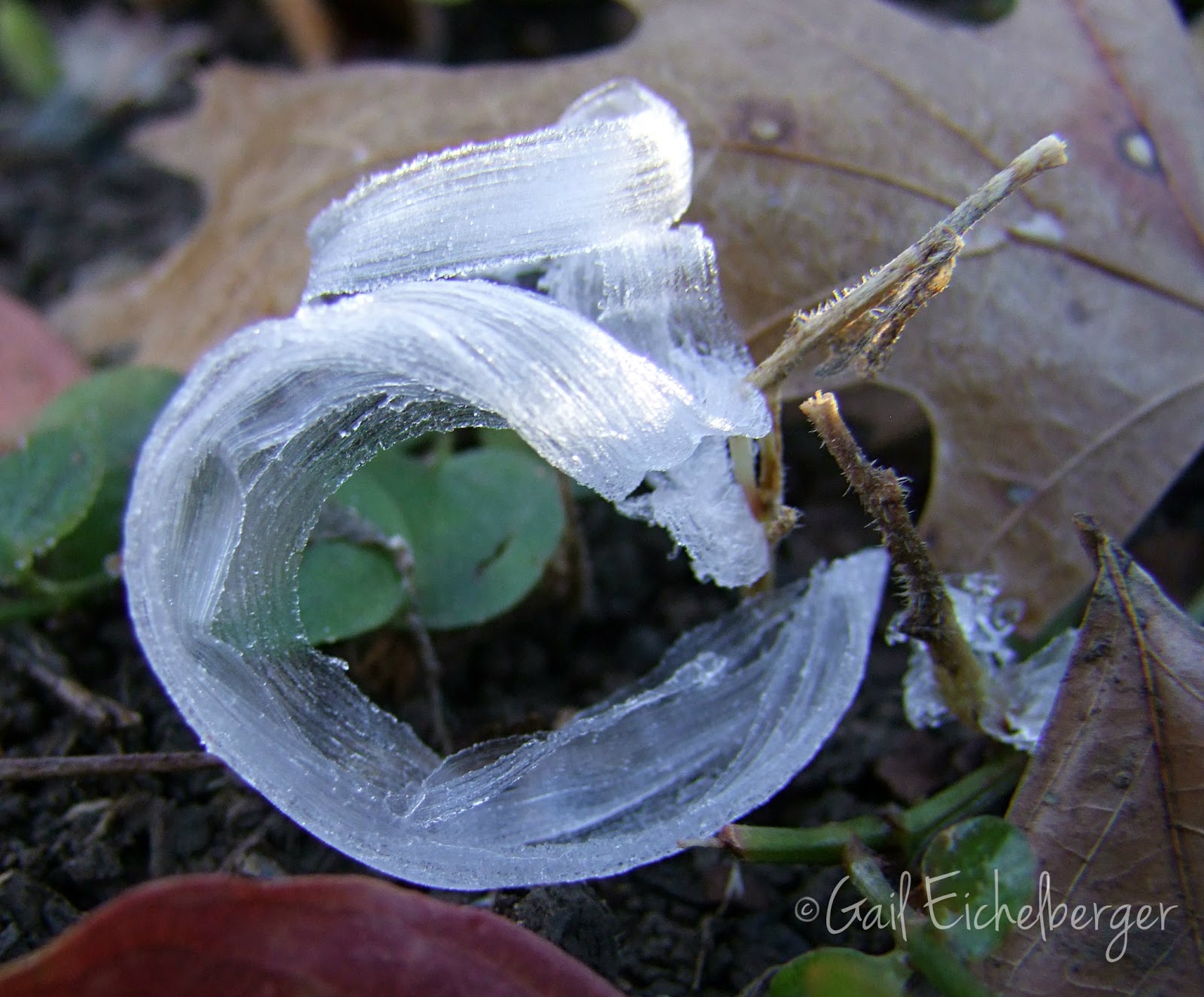
Aren't these ice candy ribbons incredible! They're provided by Frostweed.

Imagine a beautiful late fall day. It's warm, the sun is shining and Verbesina's roots draw water up into the stem. Late that night, temperatures drop well below freezing and the stems freeze, splitting open, emitting the plant juices, which immediately freeze into ribbons of ice that curl around the stem and the base of the plant!

Frostweed flowers will continue to form as long as the temperatures are cold, the plant juices are flowing and the sun cannot melt them away. The scientific term is capillary action, but, I think it's magic.

The Particulars

Family: Asteraceae

Common names: White crownbeard, Frostweed, Iceplant, Iceweed, Virginia Crownbeard, Indian Tobacco, Richweed, Squawweed

Native Range: Pennsylvania west to central Texas, south to Florida

Habitat: White Crownbeard occurs in prairies, in pastures, in forest openings, along streams, and on roadsides. It is most common in areas with neutral or basic soils.

Size: The stems are 3-8 feet in height and unbranched below the inflorescence. They have winged internodes, and are pubescent. The wings that make them easily identifiable

Bloom: Flowers are produced in heads. The heads are arranged in corymbs. Each head has 1-7 white ray flowers and 8-15 off-white disc flowers.

Bloom time: August–October.

Sun: Full sun, half sun, and, even fairly shady sites.

Water: Moist to dry

Maintenance: Weeding and editing, plants can become weedy, spreading by seed and from rhizomes.

Propagation: The fruit is a winged achene with two small bristles at its apex. Best planted from seed or if in a natural area allowed to self sow. Seed dispersal is by wind, animal or flowing water

Wildlife Value: Over wintering birds eat the seeds. Bumble Bees love it. Green Metallic bees love it. Giant Carpenter Bees love it. Butterflies love it. In fact, it's an essential late summer/early fall nectar food for all visiting pollinators and it's an especially important food for  the Monarch Butterfly.

Comments: Best in natural garden, along pond edge or if well managed in the background of a butterfly garden. This plant is called "frostweed" because it often forms spectacular "frost flowers" in the fall, when a sudden overnight freeze causes the stems to burst and release sap.


I adore this plant, but, I also weed it ruthlessly if it's crowding other more delicate plants. I can't imagine Clay and Limestone without Frostweed and the other rough and tumble beauties. Let me know if you want seeds, I'll have extras for sure.

xoxogail


Thank you for stopping by and welcome to Clay and Limestone's Wildflower Wednesday celebration. WW is about sharing and celebrating wildflowers from all over this great big, beautiful world. Join us on the fourth Wednesday of each month. Remember, it doesn't matter if your wildflower is in bloom or not; and, it doesn't matter if we all share the same plants. It's all about celebrating wildflowers. Please leave a comment when you add your url to Mr Linky.


Gail Eichelberger is a gardener and therapist in Middle Tennessee. She loves wildflowers and native plants and thoroughly enjoys writing about the ones she grows at Clay and Limestone. She reminds all that the words and images are the property of the author and cannot be used without written permission.

Thursday, December 15, 2016

Frostweed flowers are nature's winter magic

Verbesina virginica has begun its flowering magic and I never tire of seeing it blooming on a cold morning.
Verbesina virginica/white crownbeard/wingstem is a valuable food sources for late pollinator visitors, so I've let it seed with some abandon in the wilder parts of the garden.
You can see capillary action in the above stem
Although, more common on the first frosty mornings of fall, here in my Middle Tennessee Zone 7 garden we have all the right ingredients for frostweed flowers to make their special appearance even in winter.

All that is needed is a warm winter day followed by a cold winter night. During the warm day, the Verbesina's roots draw water up into the stem and later that night freezing temperatures force the sap from the stems where they freeze into sculptural ice candy flower curls. The scientific term is capillary action, but

I think it's magic.

Verbesina's quirky magical winter behavior is just one of the many reasons it's a queen among the rough and tumble flowering natives in my garden. Bumble Bees love it. Green Metallic bees love it. Giant Carpenter Bees love it. Butterflies love it. In fact, it's an essential late summer/early fall nectar food for all visiting pollinators and it's an especially important food for  the Monarch Butterfly. It's has been selected for monitoring by Monarch Watch, an organization devoted to education, conservation and research about/for the Monarch Butterfly. It will always have a place in my garden.

I love its candy curls of ice, but, in the back of my mind are images of summer blooms and visiting pollinators.

xoxogail

I am posting this magical flower for Garden Bloggers' Bloom Day! Stop by May Dreams Gardens to see what other gardeners are sharing for Bloom Day.

Gail Eichelberger is a gardener and therapist in Middle Tennessee. She loves wildflowers and native plants and thoroughly enjoys writing about the ones she grows at Clay and Limestone. She reminds all that the words and images are the property of the author and cannot be used without written permission.

Monday, January 28, 2013

Frost Flower Seeds Winners

You're all winners...That's right, I am going to make sure you all get a packet of the best ever rough and tumble wildflower. Les, Sue, Garden Girl/Linda, Lisa/Greenbow, Becky, Jan, Patsy, Alison, Connie/Near Little River, Missing HenriMitchell, Liza Downey, Becki, and Ann contact me.
Verbesina virginica's rough and tumble bloom with Pokeweed
 I promise  that you won't be disappointed and your resident  pollinators will thank you! If I take a few seeds from each packet there's enough for each of you to have Verbesina virginica in your garden...forever. Please send me your mailing address, my email address is in the Welcome to my Garden on the sidebar.
When Frost Flower/Frostweed/Winstem blooms~pollinators show up!

Verbesina virginica self sows in my garden, but, I've begun scattering seeds here and there for their architectural and pollinator appeal. Plant them as soon as you get them to insure the seeds get at least a 30 day stretch of cold, moist conditioning. If there's snow on the ground you can mix them with sand and toss the mixture onto the snow or winter sow them in a container so you can keep an eye on them, then transplant where their height will best appreciated.
Frost Flower from many seasons back!

Happy Planting
xoxogail

PS It's Monday and that means I get to remind you that it's never, ever, ever, ever, ever, a good idea to use pesticides in your garden, especially if you want pollinator visitors.

More about Frost Flowers
An Almost Perfect Winter Flower
I Never Tire Of Seeing Frost Flowers
Frost Flowers Blooming In The Garden
Bees Don't Care If A Flower Is Beautiful
It's Rough and Tumble Wildflower Time


Gail Eichelberger is a gardener and therapist in Middle Tennessee. She loves wildflowers and native plants and thoroughly enjoys writing about the ones she grows at Clay and Limestone. She reminds all that the words and images are the property of the author and cannot be used without written permission.

Monday, January 21, 2013

Frost Flower Seed Giveaway

Dear Garden Bloggers, I've collected seeds from my Verbesina virginica and have 10 packets available to giveaway.

Frost Flower is one of the best of the  rough and tumble wildflowers that thrive in my garden. In case you've missed any of my posts extolling its virtues let me catch you up!

Verbesina virginica with its unusual white ray flowers is found on roadsides, woodlands and waste areas! It's a take care of itself plant that has enormous wildlife value for foraging pollinators  (carpenter, honey, bumbles and small tongued bees and butterflies) during late summer when gardens are winding down.  It’s such an important food source for Monarch Butterflies that it had been selected as a monitoring plant by Monarch Watch.
It really has a  lot going for it
  1. rough and tumble good looks, 
  2. it's a pollinator magnet
  3. drought tolerant 
  4. native species 
  5. it magically makes ice flowers on cold and frosty mornings
  6. Okay, it's not magic it's capillary action, but, I think that's magical.
It's a pretty spiffy wildflower.

One more thing! I need to tell you that I exercise just a wee bit of poetic license and call them Frost Flowers, but, when you look them up, you'll discover that they are commonly called Frostweed or Wingstem. What ever their name, they are a treat to see  in late summer and all fall when they're covered with pollinators or on a cold morning following a warm day when capillary action creates the ribbons of ice candy at the base of each stem.
xoxogail

Leave a comment and let me know if you're interested. If more than 10 people request seeds, then I will put all the names in a hat and Mr I will draw the winners and announce them here next Monday.

That's all you need to do...

Wonder if it will grow in your garden~Check out this map

I've written about Verbesina many times~It is after all a favorite of mine,  you can go to
An Almost Perfect Winter Flower here and  I Never Tire Of seeing Forst Flowers here

 Gail Eichelberger is a gardener and therapist in Middle Tennessee. She loves wildflowers and native plants and thoroughly enjoys writing about the ones she grows at Clay and Limestone. She reminds all that the words and images are the property of the author and cannot be used without written permission.

Monday, November 26, 2012

I never tire of seeing frost flowers blooming on a cold morning

I hope you don't either.
They're nature at its most magical.
If that's too fanciful for you, then they we can go with science and call it capillary action. 


All it takes is a warm winter day followed by a cold winter night. During the day, Verbesina virginica's roots draw water up into the stem and later that night freezing temperatures force the sap from the stems where they freeze into sculptural ice candy flower curls.


Capillary action is magical when it's this beautiful!
It will "bloom" ice crystal ribbons on and off all winter whenever the day warms up and the nights freeze.


I hope to never tire of seeing the marvelous and magical that nature has to show me.

xoxogail

More about Verbesina virginica read: 
Bees Don't Care If  Flower Is Beautiful
Have You Seen The Frost Flowers and 
An Almost Perfect Winter Flower

The universe is full of magical things patiently waiting for our wits to grow sharper.  -- Eden Phillpotts

Gail Eichelberger is a gardener and therapist in Middle Tennessee. She loves wildflowers and native plants and thoroughly enjoys writing about the ones she grows at Clay and Limestone. She reminds all that the words and images are the property of the author and cannot be used without written permission.

Friday, January 6, 2012

An Almost Perfect Winter Flower

What do you think?
Verbesina virginica
I never tire of seeing frost flowers 'blooming' on a cold morning. They are nature at her most magical.


 I love sharing its flower magic with you. It's a natural process that happens with just a few plants and Verbesinas are one of them~  (Have You Seen The Frost Flower? and Frost Flowers Blooming In The Garden. )
Frostweed magic!
Although, more common on the first frosty mornings of fall, here in my Middle Tennessee Zone 7 garden we have all the right  ingredients for frostweed to make its special appearance again and again. 

All it takes is a warm winter day followed by a cold winter night.  During the warm day, the  verbesina's roots draw water up into the stem and later that night freezing temperatures force the sap from the stems where they freeze into sculptural ice candy flower curls.  I think it's magical.

White Crownbeard
Whether you see the magic or the science (capillary action)  it's wonderful having a plant that can  produce ice sculptures over and over.
This is my favorite of all my frost flower photos~December 2009
But, Verbesina's quirky magical winter behavior is just one of the many reasons it's a queen among the rough and tumble flowering natives in my garden. I let it seed about the garden because it's a pollinator magnet.


Bumble Bees love it. Green Metallic bees love it. Giant Carpenter Bees love it.  Butterflies love it.  In fact, it's an essential late summer nectar food for all visiting pollinators and it's an especially important food for  the Monarch Butterfly.  White crownbeard has been selected for monitoring by  Monarch Watch~You can go here  to read about participation in MW.


Right now, I am enjoying the candy curls of ice, but, in the back of my mind are images of summer blooms and  happy pollinators. (In case you wondered, as appetizing as it is to pollinators,  it's rarely munched on by deer or rabbits.)

xxoogail

“There are two ways to live: you can live as if nothing is a miracle; you can live as if everything is a miracle.” Albert Einstein

Gail Eichelberger is a gardener and therapist in Middle Tennessee. She loves wildflowers and native plants and thoroughly enjoys writing about the ones she grows at Clay and Limeston

Tuesday, December 7, 2010

Frost Flowers Blooming In The Garden


The frost flowers are frozen in place at Clay and Limestone this week. With temperatures only reaching about 35F you can find them in the shadier parts of the garden all day long. Pure white, ribbons of ice that have formed on cold nights. Hard to believe that a flower can produce such ice sculptures over and over again.


Several readers have expressed interest in Frost Flowers after a recent post. Sue, from A Corner Garden, thought I might be teasing that such a flower can exist. But exist they do! Those of you with long memories will recognize some of this post~It's a post from last year that I've reworked with new information and photos. I hope you come to love this native as I have.

Verbesina virginica (White Crownbeard) is a stately queen among the rough and tumble flowering natives in my garden. An easy to grow plant that can be found in woodland margins, openings in woodlands, flood plains, thickets, roadsides, stream banks, pastures; damp soils. Beloved of bees and visited by many butterflies, verbesina is rarely munched on by deer or rabbits. I've come to love this plant since I first saw it growing in the wayback backyard~behind the Garden Of Benign Neglect; a tall plant that I decided to watch for a season to see what it could be~This tall asteraceae family member (can reach 6 or more feet) is a plant that most of us wouldn't give a second look~At least not until it bloomed along with other Autumn beauties.
Verbesina with goldenrod, rudbeckia and native aster

So don't get that weed whacker out too fast!
On those first cold and frosty mornings you might be able to see Verbesina virginica (more info here) transformed into Frostweed. A wonderful natural process that happens with just a few plants and Verbesinas are one of them~

Imagine a beautiful late fall day; it's warm and the sun is shining. The verbisina's roots draw water up into the stem and late that night when the temperatures drop well below freezing, the stems freeze, split open, emitting plant juices, which immediately freeze into ribbons of ice that curl around the stem and the base of the plant!

Isn't nature grand!

Everyday there is something of the marvelous to behold.
Now aren't you glad we didn't mow this plant down after one look at those flowers!
The stems are winged so look for this characteristic when id-ing them in the wild.

Frost flowers will continue to form as long as the temperatures are cold and the plant juices are flowing.

Just in case you still need convincing to grow this beauty~

Verbisina with its friend the Pokeweed

White Crownbeard/Verbesina/Frostweed has been selected for monitoring by Monarch Watch because it's an important nectar plant for monarch butterflies.

xxoogail

PS If you don't like the white it does come in yellow!

v alternifolia or Yellow Frostweed


There are two ways to live your life - one is as though nothing is a miracle, the other is as though everything is a miracle. Albert Einstein