Home of the Practically Perfect Pink Phlox and other native plants for pollinators
Showing posts with label biennial. Show all posts

Wednesday, August 22, 2018

Wildflower Wednesday: Oenothera biennis


Night blooming Common Evening Primrose is our Wildflower Wednesday star. This tall biennial is  found growing in fields, prairies, glades, thickets, waste ground, disturbed sites, and in other sunny medium to dry sites. While native to almost all the states it's found more often in the central and eastern US.

While researching the plant I noticed that it showed up on several state weed sites!  That's always disconcerting to a wildflower/native plant enthusiast, but, not all wildflowers are appreciated or valued by everyone.  Some might be put off by it's height or it's unremarkable foliage, neither bother me.  I find the yellow flowers that are still blooming when I walk the garden early in the morning to be quite charming.  I like catching their sweet lemony scent and watching the occasional bee or other pollinator visitor that's out that early.
The sweet lemon scent is designed to attract moths
At the top of the over six foot tall, hairy, olive green leafy stalk are the lemon-scented, bright-yellow, four-petaled flowers. Flowering begins in June on second year plants; the stalks continue growing throughout the season, so there are flowers until fall.


This plant can get tall, so plant it where it won't block other pretties, but, you can still enjoy the flower show. In my garden it's happily growing with Rudbeckia triloba, Silphium perfoliatum, Verbesena virginica and Asclepias syriaca. Use native grasses, Verbesinas, and/or Coreopsis to disguise the lower bare stalks.
Each flower has 4 petals, 4 reflexed sepals, 8 stamens and a prominent style with a cross-shaped stigma.
 Oenothera biennis takes 2 years to complete its life cycle, with basal leaves becoming established the first year, and flowering occurring the second. It's not difficult to have flowers every year, just save the seeds and keep planting them. You shouldn't have trouble collecting seed since each seed capsule makes at least a 100 tiny seeds.  Don't get too alarmed about all the seeds...they're an important goldfinch food.
Flowers open at dusk and generally wilt the following morning.
Wildlife value

Common evening primrose is open for the night shift. That's when the pollinating creatures of the night are out and about. Sphinx moths and other moths pollinate the flowers.


 Other visitors have included: Ruby-Throated Hummingbird, honeybees, bumblebees, and the Primrose Miner Bee. These insects seek nectar, although some of the bees collect pollen. The caterpillars of several moths feed on the foliage. This includes Endryas unio (Pearly Wood Nymph), Desmia funeralis (Grape Leaffolder Moth), Hyles lineata (White-Lined Sphinx), and Mompha eloisella (Momphid Moth; bores through stems). Various beetles feed on the foliage, including Popillia japonica (Japanese Beetle), Grahops pubescens (Leaf Beetle sp.), Altica fusconenea (Flea Beetle sp.), and several Curculio beetles. The seeds are eaten by goldfinches. (Illinois Wildflowers)

 Nancy Lawson, who blogs at The Humane Gardener says, "If I had the opportunity to rename the common evening primrose in a way that better reflects its value to the modern world, I would call it Moth Life Giver, Bee Brunch or maybe Goldfinch Candy, indicating the rich buffet every part of this plant provides to our wildlife."* I loved her description and if you follow the link I think you'll like what else she has to say!
The particulars:
Oenothera biennis
Common Name: common evening primrose
Type: Biennial herb. Taproot
Family: Onagraceae
source


Native Range: Evening Primrose can be found throughout most of the United States (some Rocky Mountain states are an exception) and Canada
Zone: 4 to 9
Height: 3.00 to 7.00 feet
Spread: 2.00 to 3.00 feet
Bloom Time: June to September
Bloom Description: Yellow
Flower: Showy 
Sun: Full sun to part shade
Water: Medium
Maintenance: Medium
Suggested Use: Naturalize
Propagation Description: Sow unstratified seed in fall – stratified in spring. Tip cuttings can be taken in spring.
Seed Collection: Collect in Aug. to Nov. It is common to find 100 capsules on a plant and over 100 seeds in each capsule. Seeds can remain viable for more than 80 years if buried in soil.
Seed Treatment: Plant on top of soil, seeds need light to germinate.
Commercially Available: Seed isavailable
Wildlife value: Birds, Butterflies, moths, bees.
Tolerate: Drought
Comments: Young leaves, flowers, shoots and first year roots are edible. Research preparation before trying. The leaves and roots are thought to have a peppery taste. It's also cultivated for its oil, which contains some essential fatty acids (Omega-6 fatty acid, linolenic acid and gamma-linolenic acid). Source

I've come to appreciate scrappy native plants like Oenothera biennis that are often the first to show up in disturbed areas. They're automatically members of the rough and tumble wildflower club at Clay and Limestone. I wish that all the disturbed areas around the country could be repopulated with natives, but, too often the non native invasives arrive first. Count yourself lucky if the good guys show up!

xoxogail

Welcome to Clay and Limestone and Wildflower Wednesday.  This day is about sharing wildflowers and other native plants no matter where one gardens~the UK, tropical Florida, Europe, Australia, Africa, South America, India or the coldest reaches of Canada. It doesn't matter if we sometimes share the same plants. How they grow and thrive in your garden is what matters most.

Mr Linky stopped linking when I moved my blog to the secure https setting. please leave your link in the comments. Thanks and so sorry.


Gail Eichelberger is a gardener and therapist in Middle Tennessee. She loves wildflowers and native plants and thoroughly enjoys writing about the ones she grows at Clay and Limestone. She reminds all that the words and images are the property of the author and cannot be used without written permission.

Tuesday, April 5, 2016

The thing about biennials

Biennials require two growing seasons to complete their life-cycle. The first year is vegetative growth; the second year, they flower and produce seed and shortly after, they die. They're usually quite prolific and will set seed well, but, you'll only have flowers every other year. If you want to have blooms every year, you've got to put a little bit of effort into making that happen.
My favorite native biennial is Phacelia bipinnatifida.
Purple phacelia/Phacelia bipinnatifida is one of my favorite spring flowers and it happens to be a biennial. I fell in love with it about 20 years ago and have worked to make sure it thrives in my garden. It's a pretty ground cover when it colonizes and it has good wildlife value (provides nectar and pollen for the earliest pollinators).
You can have a yearly blooming colony.
It's an excellent pollen and nectar source for early pollinating visitors. 

The easiest way is to find a source of first year seedlings and/or second year plants of the biennial of your choice. That's not always possible with underused natives like Phacelia bipinnatifida. Sometimes native plant nurseries sell annuals and biennials, but, most of the time you'll have to start with seeds. (Locals, you can call GroWild to see if they still have plants available otherwise, check the internet for seeds). 


If you only have one flowering plant you can still have blooms every year, it will just take a few years. It will take a little bit longer if you start with seeds.


The process:

First Spring with your biennial.  If you have a second year plant, it will bloom! Collect mature seeds (on my Phacelia it's when the ovoid capsules are ready to split), save some (Cleaned seeds should be stored dry in sealed, refrigerated containers) and direct sow others. Biennials reproduce through seeds.

If you're starting with seeds, sow them now! The seeds will germinate early the next spring, here in Middle Tennessee that often means in late February.

first leaves and true leaves

Second Spring: Seedlings will be everywhere you sowed them (cotyledons of Phacelia bipinnatifida are oval) and will rosette up (pinnately divided leaves) as the growing season continues! You can transplant them anytime, but I like to wait until fall when the rains and cool weather return.  

Now is the time to sow those seeds you saved last spring! Direct sow them into the garden and gently press the seeds into the soil. I promise you they will germinate if you've chosen the right spot in your garden. Phacelia likes moister conditions, so I plant them where I know they'll thrive.
 first year seedlings with pinnately divided leaves November 2015

Third Spring: You should now have first and second year plants and be on your way to having a wonderful yearly show! Continue to collect seeds for sowing wherever in your garden that your biennial will be happy or let them drop onto the soil where they've been growing. Continue transplanting first year rosettes during the fall.
This is what you can expect every Spring. Aren't they lovely!

They take a little bit of effort, but the results are very satisfying! 
xoxogail

Gail Eichelberger is a gardener and therapist in Middle Tennessee. She loves wildflowers and native plants and thoroughly enjoys writing about the ones she grows at Clay and Limestone. She reminds all that the words and images are the property of the author and cannot be used without written permission.

Friday, April 19, 2013

Bees Love Purple Phacelia and So Do I!

When it comes to wildflowers almost all the attention centers on perennials. They're marvelous investment plants that you can count on to make a good show in your garden year after year, but, you might want to consider adding a few annuals and biennials that are native to your part of the garden world. They're charming plants and add another dimension to the garden~many of the seedlings and first year plant's foliage is quite attractive. (Gardeners, Do Yourself A Big Favor)

 One of my favorite biennials is Purple Phacelia and it's blooming right now.
It has an interesting musky odor when you brush the leaves and flowers
I can't remember when I first met Phacelia  bipinnatifida but, I remember quite clearly the first time I saw it massed on a hillside. I was going to visit a new friend's garden and was driving up her steep drive, as I turned a bend in the drive every where I looked were blooming Purple Phacelia with bees dancing from flower to flower. There's something splendid about natives that mass naturally, and this was dazzling and magical.  I knew immediately that it had to become a part of Clay and Limestone and if at all possible I wanted it to make a big presence in the garden.
One year from seed, second year to flower, then it dies. 
I don't have hillsides of phacelia, that requires much moister soil than I can give it, but, where it's naturally wet the phacelia shines. 
Let's talk about biennials for just a bit.

To have flowers every year you have to get a colony started, so you need seeds, first year plants and flowering plants. I really was lucky to be given several plants in bloom and many first year seedlings. Here's how it works! Those first flowers were visited by Bumble bees and other pollinators and got fertilized, they set seed and then died. The fallen seeds germinated and over wintered; the following spring the original first year seedlings bloomed and their flowers were fertilized, set seed, and then died.  It's not a complicated process, but it's a brilliant cycle that continues to this day.  

I make sure the cycle is not interrupted. Which means that I collect the seeds and sprinkle them where I want new plants, sometimes I move the tiny seedlings, the first year plants and I have even been known to move second year plants in late winter.  They always seem to survive!

I hope that helps! 
Purple Phacelia plays well with other early blooming native plants.
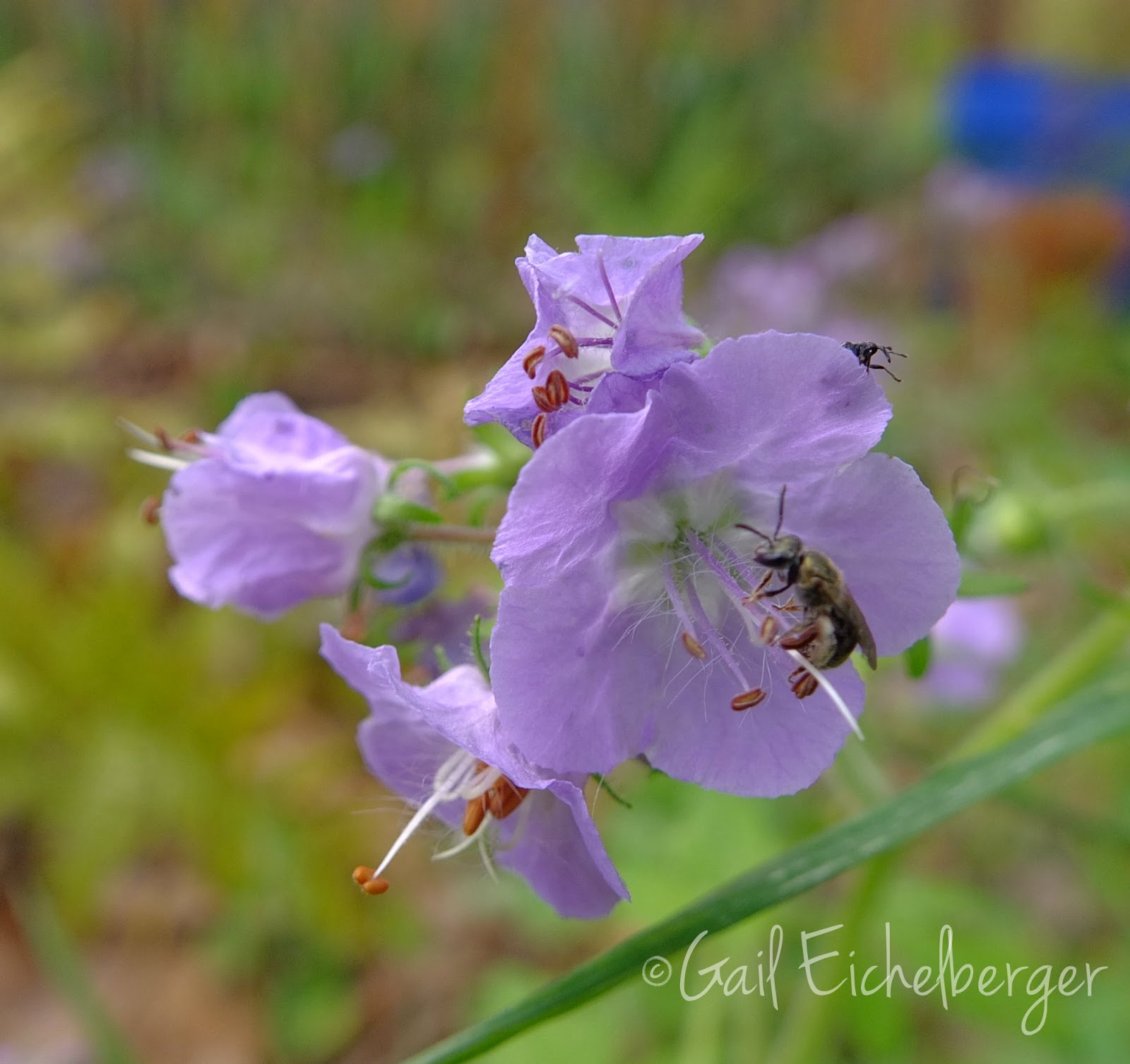
As all gardeners know, some years are better then others and this has been an especially good year for phacelia...It didn't get hot too fast and we didn't have punishing rains. As Goldilocks said, "...just right." It looks delightful right now and many native bees~like the Mason bee in the top photo, honeybees in one below and small unidentified pollinators have been visiting the plants since they opened. 
Phacelia  has pretty good wildlife value! Bees love it! They want the nectar and pollen and there is plenty of food for a variety of other visitors like skippers and small butterflies.

But, really,  Phacelia is all about the bees and that makes this gardener happy.

xoxogail

Gail Eichelberger is a gardener and therapist in Middle Tennessee. She loves wildflowers and native plants and thoroughly enjoys writing about the ones she grows at Clay and Limestone. She reminds all that the words and images are the property of the author and cannot be used without written permission.

Tuesday, July 1, 2008

Some Thoughts on a Biennial

Now, I know you all know that biennials complete their growth cycle within two years. But did you know that most biennials have a rosette of leaves and a taproot? The rosette is produced the first year along with a fleshy taproot...then it goes dormant for the winter. The taproot is a storage area for starches and sugars that the plant will utilize the following spring when it has a huge burst of energy, sending up a fabulous flower stalk. The parent plant withers and dies but not before producing loads of seeds to ensure that it will be around for a long time!

There are a few biennials in my garden. They are successful self sowers! Mullein, Rose Campion, Phacelia and Lunaria are among my favorites. The Phacelia and Lunaria are early spring bloomers and in a good year blanket areas with their sweet purple flowers.

The seeds of Lunaria are ripening now and will spread themselves about the garden.

I have never managed to collect the phacelia seeds in order to plant them in chosen spots around the garden. Phacelia seedling in the wildflower garden

So this spring, I ordered seeds* from Native Gardens, a Tennessee native plant nursery located in East Tennessee. Meredith collected the seeds, packaged them up and I broadcast them as soon as they arrived. Cross your fingers that they spread about and settle in. I love the flowers and posted about him earlier this year.

My hope is to have large swathes of color from both of these plants...they are easily removed if you don't like where they have seeded themselves.

The Rose Campion could never bloom and I would be happy. It's a cute little flower in rose pink that for some reason has reverted to white with a tiny hint of rose. Both nice colors. Don't get me wrong I love the flowers, but... it's the silver gray foliage that I admire. You can't have enough silver gray in a garden...


But, we need to talk about Common Woolly Mullein. A wonderful looking biennial with silvery sage coloring. This big, beautiful, woolly leaved plant is blooming right now. That's the problem. A serious problem according to some folks. Major flaws...

Common Woolly Mullein is considered a noxious weed in Tennessee and many other states. Here's what The Least Most Wanted site has to say!

Biology and Spread

"During the first summer after germination mullein produces a tap root and a rosette of leaves. During this vegetative stage, the rosette increases in size during the growing season until low temperatures arrest growth sometime during the autumn and winter. Beginning the next spring, second year plants bolt into maturity, flower, produce seed during the summer, and then die, completing the plant’s normal life cycle. Flowers mature from the base to the tip of the stalk. The length of the flowering period is a function of stalk height; longer stalks can continue to flower into early October. It is estimated that a single plant can produce 100,000-180,000 seeds which may remain viable for more than 100 years. The seeds are dispersed mechanically near the parent plant during the autumn and winter. Seeds at or near the surface are more likely to germinate."


Wow! That is a very successful naturalized plant! Or noxious weed!

On the other hand there are herbalists who love this big guy. The leaves, flowers and even the stems are harvestedto treat a number of respiratory ailments.

I didn't plant the mullein for its flower or its medicinal uses...it has always been the big woolly leaves that have captured my attention and interest...It has never gone to seed while in captivity at Clay and Limestone!
How Gail let this noxious weed be:

Last fall we reworked the hardscape and cut out the asphalt to extend this bed to the side door. We decided to make the bed cedar glade plant friendly. Baptisia, Grey Owl Juniper, Tennessee Coneflower, Salvia azurea and other natives were planted, along with a non native grass and the mullein. That's Verbascum thapsis with Juniperus virginiana, 'Gray Owl'.
The grass to the right of the mullein was moved there to soften the entrance. I found the woolly mullein in the front yard, a present from somewhere. I thought he would be a good foil for the juniper and the miscanthus. Doesn't he look good?

But, now we have this big yellow noxious weed, poised to take over the world! Well, my world!

He is really poised to take over empty fields...he loves a sunny, bare spot better than anything else....which may explain why there were only two small plants here. He found the only bare spots in the entire yard. I transplanted them to the sunny bed.

My promise:

I will remove the flowering stalk after I admire it for a few more days. It has an incredible presence. Goodness, it's already over 6 foot tall and growing! Do you suppose you can stop the biennial nature of a biennial by removing the flowering parts early in the second growing season? I cut back spent flowers on annuals to increase their longevity, would it work on a biennial? Can we neutralize him and keep him just a fluffy bunch of big woolly leaves? Lambs' Ear on steroids?

Just look at those leaves, they are absolutely perfect with the Gray Owl Juniper!

Sigh, it's hard having a conscience when you garden and love an invasive alien;-)

Gail

It is not enough to understand the natural world; the point is to defend and preserve it. Edward Abbey

*I also ordered Blue Eyed Mary seeds!