If you're looking for a charming native groundcover then look no further than Chrysogonum virginianum. The common name Green and Gold is a nod to its fuzzy foliage and golden flower.
 |
| The early bloom provides nectar for visiting bees and butterflies. |
It's been in my garden for more than a decade and is very much at home
between the large stepping stones on the path to the front door and in
the adjacent bed. I'm a fan of repetition planting; especially plants that are easy peasy. Green and Gold is easy to divide and transplant so, I've moved it all around the garden. It's happy in full shade and even in full sun. It flowers every spring and doesn't seem to mind a bit
of foot traffic every now and then.
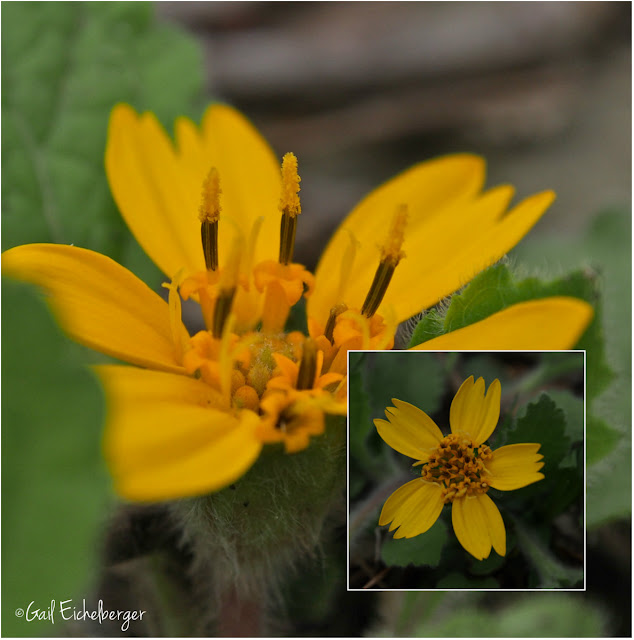
Chrysogonum virginianum is not just another yellow composite flower, it's a long blooming, great little native Asteraceae with semi-evergreen foliage and golden flowers. You'll find it happiest in woodland gardens that have good drainage in acid or neutral soil. Naturally occurring plants are found in bright filtered light along forest edges and clearings. Expect it to be vigorous, it is after all a ground cover.
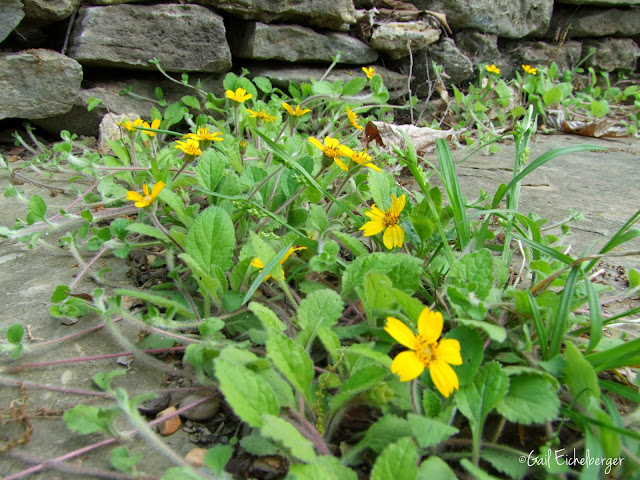
Green and Gold blooms early in my Zone 6b/7a garden; a few flowers will open in mid-March, but, April is when it pops. Then all at once the small golden flowers are waving above the green fuzzy leaves as if they're saying come on pollinators here I am!

It's a charmer that wends its way through native sedges, Huecheras, Spigelia marilandica, ferns and mayapples. It can dance with Phlox pilosa or ramble over a small boulder. The golden star flowers have five slightly-notched, yellow petals and a center of yellow disk flowers. The bright green leaves are ovate, with crenate (rounded teeth) margins. The leaves, stems and stolons are quite hairy or fuzzy.
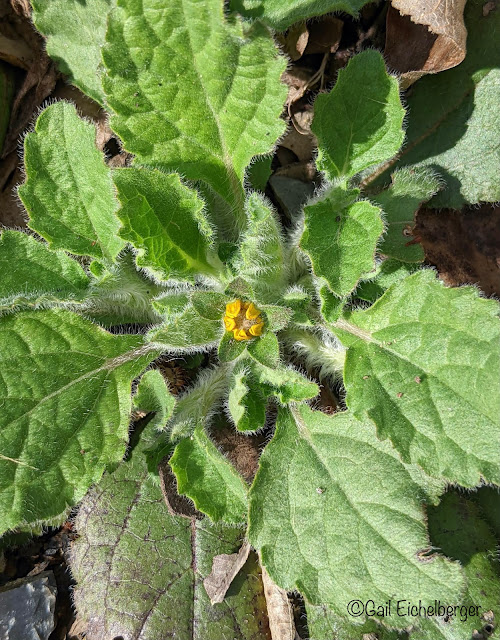 |
| The leaves, stems and stolons are fuzzy |
I recommend Green and Gold as an alternative to invasive thugs like Winter creeper (Eonymous fortunai), Creeping Jenny (Lysimachia nummularia) and Vinca minor. I wish big box stores and independent garden centers sold it instead of non-native thugs. Having mentioned thuggishness, please, remember, this native is a ground cover, so don't expect it to stay put, it will travel.
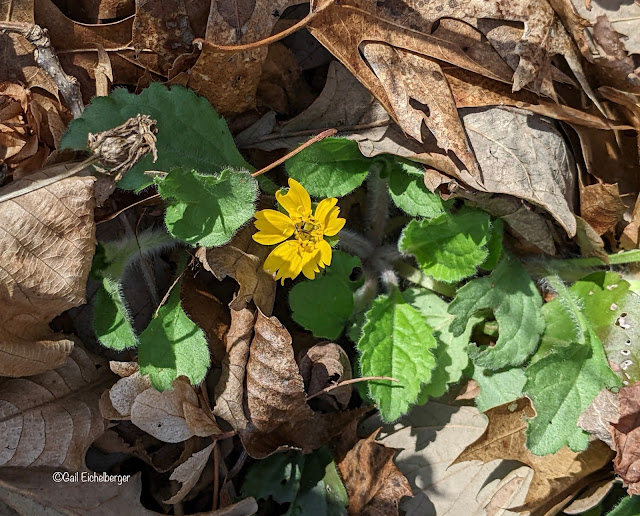 |
| fallen leaves and seedheads are a good mulch |
Good reasons to consider planting Green and Gold in your garden.
- Beautiful groundcover for shade and part shade
- Does well in a rain garden
- Will naturalize
- Lovely planted along the edge of a woodland path
- Good for planting at the base of native shrubs
- Easy to grow and maintain
- Nectar source for early visiting pollinators
The Essentials
Common Name: goldenstar, Green and Gold
Type: rhizomatous, low-growing perennial; Evergreen or semi-evergreen
Family: Asteraceae
Zone: 5 to 9
Distribution
USA: AL , DC , FL , GA , KY , LA , MD , MS , NC , NY , OH , PA , SC , TN , VA , WV
Native Habitat: Woodlands, dappled sun
Size: 4-6 inches high
Bloom Time: Late March, April, May and possible rebloom in the fall. If
you're gardening in its northern zone you might have summer
blooms, but it's too hot in Middle TN to bloom all summer. In a wet,
cool autumn there might be repeat blooms.
Bloom: Yellow
Sun: Part shade to full shade. If you want to plant it in the sun make sure it is well watered during
dry summers.
Water: Medium with good drainage. Once it's established it should be fairly drought
tolerant.
Maintenance: Low
Suggested Use: Ground Cover, Naturalize, Rain Garden
Tolerates: Deer, Shade, Drought
Companion planting: Dwarf crested iris (Iris cristata), Blue wood sedge (Carex flaccosperma), Christmas Fern (Polystichum acrostichoides), Hairy Alumroot (Heuchera villosa), Ohio spiderwort (Tradescantia ohiensis and Blue-stem goldenrod (Solidago caesia)or what ever combination of plants that need a spot of golden star beauty.
Comments: Nectar source for early visiting pollinators.
Even though it's a spring bloomer Green and Gold is an honorary member of the Clay and Limestone Rough and Tumble Wildflower club!

Take a chance on Golden star, you won't regret planting it.
xoxogail
PS Don't forget our Wildflower Wednesday monthly challenge! The first part of this challenge is to do something every month during 2022 that supports native wildflowers, pollinators, and the critters that visit and rely on our gardens. The second part of the challenge is to post about it somewhere: Your blog; Instagram, Facebook, Twitter or even your neighborhood listserve.
Why post it? Because positive publicity is needed to educate our friends, neighbors and communities about how important even the smallest changes we make as gardeners can be for pollinators, birds, insects and mammals that live all around us.
I don't issue a challenge without my own follow through! This month I've begun researching the effects of light pollution on our garden visitors and residents. I shared the information with our neighborhood FB group. I am also looking into signage for my garden that might help others learn about light pollution and wildlife. A long term plan is to get involved with locals who are also concerned with light pollution.
Thank you for stopping by and welcome to Clay and Limestone's Wildflower Wednesday
celebration. WW is about sharing and celebrating wildflowers from all
over this great big, beautiful world. Join us on the fourth Wednesday
of each month. Remember, it doesn't matter if they are in bloom or not;
and, it doesn't matter if we all share the same plants. It's all about
celebrating wildflowers. Please leave a link in the comments if you have a WW post.xoxogail
Gail Eichelberger is a gardener and therapist in Middle Tennessee. She loves wildflowers and native plants and thoroughly enjoys writing about the ones she grows at Clay and Limestone. She reminds all that the words and images are the property of the author and cannot be used without written permission.


