Home of the Practically Perfect Pink Phlox and other native plants for pollinators
Showing posts with label pollination. Show all posts

Tuesday, June 18, 2019

A Gentle Giant for Pollinator Week

To help celebrate Pollinator Week I am republishing this post from 2015 on Eastern Carpenter Bees/Xylocopa virginica. I've added a few details and refreshed some photos. I hope you enjoy it! xoxogail 

There's probably no other bee that arouses irritation quite like this gentle giant. Just search "carpenter bee" and you will get hundreds, if not thousands of "results" and almost all are about how to get rid of them.

They're very cool critters and I love them even though they have tunneled into my front porch deck and my carport stained posts. We had the porch painted and they don't like it! They continue to nest in our stained carport wood.

 
Robbing a Penstemon

Five interesting facts about this gentle giant.

1. These big beautiful, noisy bees are excellent pollinators. In fact, they are being studied across the globe for pollinating green house crops like passionflower, blueberries, greenhouse tomatoes and greenhouse melons.


2. They are generalist foragers and are known to pollinate garden crops and garden plants. Like eggplant (Solanum melongena), tomato (Solanum lycopersicum), passion fruit (Passiflora edulis) and other species in that genus, cucurbits (Cucurbita spp.), cassias (Cassia spp.), Carolina jessamine (Gelsemium sempervirens), cigar orchid (Cyrtopodium punctatum), bee balm (Monarda spp.), aromatic sumac (Rhus aromatica), and wild lupine (Lupinus perennis).


3. They are buzz pollinators - meaning they use vibrations, or sonication, to release pollen grains from the flower's anthers. To release pollen carpenter bees are able to grab onto the flower and move their flight muscles rapidly, causing the flower and anthers to vibrate, dislodging pollen. About 8% of the flowers of the world are primarily pollinated using buzz pollination. Wildflower gardeners~all Dodecatheon are buzz pollinated! Eggplants, potatoes, tomatoes, blueberries and cranberries are also buzz pollinated.


Camassia
4. They typically visit flowers that have large, open-faces with abundant nectar and pollen; bloom during the day; are pale or saturated in color; have a fresh odor; anthers specialized for pollen collection by bees; and corollas with strong walls.


5. They are nectar robbers and cheat the pollination process by breaking open the sides of flowers, like salvias and penstemons to get at the nectar! 

Bonus info. The menacing/dive bombing carpenter bee you encounter is only protecting a nest. It's a male drone and he's all buzz and no sting!


Happy Pollinator Week where ever you garden!xoxogail

PS In case you need a reminder! Please, never, ever, ever, ever, ever use pesticides in your garden. The pollinators will thank you by taking up residence and pollinating your fruits, vegetables and flowers!

Gail Eichelberger is a gardener and therapist in Middle Tennessee. She loves wildflowers and native plants and thoroughly enjoys writing about the ones she grows at Clay and Limestone. She reminds all that the words and images are the property of the author and cannot be used without written permission.

Monday, July 11, 2016

The nectar robbers are at it again.

Carpenter bees are notorious nectar robbers. That big body makes it hard to fit into many flowers and they will drill or cut into the corolla of a plant to get at the nectar. It looks like the stinkers are getting nectar without a pollen transfer which messes with the mutualism that one expects with pollination.

Today, as I watched a beautiful carpenter bee work its way around the flowers of  Phlox 'Jeane', I wondered if the nectar of that flower could be depleted and what effect that might have on pollination and other visitors?
I wondered what affect this would have on pollination

So I did a little research.

It was always assumed that nectar robbers had a negative impact on the plants that they visited, but that is not necessarily true. The authors of a paper published in the Ecological Society of America Oct 2000 examined the last 50+ years of research on this subject and concluded that nectar robbing could have a beneficial or neutral effect. Here's what they said, "The effects of nectar robbers are complex and depend, in part, on the identity of the robber, the identity of the legitimate pollinator, how much nectar the robbers remove, and the variety of floral resources available in the environment." If you want to read more follow my highlighted link above.
Carpenter bee zeroing in on the nectar machine P paniculata 'Jeana'

I have no idea what effect nectar robbing will actually have on P paniculata 'Jeana'. She is after all a nectar machine! Last summer she was covered with Swallowtail butterflies, skippers, hummingbird moths and bees for almost 6 weeks.

I am hoping that a little nectar robbing now doesn't rob me of the pleasure of watching all her pollinator visitors the rest of this summer!

xoxogail

Gail Eichelberger is a gardener and therapist in Middle Tennessee. She loves wildflowers and native plants and thoroughly enjoys writing about the ones she grows at Clay and Limestone. She reminds all that the words and images are the property of the author and cannot be used without written permission.

Thursday, September 17, 2015

I'm crazy about a good colonizing plant like Physostegia virginiana


If you like a well behaved plant that never, ever trespasses into another plant's space then forget about Physostegia virginiana, aka, False dragonhead, its colonizing ways will make you crazy.**
 the big late summer show from several seasons past
Of course, you could consider some other pretty lavender-pink late blooming flowers, but, you will miss the dramatic show and the cool bottom up bloom.
With colonizers you get free offspring and a dramatic show
 I didn't edit last year or this spring (hand surgery) and the result is a marvelous mass planting, much larger than usual. It makes me happy every time I step into the garden.  Surely this won't surprise any of you! My mostly native garden has its fair share of colonizers. I let them duke it out all summer and sit back to enjoy the fall show. It never disappoints me.
I garden for wildlife and grow False dragonhead because it's a magnet for pollinators, especially bumbles, carpenter bees and small bees and because it makes a wonderful and dramatic late summer/early fall show in the garden.

The purplish pink tubular flowers are perfect for plump little bumblebee bodies to slip inside and sup on the nectar and collect a little pollen.

 When you watch bees work these plants~ they move in and out, up and down and all around the flower head a mass planting makes sense.  When they're finished with one, they quickly move onto the next False dragonhead plant not a plant in a different genus. I've read that a planting of the same flower should be at least 4 foot wide...the key for me is "at least".  This planting is much larger~maybe 10 feet by 4 feet. This fall they'll have a whole lot of the same plant in one spot! That's what makes colonizing plants so attractive to me, they reproduce to create a nice sized planting for pollinators....and it's free plants. (I will have plants to share with others this fall.)
Bumbles are the primary pollinator~not the chubby carpenter bee~It's too large.
The entire flower head is striking, but, let's take a closer look at the individual flower. Do you suppose the dots, stripes and dots act like nectar guides to draw bees on to the perfect central lower lip landing pad? They're certainly colorful. When you get close you can see how perfectly designed the tubular flowers are for a bumblebee! It's a perfect relationship between bee and flower~ the bee gets food and the flower gets pollinated. We get to enjoy the beautiful flowers and watch the delightful critters.
A perfect flower for bumbles...ahhhh, the Pollination Syndrome at work!
Nature amazes me, every single day!
there's plenty of room for smaller bees


xoxogail

PS. In case you need a reminder, please make the pledge to never, ever, ever, ever use pesticides in your garden.

** Please don't call native plants invasive. They may be thugs, they may be aggressive, but, what they are is highly competitive plants that you must edit or decide not to plant in your gardens!

Gail Eichelberger is a gardener and therapist in Middle Tennessee. She loves wildflowers and native plants and thoroughly enjoys writing about the ones she grows at Clay and Limestone. She reminds all that the words and images are the property of the author and cannot be used without written permission.

Friday, March 20, 2015

Winter annuals for a native plant garden!

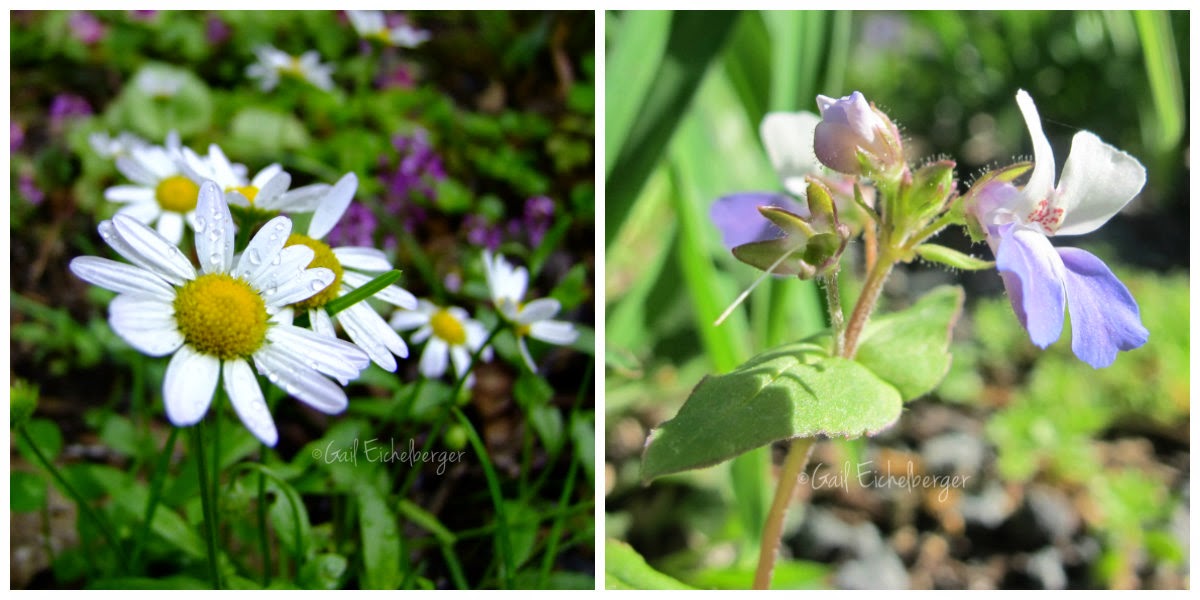
Two of my favorites, Entireleaf Western Daisy and
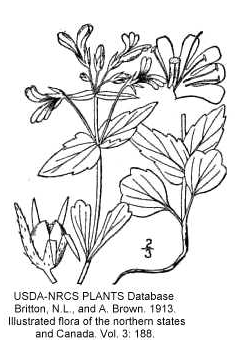
Blue-eyed Mary are showing off their attractive rosette stage.  (A Passalong Plant:Blue-eyed Mary)

We have a tendency to think of winter as a dormant season with plants at rest, but there really is a great deal of growing going on all winter. Just take a walk in your garden and you'll see signs of active life! Mosses, fungi and lichens are alive and thriving and the weedy winter annuals are reminding you that weeding isn't too far away! (go toThe Fascinating World of Fungi for more on them)
Edible Auricularia auricula/Jelly Ear growing on dead hardwood branch (January)
The stars of this post, Blue-eyed Mary and Entire leaf Western Daisy have been germinating and developing underneath the leaf litter in my garden. They both are cool season growers, are tolerant of really cold weather (and snow) and, are excellent reseeders in most gardens. By the way, that's how other winter annuals like Chickweed, Henbit, etc. get a toe hold in our gardens.
Astranthium integrifolium/Entireleaf Western Daisy

Entireleaf Western Daisy starts blooming in April (and keeps on going most of the summer). Blue-eyed Mary is also an April bloomer, but, blooms only for about three weeks. If pollinated, they set seed that matures and drops onto the garden soil where it has several months of warm stratification (necessary) before it germinates. I find they both germinate best in situ and you need to be on top of  the BEM in order to  harvest ripe seed, (it needs to be planted immediately).

Here's what works for me: Place a soil filled container near them to catch falling seeds; leave the container in the garden until the following late winter or early spring and then plant those seedlings when the ground is no longer frozen. Repeat to increase your collection.

Collinsia verna/Blue-eyed Mary
The only problem with these wonderful winter annuals is that they they aren't generally available at nurseries. I suspect that seed collection is a big issue. They're also rather fragile, especially Blue-eyed Mary, and that's not an ideal selling point. I know that GroWild (call them) had a few Collinsia verna/Blue-eyed Mary for sale. When it comes to Astranthium integrifolium/Entireleaf Western Daisy, unless you know me and live in Middle Tennessee, you may be plumb out of luck trying to find it.

I am hopeful that there will be blooms to show you later this spring, in the mean time, here's a peek at what's to come.


Happy Spring my friends.
xoxoGail

Gail Eichelberger is a gardener and therapist in Middle Tennessee. She loves wildflowers and native plants and thoroughly enjoys writing about the ones she grows at Clay and Limestone. She reminds all that the words and images are the property of the author and cannot be used without written permission.

Thursday, May 22, 2014

Nectar Robbers


Carpenter bees are notorious nectar robbers. Their big body makes it hard to fit into some flowers and they will drill or cut into the corolla of a plant to get at the nectar.

The stinkers are cheating the flowers; they get the nectar without a pollen transfer. I am not too worried, pollination must be happening, there are plenty of offspring.

The next time you're in the garden check the corollas on the tubular plants (penstemon, salvia, cuphea) for evidence that the nectar robbers have been there.

xoxogail

PS You can read more about Carpenter bees here and here.


Gail Eichelberger is a gardener and therapist in Middle Tennessee. She loves wildflowers and native plants and thoroughly enjoys writing about the ones she grows at Clay and Limestone. She reminds all that the words and images are the property of the author and cannot be used without written permission.

Wednesday, May 29, 2013

Bottoms Up: An Almost Wordless Wednesday

Ahh... Bumbles!

The Bumbles are out and about...They took forever to show themselves in the garden and bottoms up is what we'll see from now on!  

I am one happy gardener.

xoxogail

Gail Eichelberger is a gardener and therapist in Middle Tennessee. She loves wildflowers and native plants and thoroughly enjoys writing about the ones she grows at Clay and Limestone. She reminds all that the words and images are the property of the author and cannot be used without written permission.

Friday, February 24, 2012

Tommies On My Hillside Sing A Spring Song


The Tommies are in bloom!  I wish you were here to see them!  I know they must be making a statement because Mr I Do Not Garden or Blog thinks they look wonderful.

He's right, they do look pretty wonderful.


Just look at that flower, it's covered in golden delicious pollen.

 But, you don't have to take my word for it.
The hillside that has charmed me for decades!
 You might remember my inspiration!  A dream of a hillside with tens of thousands of Tommies.

 I think I've finally found my hill.  It was covered with forsythia and made the entrance to the house feel crowded.  Early last fall we cleared the shrubs and planted  Juniperus virginiana 'Gray Owl', Panicum virgatum 'Northwind',  stone unearthed in the clearing process and of course Crocus tommasinianus.

So far the Tommies are unscathed by the resident rodents!  The hill has perfect drainage, great soil and plenty of sunshine. They just  need one other  thing to insure that they naturalize with ease and
also planted on Tommie Hill
It sure looks to me like the bees are doing their best to make sure there will be more Tommies at Clay and Limestone!
xxoogail

Gail Eichelberger is a gardener and therapist in Middle Tennessee. She loves wildflowers and native plants and thoroughly enjoys writing about the ones she grows at Clay and Limestone. She reminds all that the words and images are the property of the author and cannot be used without written permission.