Home of the Practically Perfect Pink Phlox and other native plants for pollinators
Showing posts with label Small garden plants. Show all posts

Wednesday, October 31, 2012

Amsonia After The Fall

It's the end of October and the Amsonias are winding down.
 Amsonia hubrichtii
Gone are the wispy clouds of gold
A'Seaford Skies' (A. hubrectii x A. tabernaemontana)
Gone are the amber leaves with hints of burgundy.

 A. tabernaemontana cross
Gone are the rich autumn colors.

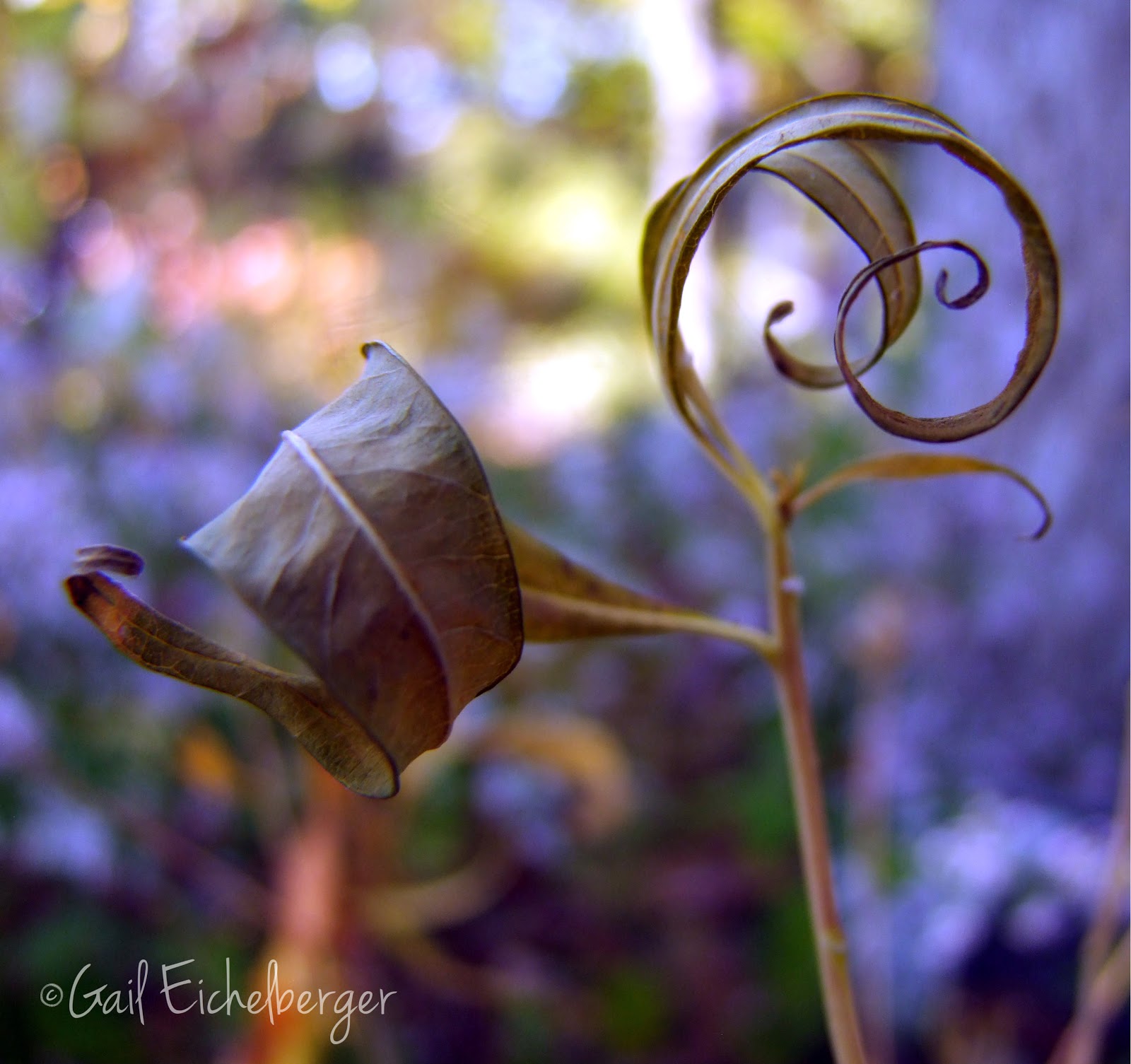
In their place are beige curls. Wonderful beige curls that are too easily over looked in a garden filled with ex-asters, the last 'Lovely Fairy' rose and trees still holding onto their golden leaves.

Do yourself a favor, head out into your garden and take a close look at the fading Amsonias, you might be surprised to find~
Golden curls.


Ribbons curls.
Curlicues.


Camouflage curls.


More curls than you can possibly imagine!
They make this gardener smile and I'm pretty sure they'll make you smile, too.

xxoogail


Gail Eichelberger is a gardener and therapist in Middle Tennessee. She loves wildflowers and native plants and thoroughly enjoys writing about the ones she grows at Clay and Limestone. She reminds all that the words and images are the property of the author and cannot be used without written permission.

Wednesday, August 22, 2012

Wildflower Wednesday~Two Native Verbenas

Verbena hastata
I love verbenas...and the two natives I have growing in my garden are a treat to the eyes in this time of golden yellow rudbeckias.
Rose vervain with Brown-Eyed Susan, 'Grey Owl' Juniper and Switchgrass
I've grown Verbena/Glandularia canadensis 'Homestead Purple' for years, but, have never found it happier than in its new home on the Tommies Hill. The full sun and excellent drainage have kept this fellow blooming from early spring, when it was planted, all though this long hot summer. There are half a dozen or so plants on the Hill and I am more than sure they would cover the entire bed if Rudbeckia triloba hadn't sprouted there!

'Homestead Purple' is a chance hybrid that was discovered by Alan Armitage and Michael Dirr at a Georgia country homestead while they were driving  back to Athens, Georgia. They saw a patch of brilliant purple flowers and stopped to speak with the homeowner, took cuttings and the rest is history. 

We have them to thank for a plant that blooms for months; provides nectar for visiting bees, skippers and butterflies and is one of the best flowering groundcovers ever!  It's not unusual for Rose verbena to be semi-evergreen in my Zone 7 garden, but, it will die out in badly draining soil.  So plant it on a well drained site with full sun and let it fill in.

If you're like me  you can combine it with golden yellow rudbeckias, purple asters, Liatris, Echinaceas, Gaillardias and native grasses or go for a tamer look and plant it in the front of abed with sweet pale yellows and blues and silvers. 

'Homestead Purple' is a perennial in zones 7-10 but, the species is perennial in the Central Plains and the Eastern US.
each bloom is about 1/4 inch~now that's tiny
Verbena hastata is new to Clay and Limestone~by new I mean brand new, having just brought several plants home from GroWild (my go to nursery for native plants) this past week. I am so excited about this plant, that I am willing to do what I can to make Swamp Verbena happy!
A hard spot to photograph, it's either too shady or too sunny!

Yes, Swamp Verbena is the common name and it's happiest in a moist soil; will even tolerate soggy for a bit of time. They're planted on the far edge of the Susan's Bed in a newly dug space between slabs of bedrock where I hope it will stay moist enough to keep it happy the rest of the summer and will then settle in nicely during our usually wet, wet winters. That's the plan!  We'll see if the weather and the verbena cooperate.

You'll find V hastata in almost every state and province minus a few in the US and Canada...
Flowers on each spike bloom bottom to top
Here's what I like about this plant and why I was so excited.  It's cute.  It's a slender, upright plant with lanceolate, serrated leaves and it has flowers on showy candelabra-like spikes.  The flowers are the  tiniest little things and each one is about 1/4 inch and they open a few at a time from the bottom up.  Did I mention that the tiny little flowers are a marvelous blue-purple that are just what this garden needs in the middle of the time of rudbeckias!

More importantly, they also fit right in with the other rough and tumble, take care of them selves wildflowers that do best in my garden. If it's happy, it will grow tall, form a small colony, bloom for months and attract pollinators.
If your lucky you might even find a Bumble on one...Just in time for Wildflower Wednesday!

xxoogail
Welcome to Clay and Limestone's Wildflower Wednesday celebration. WW is about sharing and celebrating wildflowers from all over this great big, beautiful world. Join us on the fourth Wednesday of each month. Remember, it doesn't matter if they are in bloom or not; and, it doesn't matter if we all share the same plants. It's all about celebrating wildflowers. Please leave a comment when you add your url to Mr Linky.


Gail Eichelberger is a gardener and therapist in Middle Tennessee. She loves wildflowers and native plants and thoroughly enjoys writing about the ones she grows at Clay and Limestone. She reminds all that the words and images are the property of the author and cannot be used without written permission.

Wednesday, March 28, 2012

Collinsia verna, A Passalong Plant for Wildflower Wednesday

I love how the little flower head is almost always tilted, giving her a pert look
I have several plants that fit in the passalong category, but, none is more treasured than Collinsia verna.

The flower reminds me of the colors of the spring sky
One look at that face with its bicolored flowers and you'll know why I walk the garden looking for seedlings in late winter and early spring.  Don't you think the blue and white petals are a perfect match for a spring sky. Sigh.  It's a sweet little flower that deserves to be sown in many more gardens.

This is what I look for starting in February

Blue-Eyed Mary is a winter annual that can be found growing in rich deciduous woodlands from New York to Wisconsin and down into Tennessee.  Like other winter annuals it germinates in the fall and overwinters as small two or three leaved seedlings that begin growing again in February.  That's why I begin my search so early.
another small flower that requires crawling on knees to really see

I've tried for years to get it established at Clay and Limestone, starting back in 2006 when I ordered seeds from the Native Garden Nursery. They arrived along with seeds for Purple Phacelia, a sweet native clematis and excellent planting instructions. But, just when I think it's here to stay, they all, but disappear.  I am not alone in my curiosity about their iffiness! Botanists researching Collinsia verna have observed dramatic fluctuations year to year in germination rates in woodland colonies. Of course they decided to set up an experiment or two in which they were able to determine that if bumbles and other pollinators weren't available that Blue-Eyed Mary will self fertilize.  Pretty cool!  If you want to know more about the study follow the link~(research study sited)

The bumbles were out and about last spring and surely visited the small colony, but, even if they missed the Marys, maybe they self-pollinated and dropped seeds that didn't germinate.  I've concluded that a long hot, dry summer followed by an even drier fall made it especially difficult for germination. The good news is that if the plants dropped seeds then, they are likely to be found dormant in the C and L soil seed bank just waiting for optimal conditions! I might have to provide a little water if Mother nature repeats last year's especially dry fall.
there are usually four seeds per flower
 I still search for seeds and plants every year. 
the transplants have  already perked up in the garden
This year I didn't have far to go.  Just when I had about given up hope of  finding any in my garden, I  got an email from Ginny, a Clay and Limestone reader, asking me if I might want a few plants from her   Middle Tennessee garden. Want them, of course I did!   She very kindly  invited me over and I dug several clumps, toured the garden, had a fantastic visit and only managed to take one blurry photo.

I sure hope the Bumbles do their job this year and that Mother nature cooperates with good fall rain
You may be asking yourself, "What kind of garden blogger forgets to take photos!"  The kind who jumps up and down with joy when a kind reader offers to share a hard to come by flower. Thank you Ginny very much.

xxoogail

More facts about Blue-Eyed Mary:

  • Collinsia verna is a plant of moist woodlands and will germinate better if soil is moist and cool in the fall.
  • It grows taller and stronger in full sunlight, but, requires consistently moist, well draining soil. Give it dappled sunlight and moist soil in a southern garden.  
  • One thing to keep in mind is that Blue Eyed Mary seeds are germinating  at exactly the same time that many gardeners are  raking leaves and cleaning up their gardens.  Gardeners who like to let leaves remain in place are going to have better success in keeping Collinsia verna in their garden.
  • The nectar and pollen of the flowers attract bumblebees and other long-tongued bees. The flower buds and seed capsules of Blue-Eyed Mary are food for the caterpillars of the butterfly Celastrina argiolus (Spring/Summer Azure). 
  • If they bloom before Bumbles are out and about they can self pollinate.
  • They're now listed as an endangered plant and have protected status in many states.
  • I pinky swear to let you all know where to find seeds. 
  • I forgot to say, that Terri Barnes of GroWild shared seeds with me, too. Terri, they did germinate, I just found tiny little seedlings. xo


Welcome to Clay and Limestone's Wildflower Wednesday celebration. WW is about sharing and celebrating wildflowers from all over this great big, beautiful world. Join us on the fourth Wednesday of each month. Remember, it doesn't matter if they are in bloom or not; and, it doesn't matter if we all share the same plants. It's all about celebrating wildflowers. Please leave a comment when you add your url to Mr Linky.


Gail Eichelberger is a gardener and therapist in Middle Tennessee. She loves wildflowers and native plants and thoroughly enjoys writing about the ones she grows at Clay and Limestone." She reminds all that the words and images are the property of the author and cannot be used without written permission.