Home of the Practically Perfect Pink Phlox and other native plants for pollinators
Showing posts with label Salvia elegans. Show all posts

Wednesday, October 9, 2019

Salvia elegans is delightful in a pollinator garden


 I believe that adding pollen and nectar rich non-natives enhances a pollinator habitat...especially the ones that bloom in mid fall. Our middle south growing season is long; bees that are provisioning their nests for the winter and migrating butterflies and hummingbirds need all the help that they can get in blooming plants. Pineapple sage is especially valuable at this time of year. This fabulous native of South America blooms in early fall just when the garden needs a jolt of delicious red and the hummers moving south need nectar to fuel their flight.

Salvia elegans was planted in 2009 and survived a mild winter with only leaves for mulch, but, a normal and wet winter killed it and now it lives in containers from spring until the first killing frosts. I say killing frosts because I protect all my blooming plants, annuals and perennials, with old bed sheets if we are continuing to have warm days and only an occasional fall frost.

Salvia elegans is culinary plant that I don't even think about eating. Even if they are said to be tasty in a salad, I won't be picking the flowers, not after waiting all season for them to bloom.
The Cloudless Sulphur, Phoebis sennae nectaring on Salvia elegans
 Once they bloom the Cloudless Sulphurs are all over them. That's one reason they're in my garden. The other one is that they are attractive to hummingbirds and are blooming when they migrate through middle Tennessee.
I think of Pineapple sage as a hummingbird and butterfly plant and was surprised to see this bee nectaring.
Pineapple sage is fast growing, but slow to bloom. I tuck them into containers and patiently wait for the fall show. The 3 inch plants I planted in spring are 3 foot tall and 2 foot wide with bright green leaves that are a foil for the scarlet red flowers. In a sunnier garden with moist soil they can reach sub-shrub size.  Already this season there have been butterfly, hummers and bees nectaring on the scarlet blooms.
Critters beware! A Crab spider is lurking.
 It goes without saying that its best in fall when it sends up those vivid red flowers. If you want gorgeous summer color plant S elegans ‘Golden Delicious', the fire-engine red blooms and chartreuse leaves are incredible and look smashing with the purple blues of the ex-asters.


 The Particulars in case you wanted more info!

Family: Lamiaceae with typical characteristics of opposite leaves and square stems.
Genus/species: Salvia elegans
Common Name: pineapple sage
Type: Herbaceous/shrubby perennial
Zone zones 8 to 10:
Height: 3.00 to 4.00 feet
Spread: 2.00 to 3.00 feet
Leaves: ovate, soft-hairy, light green (to 3” long).
Flower: Two-lipped bright scarlet red flowers (to 1” long), in loose whorls, bloom on terminal spikes to 8” long from late summer into fall.
Bloom Time: August to October
Sun: Full sun
Water: Medium, well draining
Comments: An easy peasy plant for middle south and southern gardens. Folks gardening further north might have to move it inside to appreciate the bloom. They may bloom too late for hummers, but, you can enjoy the beauty and add the flowers to your salads. I have been known to cover them when a frost is forecast and warm weather is expected to return.  
Attracts: Hummingbirds, Butterflies and bees


xoxogail


Gail Eichelberger is a gardener and therapist in Middle Tennessee. She loves wildflowers and native plants and thoroughly enjoys writing about the ones she grows at Clay and Limestone. She reminds all that the words and images are the property of the author and cannot be used without written permission.

Tuesday, October 17, 2017

Must have fall blooming supportive players for my wildlife friendly garden

Dear friends,

The plants in my garden need to be more than just pretty faces. These three non-natives provide much needed nectar and/or pollen in mid/late fall when many native plants have gone to seed. My garden continues to be mostly native, but I believe that adding pollen and nectar rich non-natives enhances a pollinator habitat. Our growing season is long; bees that are provisioning their nests for the winter and migrating butterflies and hummingbirds need the extra blooms that they bring to the garden.

They also have very pretty faces.

xoxogail

Of course, you all know that the very best thing you can do for bees and other pollinators is to never, ever, ever, ever use pesticides! 


 For long bloom and a fantastic pollinator buffet, plant African Blue Basil. 
 It's a sensory treat of pretty flowers, buzzing bees and fragrance all summer long.


It's a tender perennial and blooms non-stop...Well, until a freeze stops it. It's not an easy plant to find, but, worth the trouble to locate it.
Ocimum kilimandscharicum x basilicum 'Dark Opal'
 The leaves of African blue basil are purple when young and folks claim that it makes a wonderful pesto! I'll never know because I am growing this beauty for the bees.
Oh my gosh, is this ever a buffet for bees of all sizes.

Family: Lamiaceae 
Cultivar: Ocimum kilimandscharicum x basilicum “Dark Opal”
Type: Tender perennial
Hardiness Zone:  9-11
Height: 2 feet in my garden
Spread:  2 feet 
Color:  Purple leaves. Whitish/pinkish flowers
Bloom: non-stop summer until frost
Comments: It's sterile and never sets seed, so I will take cuttings and hope they make it through the winter. It's taller than most basil plants and if that bothers you, pinch the tips and it will remain shorter and fuller. This should be in every pollinator garden...It's blooming now and has been for months.


Another must have for my garden is the late blooming Pineapple sage.


This fabulous native of South America blooms in early fall just when the garden needs a jolt of delicious red and the hummers moving south need nectar to fuel their flight. 
The Cloudless Sulphur, Phoebis sennae nectaring on Salvia elegans
Salvia elegans is another culinary plant that I haven't brought to the table! I can't imagine picking the flowers (even if they are said to be tasty in a salad) after waiting all summer for them to bloom. Once they bloom the Cloudless Sulphurs are all over them. That's one reason they're in my garden. The other one is that they are attractive to hummingbirds and are blooming when they migrate through middle Tennessee.
I think of Pineapple sage as a hummingbird and butterfly plant and was surprised to see this bee nectaring.
Pineapple sage are fast growing, but slow to bloom. I tuck them into the Susans Bed and patiently wait for the fall show. The 3 inch plants I planted in spring are 3 foot tall and 2 foot wide with bright green leaves that are a foil for the scarlet red flowers. In a sunnier garden with moist soil they can reach sub-shrub size. This season there have been butterfly, hummers and bees nectaring on the scarlet blooms.
Critters beware! A Crab spider is lurking.
Family: Lamiaceae
Genus/species: Salvia elegans
Common Name: pineapple sage
Type: Herbaceous perennial
Zone zones 8 to 10
Height: 3.00 to 4.00 feet
Spread: 2.00 to 3.00 feet
Bloom Time: August to October
Color: Red
Sun: Full sun
Water: Medium
Comments: An easy peasy plant for middle south and southern gardens. Folks gardening further north might have to move it inside to appreciate the bloom. They may bloom too late for hummers, but, you can enjoy the beauty and add the flowers to your salads. I have been known to cover them when a frost is forecast and warm weather is expected to return.  
Attracts: Hummingbirds, Butterflies and bees


Salvia x 'Mystic Spires' is a third must have supportive player for my wildlife friendly garden.
Bombus pennsylvanicus is my guess, but it is only a guess!
This is a stunning blue flower that looked wonderful with the Golden Asters that bloomed in September. I don't plant this in the garden, but into containers that I strategically place in the garden.  The nectar rich flowers attract a variety of pollinators including hummingbirds, butterflies, and a variety of bees, but especially bumblebees in my garden.

A month of 90+ weather didn't stop 'Mystic Spires' from flowering. I expect it to flower until we have a freeze. You can be sure I will cover this one if warm weather is forecast to follow a freeze or frost!  I am hoping it will overwinter, because this is a fantastic plant for a critter friendly garden. 


Family: Lamiaceae
Salvia x 'Mystic Spires'
No common name
Parentage: (S. longispicata and S. farinacea)
Type: Perennial in zones 7b to 10b
Height 3 ft. to 6 ft.
Spread 1 ft. to 3 ft.
Light Full Sun
Bloom: Early Summer, Late Summer, Summer
Color: Deep blue, incredibly showy
Comments: Is happy in a container. Might overwinter if winter drainage is good in  Zone 7. If it looks scraggly or needs to be refreshed, just cut it back, more blooms will follow.
Wildlife: Attracts Butterflies, Bees,  Hummingbirds


PS  Now make this garden blogger smile and pop over to May Dreams Gardens, where our delightful hostess, Carol, has set up the Mr Linky magic carpet ride to take you to more Bloom Day posts than you can imagine.

Gail Eichelberger is a gardener and therapist in Middle Tennessee. She loves wildflowers and native plants and thoroughly enjoys writing about the ones she grows at Clay and Limestone. She reminds all that the words and images are the property of the author and cannot be used without written permission.

Wednesday, November 13, 2013

Wordless Wednesday: Last Butterfly In The Garden

 The cloudless sulphur, Phoebis sennae nectaring on Salvia elegans

xoxogail


Gail Eichelberger is a gardener and therapist in Middle Tennessee. She loves wildflowers and native plants and thoroughly enjoys writing about the ones she grows at Clay and Limestone. She reminds all that the words and images are the property of the author and cannot be used without written permission.

Tuesday, October 15, 2013

GBBD: October 2013

 Welcome to my Central Basin woodland garden and the Garden Bloggers Bloom Day fall show.

The garden has begun its transition from the golden hues of the Susans and the Goldenrods to the the soft purple mist of violets and blues of the ex-asters. They aren't the only flowers in bloom, but, they are the big fall show and dearly loved by the many garden residents and visitors who visit for pollen, nectar and seeds.
The centers turn red centers when the flower is pollinated
Symphyotrichum shortii(N) is by far the most abundant ex-aster in the garden. They were one of the first wildflowers to introduce themselves to me almost 30 years ago when we moved into this wooded neighborhood and I've loved them ever since. I let them stand all winter and set seed every where. I think they are stunning massed, but, for a less exuberant look pair them with grasses and bold leaved plants.
Don't tell the other seasons, but, Autumn is my favorite and October is my favorite month! The sky is a seamless blue, the days are cooler and the light is fantastic. (See post October Blue Skies)
Aster tataricus
It's a busy time in the garden, even busier than spring. Wildflowers welcome the foraging bees, the nectaring butterflies, a host of other pollinators and birds as they make a mad dash to mate, to provide for offspring or to prepare themselves for migration. (see Pardon My Big Aster for more on Aster tataricus)

It's one of the best times to photograph the critters, they're slower and pose sweetly on the flowers. I like to think they're savoring the last of the pollen and nectar.
Gaura lindheimeri 'Crimson Butterflies'
Many of the plants that stopped blooming in the summer make a repeat visit in October. I welcome back the pink butterfly blooms of Gaura lindheimeri. It sulked all summer, but is putting on a vary nice show right now.
Some wildflowers only bloom in the fall and Eupatorium serotinum(N) is one of them. It's a magnet for pollinators and colonizes wonderfully to fill in large areas with its white Asteraceae blooms.
Salvia leucantha
 Salvia leucantha is a very late bloomer. It opens up when one needs its pop of violet and white flowers, just in time for the last of the nectar robbing carpenter bees to forage on it.
Luscious, velvety Salvia azurea(N) is a counterpoint to the yellows and golds of early Autumn. Collect seed and sow in the garden for a large stand.
Floppy Golden Aster (N) brings a much needed spot of golden yellow back to the garden when the Susans fade.
The Sulphur butterflies rejoice when Salvia elegans begins to bloom. They've been circling the garden for weeks, waiting to make a big yellow statement against the intense red flowers. The hummers are thrilled, too. If truth be told, so am I.

Although, this is a native plant garden, I do plant annuals like the Salvias mentioned earlier, delicious red Pentas (above) multi-colored lantanas, a few violas, cupheas, Purple hyacinth vine and,
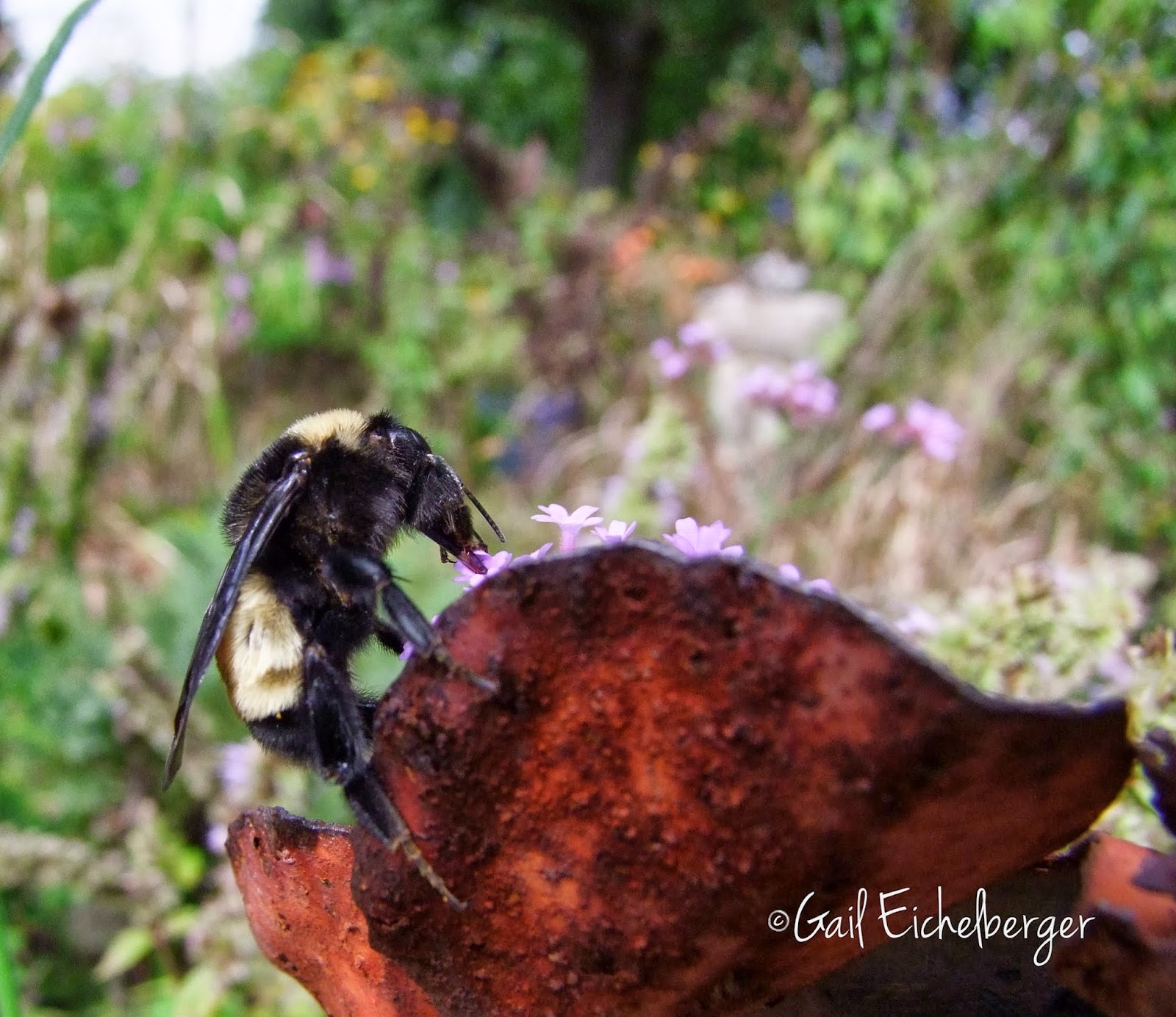
Bumble resting on the rusty sunflower while nectaring on the Verbena bonariensis
Verbena bonariensis for their long bloom, their lovely flowers and to feed the pollinators. The sight and sounds of busy bees, butterflies and other critters makes me happy.
Before long the humming and buzzing will be gone, until then I will appreciate each and every flower that feeds the critters and fills my heart with joy.

xoxogail

It's October 15 and you know what that means! Garden bloggers all over the blogosphere are celebrating Bloom Day. You can see more gardens then you can imagine in one day if you stop by Carol's blog, May Dreams Gardens to take the Mr linky magic carpet ride to flower adventure.

Gail Eichelberger is a gardener and therapist in Middle Tennessee. She loves wildflowers and native plants and thoroughly enjoys writing about the ones she grows at Clay and Limestone. She reminds all that the words and images are the property of the author and cannot be used without written permission.