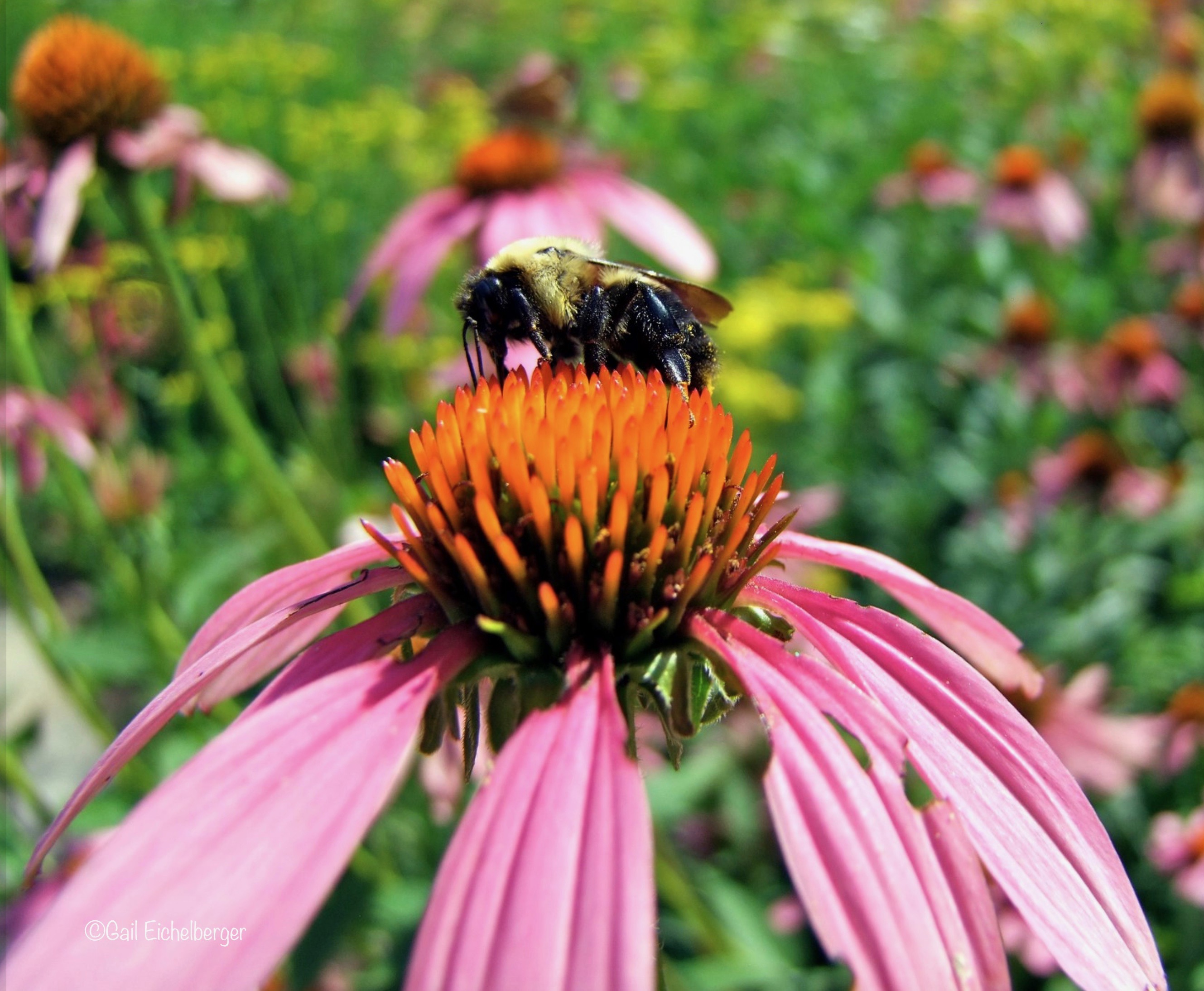
I appreciate all the pollinators at Clay and Limestone, but, my favorite has always been Bumbles.
We moved into this house in early fall 3 dozen years ago. The yard was a mess and there were no real garden beds, but the Summer Phlox and blue wood aster were still blooming. I was captivated
by the Bumbles who were actively working the flowers as much as I was by the
flowers. Those bumbles stole my heart. Over the years I noticed how hard they worked in the garden. They were the first pollinators up and about each morning and the last to leave each night. I
found them sleeping on flowers on cool mornings and watched them
nectaring and gathering pollen on the last of the latest blooming
ex-asters in November. They were a joy to watch and I wanted to learn all about them. (from earlier post)
Many years later and Bumbles still make me smile, but, so do a dozen other pollinators. To celebrate June Wildflower Wednesday and Pollinator Week here are more wildflowers and their pollinator visitors.
Phlox paniculata and a Carpenter bee

Although, Bumbles are hard workers, they are not the only active garden visitors. When the Bumbles are slow to arrive Eastern Carpenter bees are out and about visiting some of the earlier flowers. They are generalist foragers and are known to pollinate garden crops and garden plants. Who could not love these giant beauties. The menacing/dive bombing carpenter bee you encounter is only protecting a nest. It's a male drone and he's all buzz and no sting! In the photo above you can see them "nectar robbing" Phlox.
The first Phloxes in this garden were here when I arrived. They were the offspring of whatever the previous gardeners might have planted 30+ years ago and were all wonderful magenta flowered beauties. They are still here, well, the offspring of the offspring are still here and after years of letting species and cultivars go to seed, real treasures have been produced in the crossings of the crossings.
Butterflies, moths (including Hummingbird and Sphinx moths) and skippers are the primary pollinators of phlox.
Their proboscis are long enough to reach the nectar at the base of the
narrow phlox corolla and pollen is carried to the next flower. In fact, Phlox has all the characteristics of a classic butterfly nectar flower.
- clustered flowers with a landing platform
- brightly colored
- open during the day
- ample nectar producer
- nectar deeply hidden in corolla
Silvery Checkerspot on Gloriosa Daisy.
 |
The Gloriosas have most of the characteristics of their Rudbeckia hirta parent, except the flowers are three times as large and their colors are mixtures of pure yellow or bicolored, many with dark mahogany red splotches at the base of the petals. Yes, I do love the many colorful varieties and the big flowers, but I also love that they're all rough and tumble flowers that can take the heat and humidity of our Middle South summers and continue to bloom until frost (deadhead them). Gloriosa Daisies do very well.
Butterflies, bees of all sizes, wasps, beetles and even little loper caterpillars rely on the many Susans for food, and shelter. Plant them in your garden and sit back and watch the pollinators. I've already seen small Carpenter Bees, Green Metallic bees, Bumbles and skippers visiting the flowers to feed and/or gather pollen. Above photo: Silvery checkerspots which can be seen in meadows and forest openings.
Partridge Pea and Bumbles

First, cool thing: Those cool flowers, that the bumbles make a mad dash for every
morning, have no nectar, only pollen. The bees are attracted to the
food pollen on the purple anthers, and get dusted with the reproductive
pollen from the yellow anthers. Nature is amazing and plant
reproduction is so cool. Second, cool thing: Partridge Peas are not nectarless. Nectar is produced at the base of the leaf in tiny,
reddish-orange glands called nectares. Ants visit them regularly. Third cool thing: These are annuals and they will always be in your garden because they seed about so beautifully. Fourth cool thing: They're the larval host for Cloudless giant sulphur, Orange sulphur, Sleepy orange butterflies. See photo of Sulphur on Coneflower later in post.
Mountain Mint and a fly

The flowers of Pycnanthemum muticum might be small, but they are mighty!
The researchers at Penn State's The Pollinator Trial
found that Clustered Mountain Mint was the best plant for flowering
longevity; for pollinator visitor diversity; for sheer number of insect
visitors (78); and, for sheer number of bee and syrphid visitors.
...and yes, it's a mint so be prepared for it to move across your garden!
Ruellia strepens and a butterfly

Much to my sorrow, I have never, ever seen pollinators on a blooming flower, but, I've read that long tongued bees,
miner bees, carpenter
bees and parasitic bees are its primary pollinators. Apparently,
fertilization has been very successful in my garden, because the
progeny is all over. Maybe, the pollinators are sneaking visits when I
am inside. But, it's more likely as Researchers at a college in Missouri, discovered: flowers of R strepens
open during the early morning dark hours, allowing pollination by moth
species. That's good to know. According to another source the
lavender-blue trumpets attract hummingbirds and butterflies, too. Here's a link to a site with a bee foraging on the flower! Let me tell you, I was thrilled to find it!
Asclepias speciosa bumble and Eastern Tiger swallowtail
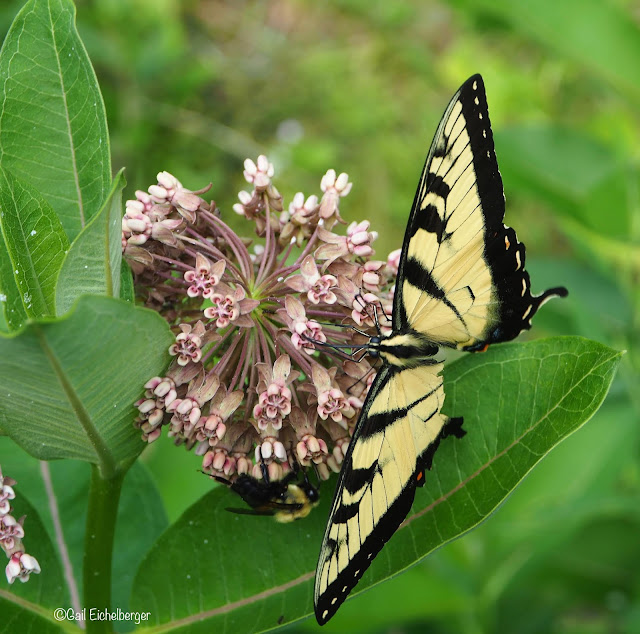
"Common milkweed is Nature's mega food market for insects. Over 450 insects are known to feed on some portion of the plant. Numerous insects are attracted to the nectar-laden flowers and it is not at all uncommon to see flies, beetles, ants, bees, wasps, and butterflies on the flowers at the same time. Occasionally hummingbirds will try, unsuccessfully, to extract nectar. Its sap, leaves and flowers also provide food. In the northeast and midwest, it is among the most important food plants for monarch caterpillars (Danaus plexippus). Other common feeders are the colorful (red with black dots) red milkweed beetle (Tetraopes tetraophthalmus), the milkweed tussock caterpillar (Euchaetes egle) and the large (Oncopeltus fasciatus) and the small (Lygaeus kalmia) red and black milkweed bugs. The latter two are particularly destructive as both the adults and nymphs are seed predators. They can destroy 80 to 90 percent of a colony's seed crop. The red (or orange-red) and black coloration of most of these insects is known as aposematic coloration; that is, the colors advertise the fact that the organism is not good to eat." Source
...and yes, this is an aggressive plant, so plant it where it can move around all it wants/can.
Spiderwort and a bumble

I love my garden in the early morning. Once the sun has made it past the trees, it begins to spot light the shadier garden nooks. Tradescantia look their best in that cool morning sun. The sun light makes those feathery violet hairs glow. Later in the day they're washed out by the hot, bright light, but that is the case for many delicate flowers. Spiderworts are pollinated by bumbles and that makes me really happy. Beautiful and unique flowers that are not terribly temperamental about soil. They come in a kaleidoscopic palette of sumptuous colors. If tamed with a cutting back the plants can bush out and possibly rebloom.
...and yes, some can be aggressive. I don't care, I adore them.
Hydrangea arborescens and a bumble

I love watching the Bumbles work a Hydrangea arborescens flower. They move so fast it's nearly impossible to get a good photo. Hydrangea arborescens, commonly known as smooth hydrangea or wild hydrangea, is a gangly limbed deciduous shrub with large, opposite, toothed leaves and grayish stems. The dome shaped flower head is composed of sterile and fertile flowers that begin to bloom in June in my garden. It's native to woodland slopes, hillsides and stream banks in the Eastern US. I adore it.
Most of you know I garden for wildlife, so the wildlife value of plants I bring into the garden are important. Wild hydrangeas have pretty good wildlife value: they're pollinated by many species of native bees and beetles and it's a host plant for two moths, Darapsa versicolor/Hydrangea Sphinx Moth and Olethreutes ferriferana/Hydrangea leaf-tier moth. I love that little carpenter bees (Ceratina spp.), Halictid bees, masked bees (Hylaeus spp.), miscellaneous wasps, mosquitoes, Syrphid flies, thick-headed flies, Muscid flies, dance flies (Empis spp.), tumbling flower beetles, and long-horned beetles (source) visit the flowers, but, watching a bumble bee race back and forth is fabulous.


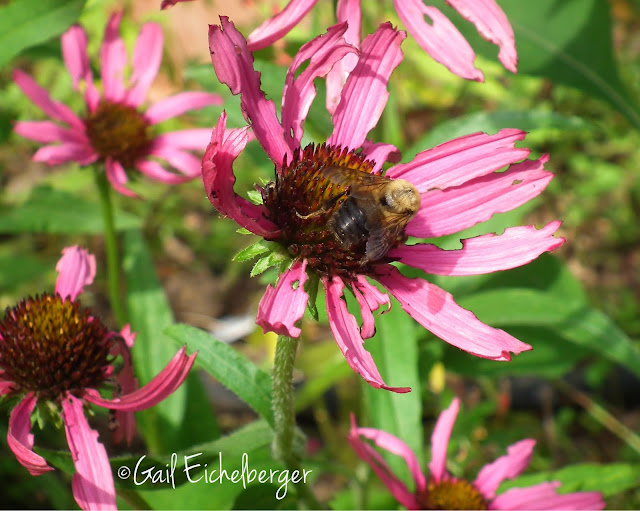
We've been convinced by advertising that a garden should be perfect and that insects are harmful and must be eliminated or they will damage our flowering plants and make them ugly. I encourage everyone to reconsider beauty and to begin to appreciate the insect damaged plant as providing food for a critter that may in turn be food for a spider, another insect or a song bird.
A friend told me she use to pull the caterpillars off her fennel before she knew they were Swallowtail butterfly cats. I told her what they were! New gardeners need to make sure ugly bugs aren't beneficial insects before you pluck them off or squish them. Some of the "good bugs" include lacewings, lady beetles, minute pirate bug, soldier bugs, assassin bugs, braconid wasps, tachinid flies, flower flies and aphid mites. Their larva aren't always attractive!
So embrace imperfection in your garden!

- You can help create a paradigm shift that redefines garden beauty to include imperfection.
- You can refuse to be shamed or swayed by the judgement of perfection worshipers.
- You can say no to pesticides that poison flowers and kill our important garden visitors.
- You can let nursery managers know that you don't need or expect them
to offer "perfect plants" that have pre-treated with insecticides (often neonicotinoids).
- You just have to do it!
Your garden will not be magazine perfect, but, pollinators don't care if
your flower petals are chewed on. They need flowers bursting with
pollen and nectar. Your garden will be teeming with life.
Spiders will build webs; the beneficial insects will keep aphids in
check; pollinators will pollinate; and, birds will hunt the insects.
It will be a beautiful imperfect garden, just as it's supposed to be.

I am so glad you stopped by. xoxogail

- Plant
many different flowers that bloom over the entire growing season to
encourage different native bees to move into your garden.
- Plant flowers in drifts....It increases pollinator efficiency and looks prettier!
- Plant the pollinator power house wildflowers for your neck of the woods.
- Plant night blooming and fragrant flowers.
- Make peace with weedy lawn natives.
- Let our gardens be a little messy, so that there are nesting places and shelter.
- If you want to encourage a diversity of pollinators~~ you will need to provide open areas (e.g. bare earth, large stones) where butterflies, may bask, and moist soil from which they may get needed minerals.
- Accept that not all pollinators are pretty and not all are well behaved; Wasps! Beneficial insect larva.
- Accept that when we invite pollinators into the garden, plants will get eaten and look ratty for awhile.
- Remember birds and bats! Leave the insects alone.
- Provide a water source with easy access for pollinators.
- Plant oaks and other trees that support a lot of pollinators.
- NEVER, EVER, EVER, EVER, EVER USE PESTICIDES. I MEAN NEVER!
Gail Eichelberger is a gardener and therapist in Middle Tennessee. She loves wildflowers and native plants and thoroughly enjoys writing about the ones she grows at Clay and Limestone. She reminds all that the words and images are the property of the author and cannot be used without written permission.


