Home of the Practically Perfect Pink Phlox and other native plants for pollinators
Showing posts with label First Wednesday Taking Care of Wildlife challenge. Show all posts

Wednesday, July 1, 2026

First Wednesday Taking Care of Wildlife Challenge: For Your Reading and Listening Pleasure


 I am taking a July break, but I didn't want to leave you without a few suggestions for your listening and reading pleasure. If you have any podcasts or blogs, vlogs about nature you want to share, please do share,  I am always looking for more! Please feel free to add the recommendations in the comments on this post or in social media where this will be posted. Thanks.

xogail


 I often listen to gardening podcasts while gardening and on walks. Here are a few I have enjoyed and I hope you will, too. Just follow the highlighted links. 

Mark Fraley Podcast is a good listen and I especially recommend his interview with Dr Kim Sadler, MTSU, Center for Cedar Glade Studies. If you're a middle Tennessee resident plan a visit. I love their stark beauty. Also, he has interviewed Joanna Brichetto several times. 

 In Defense of Plants podcast. His most recent is Understanding Forest Disturbance. I loved Fireflies and Plants. You can revisit a conversation between Dr. Sara Lewis and Matt Candeias as they discuss some of the intriguing connections between fireflies and plants.

 The Joe Gardener podcast  Episode 421 Doug Tallamy Answers the Question, How Can I Help? Another good interview is with Dr Suzanne Simard about forest resilience and renewal.

Ted Talks Daily: Why Climate Action is Unstoppable and climate realism is a myth with Al Gore

Growing Greener podcast with Thomas Christopher. I haven't listened to this one yet, but, "An Ecological Perspective on Tick-born Diseases sounds important.

The Plantastic Podcast: Sam Hoadley is interviewed about plant trials at Mt Cuba  An excellent interview of Heather Holm on Pollinators and Native Plants

Native Plants Healthy Planet podcast: Check out what Tom and Fran have to say and whom they might be interviewing. Recently they spoke about Leaving the land better than we found it with Kyle Wendtland

Backyard Ecology podcast: Shannon Trimboli is the host. Folks she's just north of Tennessee in Kentucky so her programs are apropos for middle Tennessee. Recent podcasts.

Bug Banter Xerces Society podcast   Many great talks.

Margaret Roach  https://awaytogarden.com/podcast/: I especially enjoyed her interview with Kelly Norris. Kelly is an ecological landscaper and author of several books. 


Here's a list of a few of my favorite native plant garden blogs and websites.

Sidewalk Nature: Joanna Brichetto's blog/website and her tag line says it all~ Look Around. Nature is us, our yards, sidewalks, parks, and parking lots. Joanna iwrites wonderfully about the many things she's observed in nature.

Nashville Native Plant Symposium: Updates on the symposium that's happening in late July and frequent sharing of beautiful native plants.

Humane Gardener : Nancy Lawson's tag line is Cultivating compassion for all creatures great and small.

WildOnes:  Wild Ones promotes native landscapes through education, advocacy and collaborative action. The link will take you to the Middle Tennessee chapter.

Home Grown National Park : Join the native plant homegrown garden movement. The website has links to keystone plants in your eco-region.

Nuts For Natives:  A self taught gardener (like many of us) who loves native plants.

Joy Biven/Wonder Gift and Garden: You will love her Friday sharing post!

Nurture Native Nature  fun  and informative blog posts 


Have a safe and wonderful July. I'll see you in August! xoxogail


Want to Take the Taking Care of Wildlife In Our Gardens Challenge?

The first part of this challenge is to do something, even lots of things, each month that support the critters living in our gardens. Gardening with native wildflowers, shrubs and trees that make sense for our ecoregion is a good place to start or continue (as the case may be). Plants and their pollinators are a classic example of mutualism: they have coevolved through evolutionary time in a reciprocal beneficial relationship. This is also true for other critters that visit and live in our gardens. 

Activities that increase our knowledge of the natural world are equally as valuable. Helping others learn about nature is included. Golly gee whiz, there are so many things you can do. 

The second part of the challenge is to post about it somewhere: Your blog, Instagram, Facebook, Twitter or even your neighborhood listserve. Wouldn't an article in the local paper be a coup for nature! Why post it? Because positive publicity is needed to educate our friends, neighbors and communities about how important even the smallest changes we make as gardeners can be for pollinators, birds, insects and mammals, including humans, that live all around us. 

Why now? My neighborhood is changing. Yours might be, too. Every day an older home along with many (if not all) of the mature oak, hickory, maple, Eastern cedar and hackberry trees are cut down. Insects, birds, even mammals lose their home site and food supplies when we lose trees. During construction soil is compacted by bulldozers, trucks and piles of debris cause runoff; surface runoff that can carry pollution to streams and rivers. It's important that our neighbors and our community have information about how important trees are to our ecosystem. Trees contribute to their environment by providing oxygen, improving air quality, climate amelioration, conserving water, preserving soil, and supporting wildlife.

In place of the "bee lawns" composed of Claytonia, Salvia lyrata, Ruellia humilis, fleabane, Western Daisy, Violets, self-heal, clovers, native grasses (in my neighborhood it's poverty oat grass) and sedges, they're being sodded with non-native grasses. These monoculture turf lawns contribute nothing environmentally. Here's what we lose when our diverse lawns are replaced with pristine turf grass:

  • Gone are the lightening bugs.
  • Gone are the ground dwelling/nesting native bees.
  • Gone is the habitat for insects, spiders and other critters. 
  • Gone is plant diversity. 
  • Gone are trees that provided for hundreds of moths, butterflies and other insects.
  • Gone are the nesting sites for woodpeckers, hummingbirds, Chickadees and other birds. 
  • Gone is a healthy foodweb.

 It breaks my heart. 

We can't stop the progmess, but, maybe we can make a lot of educational noise and help our new neighbors see the value in providing for critters and ultimately helping the environment.

A gardener can hope! 

xoxoGail


Here's an incomplete list of things you might consider doing or changing in your garden, and things you can do for and/or in your community. But don't limit yourself to my list, make your own list or check out the internet for ideas.


Looking for ways to get involved go here for a list of environmental advocacy groups.

Buy the best wildflower, butterfly and bird id books for your state.

Read nature books to your children and grandchildren. Buy them nature books.

Get in the garden with your children and grandchildren.

Give nature books as baby shower gifts (Nature books for infants and toddlers)

Shrink your lawn and make your planting beds larger.

Plant your favorite native perennials and shrubs. Leave them standing after they've gone to seed to continue to provide for wildlife. What you plant in your yard makes a difference to wildlife. I garden for wildlife so every tree, shrub and plant is chosen with wildlife in mind.


Plant more natives and then consider planting even more. "A typical suburban landscape contains only 20-30% native plant species. Try reversing that trend in your own landscape by using 70-80% native species." (source

Plant for bloom from late spring to early winter. Bees are most active from February to November (longer in mild climates) late winter blooming Hamamelis vernalis and the earliest spring ephemerals (like the toothworts, hepaticas, spring beauties, and False rue-anemeone) are perfect plants for a variety of pollinators.

Commit to never, ever, ever, ever using pesticides in the garden.


Stay away from native plant hybrids and cultivars that are double flowered. They are sterile and have no pollen or nectar for insects and no seeds for the birds. If possible plant “true open-pollinated native wildflowers”

If you want to garden for wildlife and pollinators, don't let lack of space stop you! Plant your favorite wildflowers in large containers. You just might have the prairie or woodland garden you've always wanted...in a pot!
 
Create a water feature. Provide water year round that is accessible to birds, bees and other critters.

Make a rain garden in low spots to collect and mitigate runoff.

Show some soil! Our native ground nesting bees nest in bare soil, so don't mulch every square inch of your garden. 

Get rid of the plastic weed barriers in your garden, it's not good for anything.

Invite bugs into your garden. Plant annuals that attract beneficial bugs.


Learn to tolerate damaged plants. Imperfection is the new perfect.

Don't be in a rush to clean up the fall garden. Leave plant stalks and seed heads standing all winter. Leave those fallen leaves or as many as you can tolerate! Insects over winter in the fallen and decaying leaves. Leave a layer of leaves as a soft landing material under trees for moths and butterflies to over winter. Many caterpillars drop to the ground from the trees in the fall and need a soft landing site and a place to live over the winter.

Allow a fallen tree to remain in the garden. Limbs on the ground are a perfect shelter for small animals such as rabbits, chipmunks and squirrels and a habitat for beetles, termites and other insects.


Make a brush pile. Stack fallen brush, cut tree limbs, broken pots for ground beetles. Ground beetles are excellent at eating "bad bugs". Bugs are also good bird, toad and small critter food. 

Rethink what you consider a pest. Lots of good bugs eat aphids. Spiders are important predators and they're great bird food!

Add nesting boxes for birds. 

Turn off your yard up-lighting, eave lights and porch lights after 11pm. This is important for nocturnal critters including mammals, snakes, insects, bats, birds (especially during migration). (Birdcast suggestions)

Plant shrubs and small trees that provide berries and nuts.

Keep a nature journal: You can observe visitors to your water feature, make note of when they visit. Notice which flowers attract the most pollinators and which ones are just pretty faces. 

Join your state native plant society (Tennessee Native Plant Society)

Join WildOnes even if there's no local group you can join the national organization.  (Middle Tennessee WildOnes)

Support your local native plant sellers. (GroWild in middle Tennessee, Overhill Gardens in east Tennessee,  Resource Guide TN Native Plant Society)

Encourage your local garden clubs to offer native plant talks.

If your garden club has a plant sale encourage them to sell more native plants.

Get trained as a naturalist (Tennessee Naturalist Program. Almost every state has their own Master Naturalist training program

Take an online course on tree, fungi and wildflower id. 

Take an online course on designing with native plants.

Take a walk in your neighborhood and observe nature. To quote Joanna Brichetto in Sidewalk Nature "Look Around. Nature is here, is us, our driveways, our baseboards, parks, and parking lots."

Read! There are hundreds of books on gardening for wildlife, the environment, and rewilding our world. There are delightful blogs with wonderful and informative articles.

If you are already gardening with wildlife in mind then add a few signs that help educate your neighbors. (Xerces Society, Pollinator Partnership)

Join the Xerces Society.

Set up an information station where neighbors can pick up brochures about your garden and other info. 

Get certified (National Wildlife Federation, check to see what your state offers)

Support trees by joining the effort to make sure developers don't remove more trees than are necessary for their project. Work to make sure there are tree removal permits and that they are actually enforced in your community.


Gail Eichelberger is a gardener, Tennessee Naturalist and nature writer in Middle Tennessee. She loves wildflowers and native plants and thoroughly enjoys writing about the ones she grows at Clay and Limestone. She reminds all that the words and images are the property of the author and cannot be used without written permission.

Wednesday, June 3, 2026

Fist Wednesday Taking Care of Wildlife Challenge: Rewilding Our Urban and Suburban Landscape

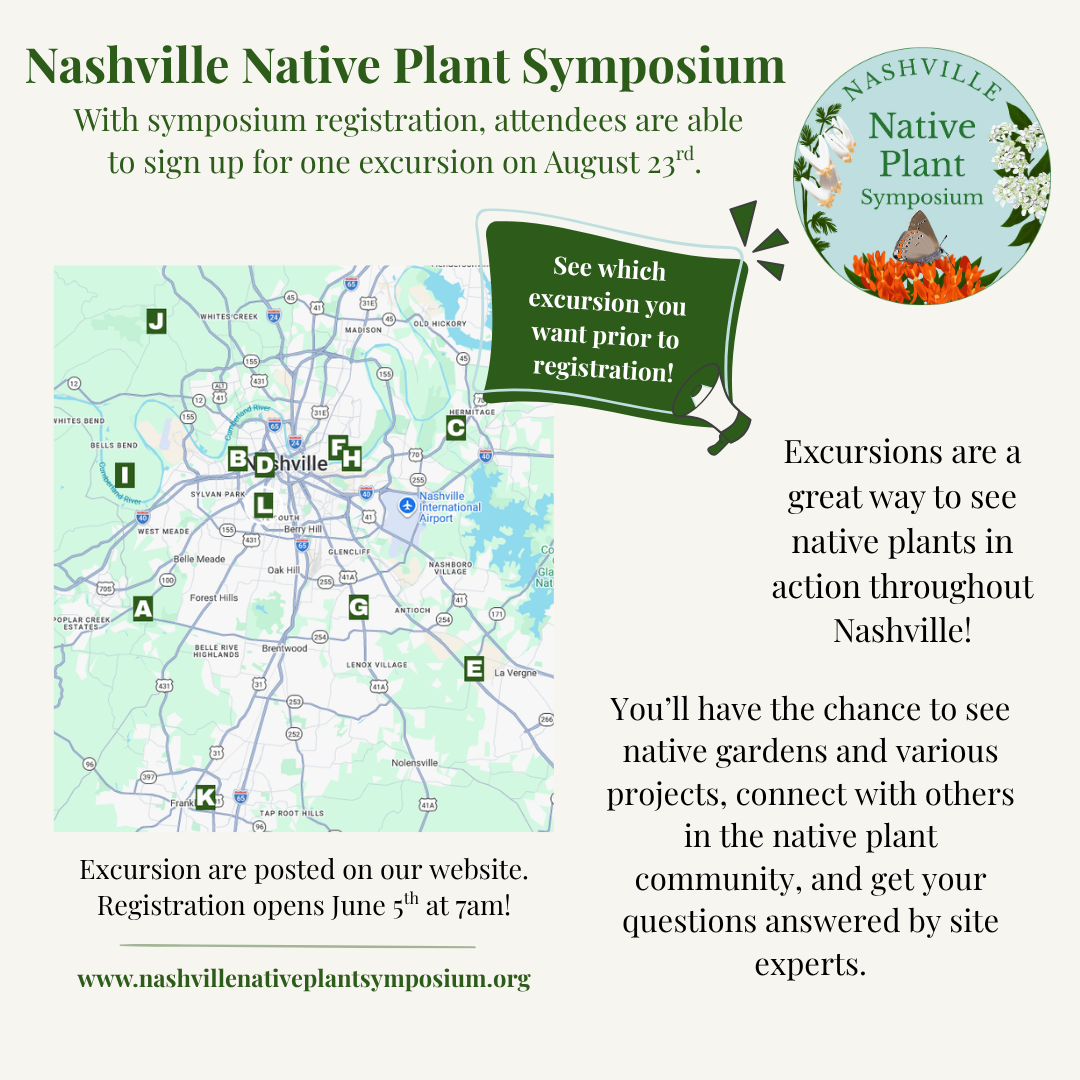
Is the theme for the 2026 Nashville Native Plant Symposium that's happening this August and registration opens on June 5th, at 7am!  

This symposium builds on the goals set in the Spring 2025 Symposium when gardeners, ecologists, land stewards, and community members met to focus on ecological restoration, native plant landscaping, and pollinator habitat building. 

Our second symposium will bring together plant enthusiasts, conservation professionals, and community members to re-imagine our neighborhoods, parks, and home gardens as thriving habitats that support biodiversity and strengthen our regional ecosystems.

We'll gather on August 22, 2026, at the Southeast Community Center for an inspiring and educational day of presentations and opportunities for networking. Featuring keynote speaker Dwayne Estes of the Southeastern Grasslands Institute.


This is an opportunity for participants to make a positive impact on our community and the environment while enjoying a day filled with learning, inspiration and networking.

Hope to see you there. 

xoxogail 

 PS  There will be fabulous excursions to sign up for when you register!


What's The First Wednesday Taking Care of Wildlife Challenge About?

The first part of this challenge is to do something, even lots of things, each month that support the critters living in our gardens. Gardening with native wildflowers, shrubs and trees that make sense for our ecoregion is a good place to start or continue (as the case may be). Plants and their pollinators are a classic example of mutualism: they have coevolved through evolutionary time in a reciprocal beneficial relationship. This is also true for other critters that visit and live in our gardens. 

Activities that increase our knowledge of the natural world are equally as valuable. Helping others learn about nature is included. Golly gee whiz, there are so many things you can do. 

The second part of the challenge is to post about it somewhere: Your blog, Instagram, Facebook, Twitter or even your neighborhood listserve. Wouldn't an article in the local paper be a coup for nature! Why post it? Because positive publicity is needed to educate our friends, neighbors and communities about how important even the smallest changes we make as gardeners can be for pollinators, birds, insects and mammals, including humans, that live all around us. 

Why now? My neighborhood is changing. Yours might be, too. Every day an older home along with many (if not all) of the mature oak, hickory, maple, Eastern cedar and hackberry trees are cut down. Insects, birds, even mammals lose their home site and food supplies when we lose trees. During construction soil is compacted by bulldozers, trucks and piles of debris cause runoff; surface runoff that can carry pollution to streams and rivers. It's important that our neighbors and our community have information about how important trees are to our ecosystem. Trees contribute to their environment by providing oxygen, improving air quality, climate amelioration, conserving water, preserving soil, and supporting wildlife.

In place of the "bee lawns" composed of Claytonia, Salvia lyrata, Ruellia humilis, fleabane, Western Daisy, Violets, self-heal, clovers, native grasses (in my neighborhood it's poverty oat grass) and sedges, they're being sodded with non-native grasses. These monoculture turf lawns contribute nothing environmentally. Here's what we lose when our diverse lawns are replaced with pristine turf grass:

  • Gone are the lightening bugs.
  • Gone are the ground dwelling/nesting native bees.
  • Gone is the habitat for insects, spiders and other critters. 
  • Gone is plant diversity. 
  • Gone are trees that provided for hundreds of moths, butterflies and other insects.
  • Gone are the nesting sites for woodpeckers, hummingbirds, Chickadees and other birds. 
  • Gone is a healthy foodweb.

 It breaks my heart. 

We can't stop the progmess, but, maybe we can make a lot of educational noise and help our new neighbors see the value in providing for critters and ultimately helping the environment.

A gardener can hope! 

xoxoGail


Here's an incomplete list of things you might consider doing or changing in your garden, and things you can do for and/or in your community. But don't limit yourself to my list, make your own list or check out the internet for ideas.


Looking for ways to get involved go here for a list of environmental advocacy groups.

Buy the best wildflower, butterfly and bird id books for your state.

Read nature books to your children and grandchildren. Buy them nature books.

Get in the garden with your children and grandchildren.

Give nature books as baby shower gifts (Nature books for infants and toddlers)

Shrink your lawn and make your planting beds larger.

Plant your favorite native perennials and shrubs. Leave them standing after they've gone to seed to continue to provide for wildlife. What you plant in your yard makes a difference to wildlife. I garden for wildlife so every tree, shrub and plant is chosen with wildlife in mind.


Plant more natives and then consider planting even more. "A typical suburban landscape contains only 20-30% native plant species. Try reversing that trend in your own landscape by using 70-80% native species." (source

Plant for bloom from late spring to early winter. Bees are most active from February to November (longer in mild climates) late winter blooming Hamamelis vernalis and the earliest spring ephemerals (like the toothworts, hepaticas, spring beauties, and False rue-anemeone) are perfect plants for a variety of pollinators.

Commit to never, ever, ever, ever using pesticides in the garden.

Stay away from native plant hybrids and cultivars that are double flowered. They are sterile and have no pollen or nectar for insects and no seeds for the birds. If possible plant “true open-pollinated native wildflowers”

If you want to garden for wildlife and pollinators, don't let lack of space stop you! Plant your favorite wildflowers in large containers. You just might have the prairie or woodland garden you've always wanted...in a pot!
 
Create a water feature. Provide water year round that is accessible to birds, bees and other critters.

Make a rain garden in low spots to collect and mitigate runoff.

Show some soil! Our native ground nesting bees nest in bare soil, so don't mulch every square inch of your garden. 

Get rid of the plastic weed barriers in your garden, it's not good for anything.

Invite bugs into your garden. Plant annuals that attract beneficial bugs.


Learn to tolerate damaged plants. Imperfection is the new perfect.

Don't be in a rush to clean up the fall garden. Leave plant stalks and seed heads standing all winter. Leave those fallen leaves or as many as you can tolerate! Insects over winter in the fallen and decaying leaves. Leave a layer of leaves as a soft landing material under trees for moths and butterflies to over winter. Many caterpillars drop to the ground from the trees in the fall and need a soft landing site and a place to live over the winter.

Allow a fallen tree to remain in the garden. Limbs on the ground are a perfect shelter for small animals such as rabbits, chipmunks and squirrels and a habitat for beetles, termites and other insects.


Make a brush pile. Stack fallen brush, cut tree limbs, broken pots for ground beetles. Ground beetles are excellent at eating "bad bugs". Bugs are also good bird, toad and small critter food. 

Rethink what you consider a pest. Lots of good bugs eat aphids. Spiders are important predators and they're great bird food!

Add nesting boxes for birds. 

Turn off your yard up-lighting, eave lights and porch lights after 11pm. This is important for nocturnal critters including mammals, snakes, insects, bats, birds (especially during migration). (Birdcast suggestions)

Plant shrubs and small trees that provide berries and nuts.

Keep a nature journal: You can observe visitors to your water feature, make note of when they visit. Notice which flowers attract the most pollinators and which ones are just pretty faces. 

Join your state native plant society (Tennessee Native Plant Society)

Join WildOnes even if there's no local group you can join the national organization.  (Middle Tennessee WildOnes)

Support your local native plant sellers. (GroWild in middle Tennessee, Overhill Gardens in east Tennessee,  Resource Guide TN Native Plant Society)

Encourage your local garden clubs to offer native plant talks.

If your garden club has a plant sale encourage them to sell more native plants.

Get trained as a naturalist (Tennessee Naturalist Program. Almost every state has their own Master Naturalist training program

Take an online course on tree, fungi and wildflower id. 

Take an online course on designing with native plants.

Take a walk in your neighborhood and observe nature. To quote Joanna Brichetto in Sidewalk Nature "Look Around. Nature is here, is us, our driveways, our baseboards, parks, and parking lots."

Read! There are hundreds of books on gardening for wildlife, the environment, and rewilding our world. There are delightful blogs with wonderful and informative articles.

If you are already gardening with wildlife in mind then add a few signs that help educate your neighbors. (Xerces Society, Pollinator Partnership)

Join the Xerces Society.

Set up an information station where neighbors can pick up brochures about your garden and other info. 

Get certified (National Wildlife Federation, check to see what your state offers)

Support trees by joining the effort to make sure developers don't remove more trees than are necessary for their project. Work to make sure there are tree removal permits and that they are actually enforced in your community.


Gail Eichelberger is a gardener, Tennessee Naturalist and nature writer in Middle Tennessee. She loves wildflowers and native plants and thoroughly enjoys writing about the ones she grows at Clay and Limestone. She reminds all that the words and images are the property of the author and cannot be used without written permission.

Wednesday, May 6, 2026

First Wednesday Taking Care of Wildlife Challenge: Where Have All My Insects Gone?

Just the other day a neighbor told me she didn't want any more insects in her garden, she said she already had enough! 


I don't feel that way at all. There aren't nearly enough insects in my garden these days.  I want more! I want to see more native bees, more beneficial insects, more moths, more butterflies, more caterpillars, more hoverflies, more dragonflies, more flies, more beetles...

They're here, but, I'm just not seeing as many as I've seen in past years.

 I can't help but wonder if the changes in my neighborhood have affected the loss of insects in my garden. 

I am now gardening in a sea of manicured lawns...Our neighborhood is changing from its established 1950s ranch homes with freedom lawns that light up each spring with Spring Beauties, glow in the summer with lightning bugs and are buzzing with bee, butterfly and other pollinators all fall. Houses, lawns and trees are being bulldozed down at a frightening rate. In their place are megahouses with perfectly manicured lawns and the same old same old non-native shrubs, all for "curb appeal". 

Here's what we lose when our diverse lawns are replaced with pristine turf grass that is fertilized and treated with pesticides:

  • Gone are the lightening bugs
  • Gone are the ground dwelling/nesting native bees
  • Gone is the habitat for insects, spiders and other critters
  • Gone is plant diversity
  • Gone are trees that provided for hundreds of moths, butterflies and other insects 
  • Gone are the nesting sites for woodpeckers, hummingbirds, Chickadees and other birds
  • Gone is a healthy foodweb


I don't even care if aphids are on plants. Bugs make a garden work better.

INSECTS MATTER! And not just to my garden. They matter to all of us. 

Insects are essential for  

  • pollination
  • decomposition
  • nutrient cycling
  • they form the foundation of several food chains and are the primary food sources for birds, amphibians, reptiles, and fish.
  • pest management 


The bad news is that insect populations are declining all over the planet-- not just in my garden. Some factors leading to their loss include urbanization, pollution, pesticide use, loss of habitat, introduced species, and climate change. 


Two of the biggest problems affecting insect populations in middle Tennessee neighborhoods are loss of habitat and pesticide use. They're both alarming to me, but, I am very concerned about pesticide use....Especially by homeowners who have easy access to major insect killers. Too many people are intolerant of bugs nibbling on their flowers.


Insects have gotten a bad rap. They're seen as a big problem that must be solved with a big solution. I can't tell you how many conversations I've had with neighbors and friends about mosquitoes. They've been convinced by major ad campaigns and pest service billboards that they just need to fog their yards to keep mosquitoes from interrupting their outside activities. They've been convinced that it's safe and won't harm anything other than mosquitoes. It's not true. Fogging harms all insects.

So I got my own ad campaign/yard sign! 


And others! I sure hope they're working!


What's a concerned wildlife gardener to do? We need to work on rebugging our gardens not debugging them.

1. Plant native trees, shrubs and perennials. In other words we must plant smarter.


Beautiful blooms in our gardens are fabulous, but, we can't stop there.  Choose plants that are attractive to the many pollinators and other critters that live in and visit our gardens.

Plant lots of colorful flowers that are rich in nectar and pollen and are host plants for the offspring of butterflies, moths and other beneficial critters. Don't deadhead them in winter, remember that the seeds and berries from these plants are often food for birds and small mammals. The standing stalks provide winter cover.

Plant an array of flower shapes that appeal to hummingbirds, bees, moths, flies and butterflies.

Plant for bloom from late spring (native ephemerals) to early winter (witch hazels).

Plant native trees and shrubs because they are host plants for hundreds of important critters that nesting birds need to feed their young. Native woody plants provide cover from predators, nighttime roosts and nesting sites.

Plant shrubs and trees that provide food/nuts and berries for birds and hungry mammals that live and visit our gardens

Provide nesting spaces for bees and other critters.

Accept that plants are beautiful even if chewed on by critters and promise to never, ever, ever, ever use pesticides and herbicides in our gardens. See #3

 Plant knowing that the more you plant for critters...crawling, flying and even digging ones, the healthier and more diverse your garden will be.  

You don't need a yard to plant native wildflowers: plant in containers placed on your patio or balcony

Simply said: Choose plants that have good wildlife value.

2. Stop using pesticides in your garden

 The first thing to ask yourself is this: If pesticides really worked would we have to use them continually? Personally, I think not, there's a great deal of money in the pesticide industry and frankly, I don't trust their studies, which are often paid for by the pesticide companies.

They're hazardous to our health, especially the health of our children.  

Source


 Harmless bugs are killed when they're caught in the spray, and other animals are hurt when they drink chemical runoff after gardens and fields drain into local rivers.  

3. Make sure plants you plant are pesticide free: Ixnay on Neonicotinoid pre-treated plants. 

 4. Reduce the size of your lawn

5.  Plant a bee friendly lawn: Use Claytonia, Salvia lyrata, Ruellia humilis, fleabane, Western Daisy, Violets, self-heal, clovers, native grasses (in my neighborhood it's poverty oat grass) and sedges

6. Concerned that neighbors will complain: Use educational signs.

7. Get active! 

Share info and photos about your native bee friendly gardens on neighborhood organizations

Post on social media 

Submit articles to newspapers 

Hold an open garden day to let your neighbors see your garden

Have a give away table with info, seeds, plants were walkers can reach them

Start a blog and write about environmental issues 

Get to know your councilperson; they can be advocates for native gardens, for protecting trees etc.

Exercise your constitutional right and vote for candidates who actively support conservation efforts.  

Contact developers and real estate agents to start their education

8. Be an advocate for nature whenever and wherever you can.  

My friend Joanna Brichetto/Sidewalk Nature author and Tennessee Naturalist, is one of the best advocates for nature that I know. She recently posted a powerful video showing mosquito fogging in her neighborhood. She wrote that the air smelled like medicine and it was drifting toward her yard were birds were foraging for nestlings. To further quote her: 

"It makes no sense to poison EVERYTHING to try and kill ONE thing. Please help spread the word that mosquito fogging is neither safe nor effective, and that the best way to control mosquitoes is 1) dump all standing water every seven days and 2) make a Mosquito Bucket of Doom."

Follow the link to see the entire post.


Joanna Brichetto Sidewalk Nature

9. Rebugged garden plants don't need to be perfect!

  • We must be okay with the damage that bugs will do to our garden plants.
  • We don't use pesticides or herbicides when we see chewed up foliage and petals.
  • We need to redefine what we think of as perfection and beauty in our gardens.
  • We invite beneficial insects into the garden when we plant the right plants and create the right conditions.
  • We celebrate that imperfection means our gardens are teeming with all kinds of wildlife, not just pretty flower faces.
  • We don't fog our gardens because it kills everything.


To conclude: 

When you let go of pesticides and embrace imperfection you become the change our world needs.

  • You help create a paradigm shift that redefines garden beauty to include imperfection.
  • You refuse to be shamed or swayed by the judgement of perfection worshipers.
  • You say no to pesticides that kill our important garden visitors.
  • You invite more insects into your garden....even when they nibble on your flowers.
  • You let nursery managers know that you don't need or expect them to offer "perfect plants" in other words, plants that have been pre-treated with insecticides.
  • You don't poison and kill everything to kill one thing. 


Insects matter to our world and I want to see more of them everywhere.

xoxogail


Want to Take the Taking Care of Wildlife In Our Gardens Challenge?

The first part of this challenge is to do something, or lots of things, each month that support the critters living in our gardens. Gardening with native wildflowers, shrubs and trees that make sense for our ecoregion is a good place to start or continue (as the case may be). Plants and their pollinators are a classic example of mutualism: they have coevolved through evolutionary time in a reciprocal beneficial relationship. This is also true for other critters that visit and live in our gardens. 

Activities that increase our knowledge of the natural world are equally as valuable. Helping others learn about nature is included. Golly gee whiz, there are so many things you can do. 

The second part of the challenge is to post about it somewhere: Your blog, Instagram, Facebook, Twitter or even your neighborhood listserve. Wouldn't an article in the local paper be a coup for nature! Why post it? Because positive publicity is needed to educate our friends, neighbors and communities about how important even the smallest changes we make as gardeners can be for pollinators, birds, insects and mammals, including humans, that live all around us. 

Why now? Because nature needs us. 

Gail Eichelberger is a gardener, Tennessee Naturalist and nature writer in Middle Tennessee. She loves wildflowers and native plants and thoroughly enjoys writing about the ones she grows at Clay and Limestone. She reminds all that the words and images are the property of the author and cannot be used without written permission.


Wednesday, April 1, 2026

First Wednesday Taking Care of Willdlife Challenge: Early Blooming Spring Plants, Hummingbirds and Coevolution

Are you ready for the hummingbirds? I am and so are several plants in my garden!

Trumpet honeysuckle and Eastern Columbine bloom just in time for migrating Ruby Throated Hummingbirds and that's no coincidence. They have co-adapted with Hummingbirds over millions of years to form a mutually beneficial relationship. Hummingbirds migrate thousands of miles annually from their winter home in Central America and they're movement north coincides with the blooming of these preferred flowers. 


When they arrive in middle Tennessee they are hungry and the red tubular and trumpet-shaped flowers of both columbines and trumpet honeysuckles hold more nectar than other flowers and are irresistible to hummingbirds. This co-adapted/mutually beneficial relationship is pretty cool. The long bill and tongue of these hummers fits into the throat of preferred flowers like columbines and trumpet honeysuckle flowers to easily reach the nectar, and while feeding, grains of pollen spill onto the head of the bird and is carried to other Columbines and Trumpet honeysuckle. It's a marvelous mutualistic dance that happens in gardens all over the Eastern United States. 

It's almost show time in Middle Tennessee. Historically Hummingbirds arrive in middle Tennessee in late March to mid-April. In fact they have been reported in Franklin, TN a city 20 miles southwest of downtown Nashville. 

 So get ready! 


'Cedar Lane' Trumpet honeysuckle/Lonicera sempervirens

Hummers need a lot of fuel. David Wentworth Lazaroff in his book The Secret Lives of Hummingbirds describes a hummer's lifestyle as high octaine meaning they must consume as much as one-and-a-half times their body weight in nectar every day. He said, “Being a hummingbird is like driving a car with a one-gallon gas tank. There is an almost constant need to refuel."


As anyone who has tried to capture a photo will tell you they are fast moving acrobats of the air. Thank you Joanna for sharing your photo with me. Now I will set up my tripod and camera and try to capture a hovering hummer which a dear friend refers to as the holy grail of hummingbird photos. 


Joanna Brichetto photo 


Although, it's not easy to capture a photo of humming birds hovering, it's not difficult to attract migrating RTH to your garden. Like all bird visitors and residents they need food, shelter, water, nesting sites and perching sites. Plant native flowers and shrubs with nectar bearing flowers to keep them happy. Hummingbirds are attracted to tubular, nectar-rich flowers in shades of red, pink, and orange.


To provide for hummingbirds that are arriving and to keep them in your garden plant the following:

Aesculus pavia/red buckeye

 Impatiens capensis/jewelweed

 Aquilegia canadensis/columbine

 Campsis radicans/trumpet creeper   

Penstemons   

Monarda/bergamot/bee- balm   

Lonicera sempervirens/trumpet (or coral) honeysuckle 

Lobelia/cardinal flower  

Silene virginica/royal catchfly and  round-leaved catchfly fire-pink   

Phlox   

Salvias: especially red flowered 


The  Audubon organization shares some cool facts about our high octane acrobatic visitors that I think are worth sharing.

  • They have specially adapted wings that not only beat 50 times a second, but they are the only bird family who can hover for extended periods of time. They can fly  backwards, forwards and upside down.
  • These tiny birds are endurance flyers. They beef up their bodies with insects and nectar to make non stop flights from central America to the eastern USA and Canada.
  • Humming birds run on flower power! They have not only coevolved with several of our spring wildflowers, but also fall blooming Jewelweed. All of which we can plant in our gardens. 
  • Habitat Gardens, wood edges. Summers in a variety of semi-open habitats, including open woods, clearings and edges in forest, gardens, city parks.  
Audubon


There may not be as many nectar sources available with this crazy up and down spring we've had in middle Tennessee so please consider hanging feeders. It's fun to watch the hummers up close and it's an easy way to supplement their nectar needs. You don't have to buy nectar, make your own, it's just sugar and water! There are recipes on the internet. Please, do not use the red dyed syrups that are often offered at big box stores.  It's also very important to keep the feeders clean.

And remember, never, ever, ever, ever  use pesticides or you will end up killing the insects aka bird food that are living in your gardens.


xoxogail


PS It's Spring Migration and millions of other birds are flying over our gardens at night. I'm wondering if you and your garden are ready? 

There are things we can do. Very important things!


Take the Taking Care of Wildlife In Our Gardens Challenge


The first part of this challenge is to do something, even lots of things, each month that support the critters living in our gardens. Gardening with native wildflowers, shrubs and trees that make sense for our ecoregion is a good place to start or continue (as the case may be). Plants and their pollinators are a classic example of mutualism: they have coevolved through evolutionary time in a reciprocal beneficial relationship. This is also true for other critters that visit and live in our gardens. 

Activities that increase our knowledge of the natural world are equally as valuable. Helping others learn about nature is included. Golly gee whiz, there are so many things you can do. 

The second part of the challenge is to post about it somewhere: Your blog, Instagram, Facebook, Twitter or even your neighborhood listserve. Wouldn't an article in the local paper be a coup for nature! Why post it? Because positive publicity is needed to educate our friends, neighbors and communities about how important even the smallest changes we make as gardeners can be for pollinators, birds, insects and mammals, including humans, that live all around us. 

Why now? My neighborhood is changing. Yours might be, too. Every day an older home along with many (if not all) of the mature oak, hickory, maple, Eastern cedar and hackberry trees are cut down. Insects, birds, even mammals lose their home site and food supplies when we lose trees. During construction soil is compacted by bulldozers, trucks and piles of debris cause runoff; surface runoff that can carry pollution to streams and rivers. It's important that our neighbors and our community have information about how important trees are to our ecosystem. Trees contribute to their environment by providing oxygen, improving air quality, climate amelioration, conserving water, preserving soil, and supporting wildlife.

In place of the "bee lawns" composed of Claytonia, Salvia lyrata, Ruellia humilis, fleabane, Western Daisy, Violets, self-heal, clovers, native grasses (in my neighborhood it's poverty oat grass) and sedges, they're being sodded with non-native grasses. These monoculture turf lawns contribute nothing environmentally. Here's what we lose when our diverse lawns are replaced with pristine turf grass:

  • Gone are the lightening bugs.
  • Gone are the ground dwelling/nesting native bees.
  • Gone is the habitat for insects, spiders and other critters. 
  • Gone is plant diversity. 
  • Gone are trees that provided for hundreds of moths, butterflies and other insects.
  • Gone are the nesting sites for woodpeckers, hummingbirds, Chickadees and other birds. 
  • Gone is a healthy foodweb.

 It breaks my heart. 

We can't stop the progmess, but, maybe we can make a lot of educational noise and help our new neighbors see the value in providing for critters and ultimately helping the environment.

A gardener can hope! 

xoxoGail


Gail Eichelberger is a gardener and therapist in Middle Tennessee. She loves wildflowers and native plants and thoroughly enjoys writing about the ones she grows at Clay and Limestone. She reminds all that the words and images are the property of the author and cannot be used without written permission.