Neither rain nor cold, or even more rain and then very cold weather could stop the delightful harbingers of
springtime that are blooming at Clay and Limestone. The delicate
white or pinkish flowers of ephemerals bloom early in spring, set
seed, then disappear until the next spring.
If you had to choose one of the earliest spring ephemerals as a favorite...Would you? Could you?
 |
Claytonia virginica or Spring Beauty
|
Would you choose the candy striped Spring Beauty?
Claytonia virginica's
flowers are about the size of a dime with five petals that spread wide
as the sun warms them. From a distance, the flowers appear white, but,
each petal is suffused with a delicate network of pastel pink veins.
Those pink veins are nectar guides. Spring Beauties are pollinated by
over 100 species of insects. That's a lot of bees, flies and other
winged creatures relying on nectar and pollen. That makes them an
important early food source and extremely important in our garden habitats and near by woodlands.
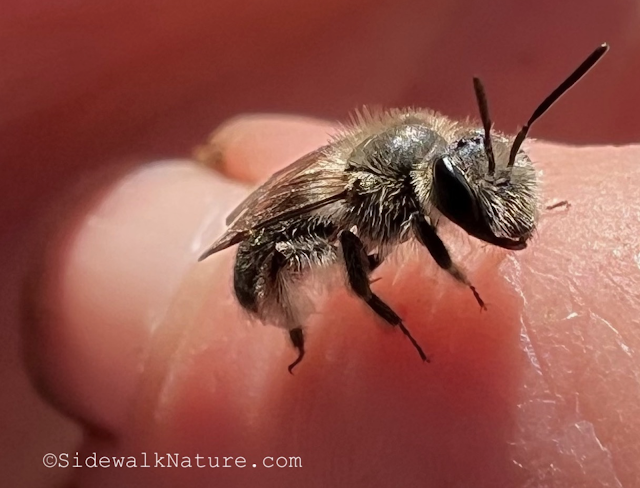
Jo Brichetto of Sidewalk Nature has written about and captured a wonderful photo of the Spring Beauty mining bee (
Andrena erigeniae). Follow the link to her article. Jo's posts reflect what many of us are observing~the destruction of habitat and the loss of native plants. The consequences to critters and to us is enormous.
Claytonia virginica still blankets some neighboring lawns. It's a glorious month of bloom and pollinator activity, but development and a strange love of a monoculture lawn has decimated them. There's plenty we can do~see the Wildflower Wednesday Challenge below for ideas.
The Particulars
Botanical name: Claytonia virginica
Common Name: spring beauty
Type: Herbaceous perennial
Family: Montiaceae
Native Range: Eastern North America
Zone: 3 to 8
Height: 0.50 to 0.75 feet
Spread: 0.50 to 0.75 feet
Flower: Showy Bloom Time: March into April (middle Tennessee)
Bloom Description: White to pink
Sun: Full sun to part shade
Habitat: prefers dappled sunlight with rich loamy soil. NO way can I give it deep loamy soil, so I enjoy the few I have.
Wildlife value: Pollinators need this early bloomer. This beauty has a bee that specializes on it. Small, potato-like, underground tubers (corms) are edible (chestnut-like flavor) and were in fact consumed by early Americans, but are time-consuming to collect in quantity sufficient for a meal.mall, potato-like, underground tubers (corms) are edible (chestnut-like flavor). Chipmunks and small mice aren't bothered by the time it takes to dig them up!
Comments: Naturalize. Mow late after plant has gone to seed. DO NOT USE WEED AND FEED.
Perhaps,
you would choose the perfumed flowers of
Cardamine concatenata/Cut-leaved toothwort! This is a
common plant in Middle Tennessee, but that would never detract from its
charm. Like many early blooming spring wildflowers this one is low to
the ground (and you can count on getting dirty knees trying to take a
decent photo). While you're crawling around you might notice their sweet
fragrance. It's especially noticeable on sunny warm days.
 |
| Cut-leaved toothwort |
If you have one plant, you will soon have more. It spreads by
rhizome and seed~But, don't be afraid...It's an ephemeral and will
disappear after setting seed.
Each flower has four petals characteristic of the mustard family (arranged in the shape of a cross), as well as four green or purple sepals, a single pistil, and six stamens with conspicuous yellow anthers. The flowers appear bell-shaped because they never completely open. The flowers are visited by several types of bees and less commonly by early-flying butterflies or bee flies. Look for honey bees, bumblebees, Mason
bees, Cuckoo bees, Miner bees, Halictid bees, and Andrenid bees (which specialize on toothwort).
 |
Andrena arabis collect pollen on toothworts
|
Toothwort and other woodland flowers require a forest habitat to
survive, so they depend on the oaks, hickories, maples, and other trees
around them. The presence of toothwort in an area can be an indicator
that the soil has not been disturbed by such activities as construction
or plowing.
The Particulars
Botanical name: Cardamine concatenata
Common Name: cutleaf toothwort
Type: Herbaceous perennial
Family: Brassicaceae
Native Range: North America
Zone: 3 to 8
Height: 0.50 to 0.75 feet Spread: 0.50 to 0.75 feet
Bloom Time: late February to March in middle Tennessee
Bloom Description: White flowers with hints of pink
Fragrance: Yes, on warm days
Sun: Part shade
Water: Medium
Comments: Naturalize. DO NOT USE WEED AND SEED on your lawn or beds.
Wildlife value: Attracts: Specialized bee~Andrena arabis collect pollen and other pollinators.
Or, does your taste go to Enemion biternatum. This lovely ground cover with Columbine like leaves and the sweetest delicate white flower. It's often confused with Thalictrum thalictroides.
 |
| it's easily overrun by invasives like garlic mustard, bush honeysuckle and wintercreeper |
This is another little spring flower that makes pollen, but, no
nectar. Small bees and flies visit to collect and feed on the pollen. Keep an eye on the beds where this lovely grows and remove all invasives that can easily crowd it out.
 |
| Isopyrum/Enemion biternatum or False rue anemone |
|
|
Eastern False Rue-anemone, False Rue Anemone or
Enemion biternatum is a sweet little
Spring ephemeral
in the Buttercup family (Ranunculaceae). It's native to shady rich or
calcereous woods & thickets; floodplain woods and limestone ledges.
(slightly alkaline soil) and is native to Middle Tennessee. I was lucky to find it in the garden when I moved here.
The Particulars
Botanical name: Enemion biternatum
Common names: Eastern False Rue-anemone, False Rue Anemone
Family: Ranunculaceae
Plant type: True ephemeral (summer dormancy)
Flowering Period: Early Spring, Mid-Spring
Flower Color: White
Sun/Shade Conditions: Filtered Shade, Partial Shade. The preference is partial sun to medium shade, moist to mesic conditions, and a rich loamy soil with abundant leaf mould.
Soil Moisture: Average, Moist, can handle some flooding
Soil pH: Adaptable, Alkaline
Soil Type: Loam, Clay, Humus-rich
Flower: Five 'petaled' (sepals) flowers with the showy yellow center stamens
Native
Faunal association: Pollinated by small bees and flies that visit it for its pollen.
If you like a different looking flower your taste might lean toward,
Trillium cuneatum. I love the dramatic mottled
foliage and those twirling sessile flowers!
Trillium cuneatum was one of the first native plants that I
discovered when we moved here. The
first spring
in our new home I found blooming Toadshade (another common name) in the
wayback backyard and transplanted it to my new woodland garden. That
was over 35 years ago, but, I remember carefully digging around it to get all
the rhizome and roots and gently placing it in the garden. They
survived and thrived despite my gardening ignorance. Please do not dig from the wild. Do not pick the flower...the plant will not survive.
 |
| Old stands of native ephemerals are precious do not dig from the wild |
Trillium cuneatum typically flowers from early March to mid
April. It can be found in rich, mostly upland woods, but, it is
especially happy growing on Middle Tennessee's Ordovician limestone
soils (neutral to basic soil). The two I transplanted multiplied to
many. Trillium will be happy in your garden, if you give it a rich,
moist soil, in shade, protect it from browsing critters and keep
aggressive perennials from crowding it. They can live for a long time
and usually do not flower until they are several years old. It's found
growing across Alabama, Georgia, Illinois, Kentucky, Maryland,
Mississippi, North Carolina, Pennsylvania, South Carolina, Tennessee
and Virginia.
 |
| seeds waiting to ripen and be harvested |
The Particulars
Botanical name: Trillium cuneatum
Common Name: whip-poor-will flowerlarge toadshade, purple toadshade, and bloody butcher
Type: Herbaceous perennial
Family: Melanthiacea, Little sweet Betsy falls within the sessile group
Flowering: flowers from early March to mid April. Showy, fragrant
Native Range: Southeastern United States
Zone: 5 to 8
Size: 1.00 to 1.50 feet tall and will spread to 1 foot
Bloom: Maroon to yellow to orange to reddish-green
Sun: Part shade to full shade
Water: Medium
Maintenance: Low
Foliage: Colorful
Pollinators: produces pollen, but, I have never seen its pollinators! I assume
Hymenoptera insects, including honey bees, bumblebees, and wasps visit the plant.
Propagation: Ants collect and disperse the seeds of
Trillium
spp. They're attracted to the elaiosome, which is a large, lipid-rich
structure attached to the seeds. The ant dispersal process is known as
Myrmecochory. The ants take the seeds to their nest, where they eat
the elaiosomes and put the seeds in their garbage (midden), where they
can be protected until they germinate.Yellow jackets are also seed
disperses.
Wildlife: Can be browsed by deer and roots and rhizomes can be eaten by voles.
Comments: Never pick flowers or leaves, you will lose your plant. Each plant in the genus
Trillium
features three leaves in a terminal whorl. A single flower emerges on
a stem which is either peduncled (on a stalk) or sessile (stalk
absent).
Trillium cuneatum is a sessile form.
I choose all of them! I choose to protect and celebrate them all. xoxogail
Don't forget our Wildflower Wednesday monthly challenge!
The
first part of this challenge is to do something every month during
2023 and beyond that supports native wildflowers, pollinators, and the
critters
that visit and rely on our gardens. Activities that increase our
knowledge of
the natural world are equally as valuable. Helping others learn about
nature is included. Golly gee whiz, there are so many things you can
do. The second part of the challenge is to post about it somewhere: Your
blog, Instagram, Facebook, Twitter or even your neighborhood listserve.
Wouldn't an article in the local paper be a coup for nature! Why post
it? Because positive publicity is needed to
educate our friends, neighbors and communities about how important even
the smallest changes we make as gardeners can be for pollinators, birds,
insects and mammals that live all around us.
Why now? My
neighborhood is changing. Yours might be, too. Every day an older home
along with many (if not all) of the mature oak, hickory, maple, Eastern cedar and hackberry trees that have
been there for over 75 years are cut down. In place of the "bee
lawns" composed of Claytonia, Salvia lyrata, Ruellia humilis, fleabane,
Western Daisy, Violets, self-heal, clovers, and dandelions that grew so well
in the shallow soil that sits on top of limestone bedrock are sodded
non-native lawns that get daily watering, whether it rains or not. Gone
are the lightening bugs. Gone are the ground dwelling/nesting native
bees. Gone is the habitat for insects, spiders and other critters. Gone
is plant diversity. Gone are trees that provided for hundreds of moths,
butterflies and other insects. Gone are the nesting sites for
woodpeckers, hummingbirds, Chickadees and other birds. It breaks my
heart. We can't stop the multi-million dollar houses from going up, but,
maybe we can make a lot of educational noise and help our new neighbors
see the value in providing for critters.
A gardener can hope!
Here's an
incomplete list of things you might consider doing or changing in your
garden, but don't limit yourself to my list, make your own list or check
out the
internet for ideas.
Shrink your lawn and make your planting beds larger.
Plant
your favorite native perennials and shrubs. Leave them standing after
they've gone to seed to continue to provide for wildlife. What you plant in your yard makes a difference to wildlife. I garden for wildlife
so every tree, shrub and plant is chosen with wildlife in mind.
Plant
more natives and then consider planting even more. "A typical suburban
landscape contains only 20-30% native plant species. Try reversing that
trend in your own landscape by using 70-80% native species." (source)
Commit to never, ever, ever, ever using pesticides in the garden.
Stay away from native plant hybrids and cultivars that are double
flowered. They are sterile and have no pollen or nectar for insects and
no seeds for the birds. If possible plant “true open-pollinated native
wildflowers”
If you want to garden for wildlife and pollinators, don't let lack of
space stop you! Plant your favorite wildflowers in large containers.
You just might have the prairie or woodland garden you've always wanted...in a pot!
Create a water feature. Provide water year round that is accessible to birds, bees and other critters.
Show some soil! Our native ground nesting bees nest in bare soil, so don't mulch every square inch of your garden.
Get rid of the plastic weed barriers in your garden, it's not good for anything.
Invite bugs into your garden. Plant annuals that attract beneficial bugs.
Learn to tolerate damaged plants. Imperfection is the new perfect.
Don't be in a rush to clean up the fall garden. Leave plant stalks and
seed heads standing all winter. Leave those fallen leaves or as many as
you can tolerate! Insects over winter in the fallen and decaying leaves. Leave
a layer of leaves as a soft landing material under trees for moths and
butterflies to over winter. Many caterpillars drop to the ground from
the trees in the fall.Make a brush pile. Stack fallen brush, cut tree limbs, broken pots for ground beetles.
Ground beetles are excellent at eating "bad bugs'. They're also good
bird, toad and small critter food.
Rethink what you consider a pest. Lots of good bugs eat aphids. Spiders are important predators and bird food!
Add nesting boxes for birds.
Turn
off your yard up-lighting, eave lights and porch lights after 11pm.
This is important for nocturnal critters including mammals, snakes,
insects, bats, birds (especially during migration). (Birdcast suggestions)
Plant shrubs and small trees that provide berries and nuts.
Keep a nature journal: Observe visitors to the water feature, make note of when they visit. Notice which flowers attract the most pollinators and which ones are just pretty faces.
Join your state native plant society (Tennessee Native Plant Society)
Join WildOnes even if there's no local group. (Middle Tennessee WildOnes)
Support your local native plant sellers. (GroWild in middle Tennessee, Overhill Gardens in east Tennessee, Resource Guide TN Native Plant Society)
Encourage your local garden clubs to offer native plant talks.
If your garden club has a plant sale encourage them to sell more native plants.
Get trained as a naturalist (Tennessee Naturalist Program, Almost every state has their own Master Naturalist training program)
Take an online course on tree, fungi and wildflower id.
Take a walk in your neighborhood and observe nature. To quote Joanna Brichetto in Sidewalk Nature "Look Around. Nature is here, is us, our driveways, our baseboards, parks, and parking lots."
Buy the best wildflower, butterfly and bird id books for your state.
Read nature books to your children and grandchildren. Buy them nature books.
Give nature books as baby shower gifts (Nature books for infants and toddlers)
Read!
There are hundreds of books on gardening for wildlife, the environment,
and rewilding our world. There are delightful blogs with wonderful and
informative articles.
If you are already gardening with wildlife in mind then add a few signs that help educate your neighbors. (Xerces Society, Pollinator Partnership)
Set up an information station where neighbors can pick up brochures about your garden and other info.
Get certified (National Wildlife Federation, check to see what your state offers)
Welcome to Wildflower Wednesday.
I am so glad you stopped by. WW is about sharing and celebrating our native wildflowers from all over this great big, beautiful world. Join us on the fourth Wednesday of each month. Remember, it doesn't matter if they are in bloom and, it doesn't matter if we all share the same plants. It's all about celebrating wildflowers. Please leave your url when you comment. I love your comments, so thank you for leaving them.
Gail Eichelberger is a gardener and therapist in Middle Tennessee. She loves wildflowers and native plants and thoroughly enjoys writing about the ones she grows at Clay and Limestone. She reminds all that the words and images are the property of the author and cannot be used without written permission.


