Home of the Practically Perfect Pink Phlox and other native plants for pollinators
Showing posts with label Central Basin Woodlands. Show all posts

Wednesday, March 25, 2020

Wildflower Wednesday: Virginia Bluebells


Mertensia virginica is in gorgeous bloom in natural areas all around middle Tennessee.**

It's hard to believe, but, this is one wildflower not in my garden. Once upon a time there was a small, but, lovely stand that made me smile every spring. A dozen years ago we reworked the front garden path. We made it wider, built a small wall and had the workers place a beautiful boulder a few feet from the new path. It wasn't until the following spring, when I couldn't find any blooming Virginia bluebells that I realized that the boulder was sitting on top of them.

Look at that blue and pink! I know you'll agree with me, that's it's long past time to bring these beauties back to Clay and Limestone.

In the meantime, here's our March Wildflower Wednesday star.

I adore their water-colored beauty. The pink buds transition to shades of blue, with touches of lavender as they open. The nodding bells are perfectly complimented by the gray green leaves and stems (technically pendulate spiral-shaped cymes).

source: Derek Ramsey (Ram-Man)
Mertensia virginica is a member of the Boraginaceae (Borage) family. Wildflowers in this family are most often blue, mauve, pink or purple, and many of them change from reddish to blue as the flowers age. The leaves of most species in this family are hairy, and some of them can cause uncomfortable skin irritation if they are handled repeatedly. Although, Virginia bluebells share the color changing flower characteristic with other Borage family members, their leaves, stems and flowers are not hairy. The genus name Mertensia is in honor of the German botanist Franz Karl Mertens (1764-1831).
Creekside at Taylor Hollow

They thrive in moist, woodland soil, damp river bottomlands and clearings in shaded forests. They're native to most of eastern North America.

A long-lived perennial, Virginia bluebells expands slowly to form beautiful clumps that return year after year. They're ephemerals and emerge early each spring, taking advantage of the rich, moist soil and full sunlight streaming through the bare branches of the deciduous trees. In the short period of time before the tree canopy emerges and blocks the sunlight, they must grow, leaf-out, flower, be pollinated, produce seeds and die back (retreat underground).

Amazing isn't it?
 Columbine, anemones, violets and other shade loving natives grow well alongside Virginia bluebells
They will become dormant by midsummer, so use other plants to hide any gaps left behind. Native Christmas ferns, wild ginger, and fall blooming woodland ex-asters make lovely companions. They will also help you identify exactly where the dormant plants are so you don't drop a boulder on them like I did!

Virginia Native Plant Society
Adding Virginia bluebells to your garden is a great way to provide nectar to local pollinators in the early spring. Bumblebees are often seen visiting flowers, and according to the New York Botanical Garden: "our native queen bumblebee serves as the principal pollinator of Virginia bluebells. Because the nectar is at the base of the long, bell-like flowers, bees that do not have a proboscis (tongue) long enough to reach it may take a shortcut and slit the corolla closer to the nectar source to pilfer the nectar. In short, some bees are nectar robbers of Virginia bluebells, which makes them ineffective as pollinators. The flowers are funnel shaped and pollinators must hover making the bumblebee a rare pollinator. It makes more sense that butterflies would be the more common pollinator; they can grasp the edges of the flower petals as they explore (and pollinate) individual flowers.

Dear readers, have you seen pollinators on your Virginia bluebells?
Source

The Particulars

Mertensia virginica
Virginia Bluebells
Borage family (Boraginaceae)
Type: Perennial, spring ephemeral
Zone: 4, 5, 6, 7
Range: Eastern US and Canada; NY & s. Ont. to e. MN, s. to NC, AR & e. KS; naturalized northeastward


Spring ephemeral: emerges in late winter, yellows and disappears by June/July
Source

Blooms: March through April
Habitat: moist bottomlands, clearings in moist woodlands
Flower:Terminal clusters of pendulous, trumpet-shaped pink, blue flowers

Source


Size: They grow 18 inches tall and spread
Soil: moist, well drained soil, that's slightly acidic to neutral
Water: moist soil essential
Wildlife value: Faunal Associations: The flowers are cross-pollinated by long-tongued bees primarily, including honeybees, bumblebees, Anthophorid bees (Anthophora spp., Synhalonia spp.), and mason bees (Osmia spp.); these insects obtain nectar and/or collect pollen. Other visitors of the flowers include the Giant Bee Fly (Bombylius major), butterflies, skippers, and Sphinx moths, including a hummingbird moth (Hemaris thysbe). This group of visitors suck nectar from the flowers. Halictid bees and Syrphid flies sometimes visit the flowers, but they are too small in size to be effective pollinators. In some areas, the Ruby-Throated Hummingbird has been observed to visit the flowers. White-Tailed Deer browse on the foliage occasionally during the spring. When this plant forms large colonies, it provides protective cover for many kinds of wildlife during the spring


Thank you for stopping by Clay and Limestone to see our March Wildflower Wednesday star. Virginia bluebells may be the most popular of all spring flowers and can be found in many gardens. It's easy to grow, providing you give it well drained, moist soil and there my friends is the rub for many of us.

I wish you all a peace filled spring and may your gardens bring you happiness and a respite from all that's happening.

xoxogail

** Most of these photos were taken at Taylor Hollow or at Edwin Warner Park on hikes and strolls and I hope they showcase this beautiful wildflower.


Wildflower Wednesday is about sharing wildflowers from your part of the world. Don't worry if you have nothing in bloom, you can still showcase one of your favorites. You don't have to write anything, just share your wildflowers. The native plants I've chosen are adapted to the environment and conditions at Clay and Limestone and provide food, nesting and/or shelter for mammals, reptiles, birds and insects. Humans seem to appreciate it, too.  It doesn't matter if we sometimes show the same plants; how they grow and thrive in your garden is what matters most. I hope you join the celebration...It's always the fourth Wednesday of the month!


Gail Eichelberger is a gardener and therapist in Middle Tennessee. She loves wildflowers and native plants and thoroughly enjoys writing about the ones she grows at Clay and Limestone. She reminds all that the words and images are the property of the author and cannot be used without written permission.

Wednesday, April 25, 2018

Wildflower Wednesday: Sedum ternatum

Sedums are a must have, hot plant these days. I've seen them for sale at local grocery stores and even at a chic furniture store. Yes, I agree, they're adorable and while, they may be a decorator's must have accessory, our Wildflower Wednesday star is the real deal. It's an easy peasy native wildflower you'll want for decorating your garden/woodland floor, not your dining room table!


Sedum ternatum, is commonly called three-leaved stonecrop or wild stonecrop. It slowly creeps to form an attractive green patch. It's happiest in average, well drained soil, in bright to filtered light and is naturally found growing in damp locations along stream banks, bluff bases and stony ledges. You can try growing it in full sun if your soil is consistently moist. I planted it along the front path with visions of it cascading over the limestone wall, but, the clay soil is too dry during the summer and it's never spread like I hoped.

Sedums are often touted as drought tolerant, because their fleshy leaves can hold moisture, but, wild-stonecrop needs moisture. Don't plant it in dry sandy soil and expect it to thrive. It's a woodland plant.

It's short, usually around 8 inches tall and will tuck nicely under shrubs and taller, leggy perennials. It has small, fleshy, succulent-like leaves that are arranged in whorls around the stems. It's even more attractive when in bloom. The flowers are small white stars with noticeably purplish stamens and a hint of scent to delight the gardener's senses and provide for early visiting pollinators.
blooming in my middle Tennessee (zone 7a) garden right now

I adore it and planted more, this time in moister soil.
The flowers are small white stars with noticeably purplish stamens.

Three leaved Stonecrop is a member of the Sedum/Crassulaceae family. Almost all family members have star shaped flowers and succulent leaves. They're enormously popular plants and propagate relatively easily. Propagation is simple: by division or cuttings. Sometimes little bits of the plants break off, fall to soil and root. Now that's easy.
kind of beat up after 3 inches of heavy rain

Plant it with Aquilegia canadensis, Phlox divaricata, Mertensia virginica, Iris cristata, Polystichum acrostichoides, Tiarella cordifolia or Heuchera Americana. My new planting is in a bed of moisture loving Phloxes and Sedges. The beds are mulched with leaf mold to keep the soil moist. It's going to look lovely at the base o Baptisia australis and cuddling up to the pink Phloxes.


My dears, it loves shade, doesn't take over, has attractive flowers, feeds the bees and looks good...This may be the groundcover you've been looking for!

The particulars
Sedum ternatum 
Common Name: three-leaved stonecrop, wild-stonecrop,
Herbaceous perennial, in warmer gardens it might be evergreen.
Family: Crassulaceae
Native Range: Eastern United States, has escaped in eastern Canada
Zone: 4 to 8
Size: less than a foot tall and might spread a foot
Bloom Time: April to May with a showy star flower
Bloom Description: White
Sun: Full sun to part shade
Water: Medium: which means it is not a drought plant, although, listed as drought tolerant, it does not thrive in a truly dry garden.
Maintenance: Low
Propagation: Division or cuttings. Seeds take a very long time.

The seed heads are pretty cool, too.

Suggested Use: Ground Cover, Naturalize, perfect in a rocky, moist spot. I have it planted with Phloxes that like it moist. Tuck it between rocks or  under leggy perennials.
Wildlife value: The flower nectar and pollen of stonecrops (Sedum spp.) attract various kinds of bees, including Andrena forbesii. Less often, wasps and flies visit flowers of these plants. Insects that feed on the foliage of Wild Stonecrop (Sedum ternatum) include the Sedum Aphid (Aphis sedi) and the aphid Aphis acrita. The Eastern Chipmunk eats the roots of this plant. (Illinois Wildflower source)
Comments: Deer proof, but, chipmunks may eat roots. This sedum tolerates more shade than other sedums.

Where to find: Middle Tennesseans can buy them at GroWild a local native plant nursery this weekend (April 27-28) at their Native Plant Festival or, order them from Prairie Nursery.
I hope spring has finally arrived for my northern gardening friends. It's been a rough spring and soon, your wildflowers will be making your heart sing.

xoxogail


Welcome to Wildflower Wednesday and thank you for stopping by to see our April star. Sedums are popular plants known for their easy care, it's a too bad that growers over look our natives in favor of exotics. Sure they're lovely, but so are our local wildflowers, especially Sedum ternatum with it's star flower! Thanks for joining in and if you are new to Wildflower Wednesday, it's about sharing and celebrating wildflowers from all over this great big, beautiful world. Join us on the fourth Wednesday of each month. Remember, it doesn't matter if your wildflower is in bloom or not and, it doesn't matter if we all share the same plants. Please leave a comment when you add your url to Mr Linky.


Gail Eichelberger is a gardener and therapist in Middle Tennessee. She loves wildflowers and native plants and thoroughly enjoys writing about the ones she grows at Clay and Limestone. She reminds all that the words and images are the property of the author and cannot be used without written permission.

Wednesday, May 24, 2017

Wildflower Wednesday: Spiderwort

I love my garden in the early morning. Once the sun has made it past the trees, it begins to spot light the shadier garden nooks.

Spiderworts look their best in that cool morning sun. The sun light makes those feathery violet hairs glow. Later in the day they're washed out by the hot, bright light, but that is the case for many delicate flowers.
Spiderwort is ephemeral - its flowers stay open only one day.

Tradescantia  virginiana like all members of the dayflower/Commelinaceae family is ephemeral - its flowers stay open only one day (half day if sited in full sun), but, it continues blooming for a long time. The leaves are strappy, with pointed tips. Each has a channel (which looks like the perfect place to fold it) and is bright green with a dark green midvein and visible parallel veins.

Cultivars are now offered with, blue-green, chartreuse, or yellow leaves. I love the species plants and usually prefer them to cultivars, but, in this case, I say, go ahead and add whatever spiderwort cultivars you want to your garden. They all attract pollinators and for me, that's important...but, so is beauty! Just take a look a 'Kate' in the photo below. She's a beauty in chartreuse leaves and those purple flower pops against them.
'Kate' a cultivar same flowers prettier leaves

In my garden, spiderwort's arching stems are usually 2 to 3 foot tall and the clumps are never wider than 2 feet. The plant hasn't spread aggressively beyond their original plantings, but then C and L doesn't have rich, moist soil, which would encourage it to misbehave. They are known to spread by seed and if any seeds sprout where you don't want them,  they're best dug out when young, before a thick, fibrous root can develop in the middle of one of your prize ornamental plants.

There seem to be two explanations of the origin of the common name: either from the sticky secretion exuded from cut or broken stems, which hardens into web-like threads or from from the angular placements of its leaves, which suggests a sitting spider. The sitting spider is a new one to me, but certainly got me on my hands and knees checking out the flowers.


It's a fabulous garden worthy plant, but it is not without its detractors!
striking purplish blue flowers with three petals, 6 yellow stamens and the most exquisite spidery violet hairs.

Perhaps it those detractors and their negative reviews of spiderwort that keep it from being in more wildflower gardens. I have often been asked to recommend plants for native/wildflower gardens and when I suggest Spiderwort, I inevitably hear, a list of negative statements. "It's too weedy." It's unruly. "It's aggressive." "It's too floppy and messy."

It can be unruly in the right circumstances and once the big bloom period passes, it is a whole lot of plant and no flower!

In my eyes it's still a garden worthy plant. I garden for wildlife and this plant always has bumbles and smaller critters visiting it. I appreciate the delicate flowers in vibrant purples, blues, pinks and even white. They are delightful in a shady garden. When the narrow, strap like leaves start to look ratty, and they do by July, I cut them back. I am rewarded with fresh growth and occasionally more blooms. Cutting back spiderwort will also curb rampant reseeding.
a white flower  from several years ago with a visiting hoverfly

Spiderworts might not belong in a formal garden, but, they are certainly at their best in a woodland or cottage garden where they mingle nicely with native geraniums, Carex, Heucheras and foamflowers. I like to let them duke it out with colonizing plants like River oats and false dragonhead. Btw, False dragonhead is winning.
Geranium maculatum 'Espresso' with 'Kate'

Spiderworts are pollinated by bumbles and that makes me really happy. Beautiful and unique flowers that are not terribly temperamental about soil; that come in a kaleidoscopic palette of sumptuous colors; bushy plant that helps fill bare areas and mixes well in layered plantings; and, easy care, make this plant attractive to me.

If you can deal with a thuggish, tall, strappy, grass like plant when out of bloom; that is more plant than blooms, and; one that declines in the heat of summer; then, this is a plant for you. If you don't want to plant it in the garden, why not plant it in a container. You can move it out of the way when it stops blooming, cut the floppy stems back and wait to bring it back out when the cooler fall weather brings on the second flush of blooms.

I hope I've made a good case for Tradescantia virginiana! I want to be honest and not mislead you! Let me know what your experiences have been.

Thanks,
gailxoxo


The particulars

Tradescantia virginiana aka Spiderwort
Type: Perennial
Size: Usually around 2 feet tall, may get taller
Leaf: Green, blue green. Cultivars offer more color including lime green.
Bloom Color: Blue, purple, pinks and white. Cultivars may cross and create a lovely palette of colors
Bloom Time: March through June. May rebloom in fall.
Native Distribution: A Central basin native plant. Eastern half of the US and Canada. W. CT to WI, s. to GA, TN & e. MO 
Native Habitat: Meadows; open woods; limestone outcrops
Water Use: Low when established, prefers moist soil
Light Requirement: Sun, Part Shade, Shade
Soil  Description: Very adaptable plant prefers humus-rich soil, but will grow in a wide range of soils: moist/dry, clay/sand, acid/alkaline.
Wildlife: Attracts bees. Pollinated by bumblebees.  Butterfly nectar source.
Comments: Juglones tolerant. POISONOUS PARTS: Leaves. A good ornamental in the garden. Attractive seasonal color for a shady or sunny area. Plant looks good with Heucheras, foam flowers and other native plants. Probably best in naturalistic plantings, woodland and shady gardens. To keep plants looking healthy, cut them back in late summer (or when they appear to stop blooming). Spiderwort spreads easily, but if kept under control, it can be used as a border plant. It is striking in mass when in bloom.


Welcome to Wildflower Wednesday and thank you for stopping by to see Tradescantia virginiana, a sweet wildflower that I think has gotten a bad rap! Thanks also, for joining in and if you are new to Wildflower Wednesday, it's about sharing and celebrating wildflowers from all over this great big, beautiful world. Join us on the fourth Wednesday of each month. Remember, it doesn't matter if your wildflower is in bloom or not and, it doesn't matter if we all share the same plants. Please leave a comment when you add your url to Mr Linky.


Gail Eichelberger is a gardener and therapist in Middle Tennessee. She loves wildflowers and native plants and thoroughly enjoys writing about the ones she grows at Clay and Limestone. She reminds all that the words and images are the property of the author and cannot be used without written permission.

Tuesday, October 15, 2013

GBBD: October 2013

 Welcome to my Central Basin woodland garden and the Garden Bloggers Bloom Day fall show.

The garden has begun its transition from the golden hues of the Susans and the Goldenrods to the the soft purple mist of violets and blues of the ex-asters. They aren't the only flowers in bloom, but, they are the big fall show and dearly loved by the many garden residents and visitors who visit for pollen, nectar and seeds.
The centers turn red centers when the flower is pollinated
Symphyotrichum shortii(N) is by far the most abundant ex-aster in the garden. They were one of the first wildflowers to introduce themselves to me almost 30 years ago when we moved into this wooded neighborhood and I've loved them ever since. I let them stand all winter and set seed every where. I think they are stunning massed, but, for a less exuberant look pair them with grasses and bold leaved plants.
Don't tell the other seasons, but, Autumn is my favorite and October is my favorite month! The sky is a seamless blue, the days are cooler and the light is fantastic. (See post October Blue Skies)
Aster tataricus
It's a busy time in the garden, even busier than spring. Wildflowers welcome the foraging bees, the nectaring butterflies, a host of other pollinators and birds as they make a mad dash to mate, to provide for offspring or to prepare themselves for migration. (see Pardon My Big Aster for more on Aster tataricus)

It's one of the best times to photograph the critters, they're slower and pose sweetly on the flowers. I like to think they're savoring the last of the pollen and nectar.
Gaura lindheimeri 'Crimson Butterflies'
Many of the plants that stopped blooming in the summer make a repeat visit in October. I welcome back the pink butterfly blooms of Gaura lindheimeri. It sulked all summer, but is putting on a vary nice show right now.
Some wildflowers only bloom in the fall and Eupatorium serotinum(N) is one of them. It's a magnet for pollinators and colonizes wonderfully to fill in large areas with its white Asteraceae blooms.
Salvia leucantha
 Salvia leucantha is a very late bloomer. It opens up when one needs its pop of violet and white flowers, just in time for the last of the nectar robbing carpenter bees to forage on it.
Luscious, velvety Salvia azurea(N) is a counterpoint to the yellows and golds of early Autumn. Collect seed and sow in the garden for a large stand.
Floppy Golden Aster (N) brings a much needed spot of golden yellow back to the garden when the Susans fade.
The Sulphur butterflies rejoice when Salvia elegans begins to bloom. They've been circling the garden for weeks, waiting to make a big yellow statement against the intense red flowers. The hummers are thrilled, too. If truth be told, so am I.

Although, this is a native plant garden, I do plant annuals like the Salvias mentioned earlier, delicious red Pentas (above) multi-colored lantanas, a few violas, cupheas, Purple hyacinth vine and,
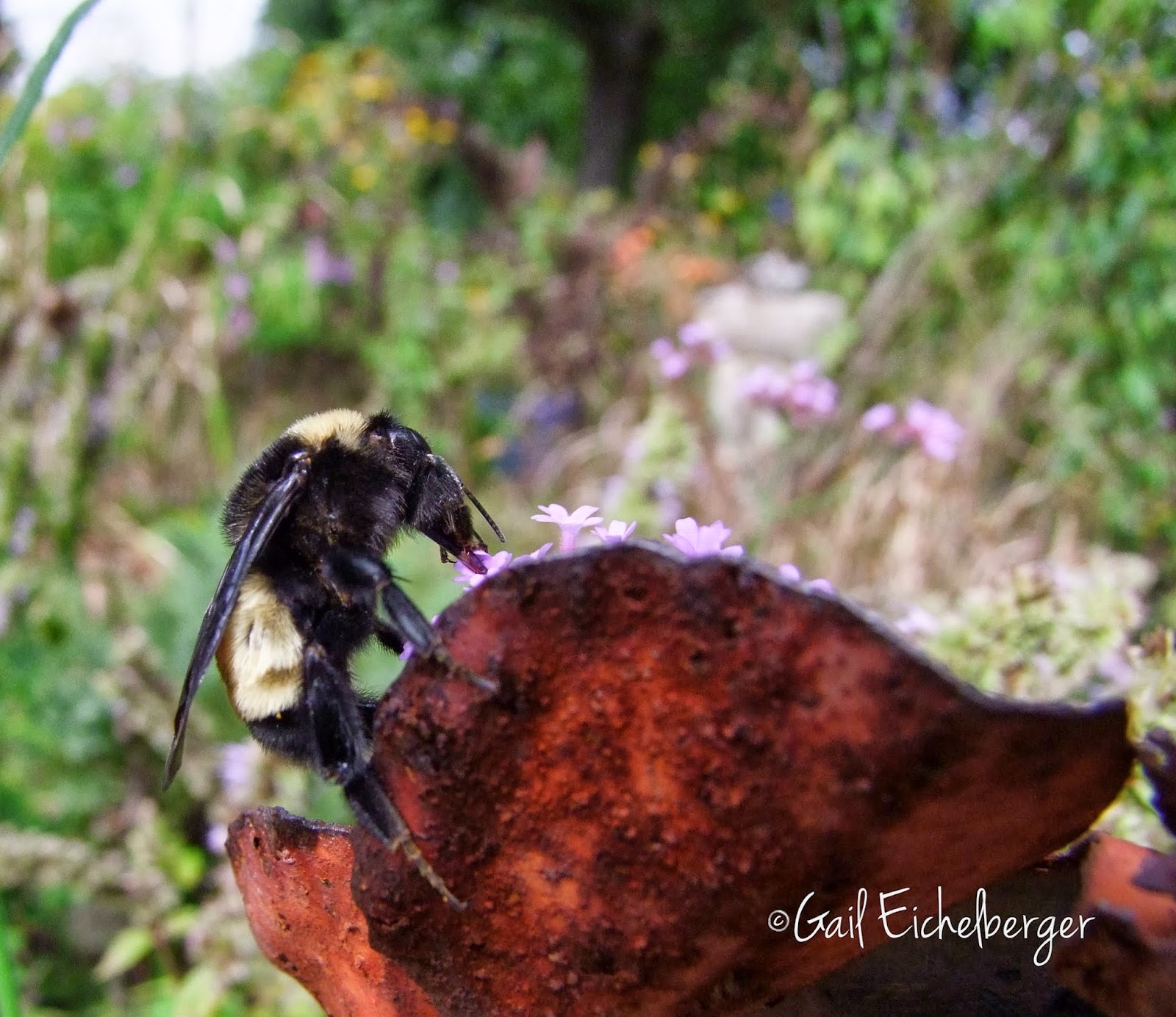
Bumble resting on the rusty sunflower while nectaring on the Verbena bonariensis
Verbena bonariensis for their long bloom, their lovely flowers and to feed the pollinators. The sight and sounds of busy bees, butterflies and other critters makes me happy.
Before long the humming and buzzing will be gone, until then I will appreciate each and every flower that feeds the critters and fills my heart with joy.

xoxogail

It's October 15 and you know what that means! Garden bloggers all over the blogosphere are celebrating Bloom Day. You can see more gardens then you can imagine in one day if you stop by Carol's blog, May Dreams Gardens to take the Mr linky magic carpet ride to flower adventure.

Gail Eichelberger is a gardener and therapist in Middle Tennessee. She loves wildflowers and native plants and thoroughly enjoys writing about the ones she grows at Clay and Limestone. She reminds all that the words and images are the property of the author and cannot be used without written permission.

Monday, June 6, 2011

A Pollinator Friendly Shrub

Hypericum frondosum June 1, 2011
Hypericum frondosum is blooming and the bumbles couldn't be happier. They have been on a feeding frenzy since the first golden flowers opened. I'm pretty thrilled, too. I love these blooms, love the blue-green foliage and the plant's leggy presence in the woodland gardens. They warm up the shady green when the last of the spring flowers quiet.

The one H frondosum "Sunburst' I bought way back when I first stumbled upon native plants has grown into dozens. (It's quite a prolific plant!) All of them sporting golden, fuzzy pollen rich flowers like the cultivar, but, not with its compact, mounded shape. That's okay with me~I almost always prefer the straight species and the flower visitors are not complaining either.

I've moved 'Sunburst's' offspring all over the garden. They make their biggest impact in the Central Basin Woodland Garden. It's a large oblong shaped bed behind the Waiting Bench. It's planted with perennials and shrubs that might be found in the woodlands adjacent to a cedar glade. On the edge are plants that need more sun, like Juniperus virginiana 'Gray Owl', Panicums and the native ex-asters. The interior of the bed is chock full of Golden St Johnswort, Chasmanthium latifolium, shade tolerant native ex-asters, Phlox pilosa, Penstemon calycosus, Christmas Ferns and more.

Gray Owl Juniper, H frondosum, River Oats, penstemon, and S oblongifolius

A Central Basin Woodland is green a good deal of the summer and brown all winter! It took me a long time to be comfortable with that look. I love it now~especially the leggy hypericum dotted with spent seed capsules, browning grasses standing tall and seed heads swaying in the wind all winter long. Right now, it's beginning to glow as the hypericum flowers open a few at a time.
Critter heading toward that giant fuzzy pollen only producer!
Flowers of hypericum only produce pollen. Not one bit of nectar. The stamens are little pollen wands that dance in the breeze. They are perfect attractors for pollen eaters, pollen collectors and pollinators! I love to sit on the bench and watch the Bumbles move from flower to flower to flower...gathering pollen to feed their offspring. A little of the pollen of one flower sticks to them and is carried to the next flower or perhaps to the next shrub, where it cross pollinates the flowers. I think Clay and Limestone is going to have a big crop of seeds this year!


It's a great little shrub for this garden:
  • The species is a loose limbed beauty with golden flowers, bluish green foliage, stunning fall color and exfoliating bark for year round good looks.
  • It attracts Bumbles, Syrphid flies and Halictid bees~all seeking pollen.
  • It's endemic to forests/woodland that are adjacent to cedar glades.
  • It tolerates the extremes that this garden throws at plants~wet winters and dry summers.
  • It never fails to open the first week in June~rain or shine.
  • Zones 5 to 8; a Southeastern native.
  • Grows quite nicely from seed.
Any ideas what creature this might be?
It's a pretty fine shrub, but, it's not perfect:
  • The flowers open a few at a time.
  • Some years the buds fail.
  • The leggy good looks can be off putting as a foundation planting.
  • It seeds madly and if you have a cultivar expect them to revert to species.
  • It's short lived.
Bud failure
All in all it's a pretty fantastic shrub that feeds pollen collecting bees, makes a great statement in a garden and brings a smile to my face. I even think the failed bud is good looking!

xxoogail


PS Trust me when I say "If you want pollinators to visit your garden, you must, never, ever, ever, ever, use pesticides and, if possible, buy pesticide free plants for your garden."

This post is also part of a series on native pollinators in the garden~ Earlier posts and their links are listed below for your convenience.


    Part I~Now Is The Time To Bee-gin Thinking About Bees ( here)
    This Is The Place To Bee ( here)
    If You Could Plant Only One Plant In Your Garden~Don't (here)

    Must Bee The Season of The Witch (here)
    Go Bare In Your Garden (here)
    We can't All Be Pretty Pollinators (here)
    Eye, Eye Skipper, Big Eyed Pollinators (here)
    What's In Your Garden (here)
    Carpenter Bees (here)
    Got Wildflowers?(here)
    It's Spring and A Gardener's Thoughts Are On Pollinators (here)
    The Wildflower and The Bee (here)
    A Few Good Reasons To Plant Milkweek (here)
    Got Shade? You Can Have Pollinators (here)
    Royalty In The Garden (here)

    Other bee posts you might want to read~
    Count Yourself Lucky To Have Hoverflies (here)
    Bumblebee Hotel (here)
    Still Taking Care Of Bzzness (here)
    My Sweet Embraceable You (here)

    Bee clip art (here)
    This post was written by Gail Eichelberger for my blog Clay and Limestone Copyright 2011.This work protected under the Digital Millennium Copyright Act. Please contact me for permission to copy, reproduce, scrape, etc.